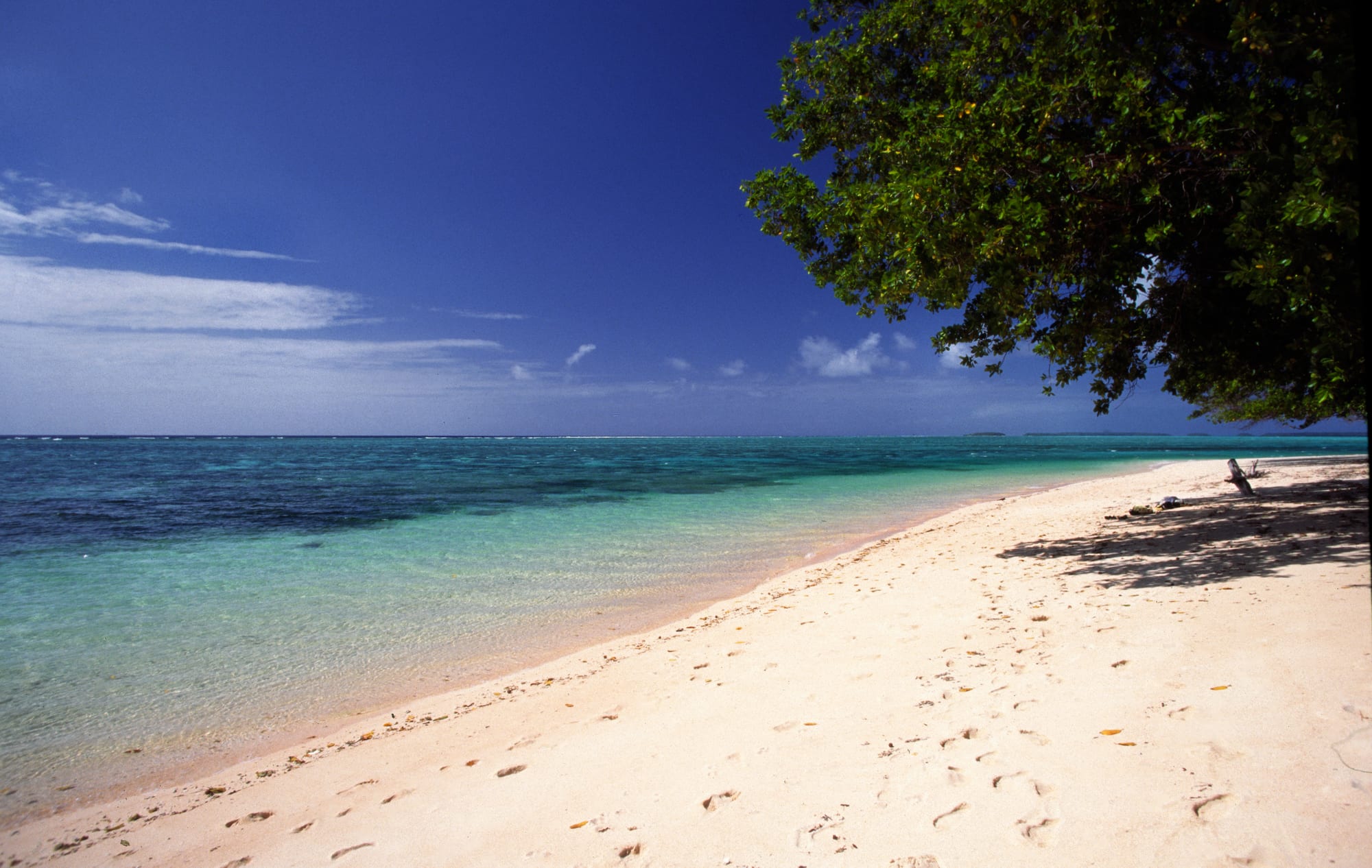
Coconut palms leaning over a white-sand beach beside a calm, pale turquoise lagoon under a bright sky

Marshall Islands

Laura Beach at the western end of Majuro Atoll, the capital and most populous atoll of the Marshall Islands. (mrlins / Wikimedia Commons · CC BY 2.0)

A nation of 29 low coral atolls and five islands scattered across the central Pacific — a great seafaring culture, the site of US nuclear testing in the 1940s and 50s, and one of the countries most exposed to rising seas.

Explore Marshall Islands

History

The Marshall Islands were settled around two thousand years ago by Micronesian voyagers who became among the finest open-ocean navigators in the world, reading swells and the way waves bend around islands, and recording those patterns on lattice "stick charts" made of palm ribs and shells. Society was organised around matrilineal clans and paramount chiefs, the iroij.

European ships passed from the sixteenth century, and Spain claimed the islands without settling them. Germany bought them in 1885 and ran the atolls as a copra trade. Japan took the islands during the First World War, held them under a League of Nations mandate, and fortified several atolls heavily. In 1944 US forces captured Kwajalein and Enewetak in fierce fighting, and the islands passed to the United States.

From 1946 to 1958 the United States used Bikini and Enewetak atolls for 67 nuclear tests, including the 1954 Castle Bravo detonation, its largest ever. Whole communities were moved off their home atolls, some were exposed to fallout, and parts of the islands remain contaminated and uninhabited; compensation and resettlement are unresolved to this day. The Marshall Islands adopted a constitution in 1979 and became a sovereign state in free association with the United States under a Compact that took effect in 1986, joining the United Nations in 1991. The US still funds much of the budget and operates a missile-defence test range at Kwajalein.

  • Marshall Islands: The Nuclear Atolls A navigator society scattered across the central Pacific — colonised by Germany then Japan, taken by the US, used for 67 nuclear tests, and now an independent state in free association with Washington and on the front line of rising seas

Culture & Customs

Land in the Marshall Islands is held through the mother's line, in clan parcels called weto, and traditional authority still rests with the iroij. Kinship obligations run deep: sharing food and helping relatives are expected, and a person's standing comes from generosity rather than accumulation.

Christianity, brought by Protestant missionaries in the nineteenth century, is now central to life. Sundays are for church and rest, Gospel Day is a major holiday, and church choirs and fundraising events are a big part of the social calendar. A child's first birthday, the kemem, is celebrated with a large feast to which the whole community is invited.

Older skills survive alongside imported life: outrigger-canoe building and sailing, wave-and-star navigation, and fine weaving of pandanus and coconut fibre into mats, baskets, and fans. Manit Day sets aside time each year for these traditions, with canoe races, weaving displays, and demonstrations of local food preparation.

Daily Life

About three-quarters of Marshallese live in two crowded urban centres: Majuro, the capital, a ribbon of land enclosing a large lagoon, and Ebeye, a tiny, extremely densely packed island next to the US base at Kwajalein, where many residents work. The rest live on the outer atolls, largely by subsistence fishing and growing breadfruit, taro, pandanus, and coconut.

The cash economy depends heavily on US Compact funding, payments for the Kwajalein range, fishing-licence fees from foreign fleets, a large open ship registry, and remittances. Many thousands of Marshallese have moved to the United States, where the Compact lets them live and work; the town of Springdale, Arkansas, has one of the largest communities.

Imported rice, flour, sugar, and tinned meat have displaced much of the traditional diet, and the Marshall Islands now has some of the world's highest rates of diabetes. Rising seas, saltwater flooding of gardens and freshwater lenses, and drought on the northern atolls are pressing, everyday concerns rather than distant threats.

Food

Marshallese food starts with the reef and the ocean — tuna, reef fish, octopus, clams, and lobster — eaten grilled, raw with lime and coconut, or in soups. Breadfruit is the main starch, roasted or boiled or fermented into a paste called bwiro; pandanus, taro, and arrowroot fill out the traditional table.

Coconut appears at every stage: the water to drink, the flesh grated for cream, sprouted coconut ("spongy" iu) eaten as a snack, and the sap tapped for a sweet drink. Chicken and pork are cooked for feasts, often in an earth oven. The coconut crab, a large land crab that feeds on fallen coconuts, is a prized delicacy.

Everyday eating in Majuro and Ebeye now leans heavily on imported staples — white rice, ramen, tinned corned beef and fish, and fried chicken — and on a few restaurants and takeaways serving a mix of American, Chinese, and Pacific dishes.

Attractions & Natural Wonders

Bikini Atoll, a UNESCO World Heritage Site, is the country's most extraordinary destination when dive operations run: a lagoon holding a "ghost fleet" of warships sunk in the 1946 tests, including the aircraft carrier USS Saratoga and the Japanese battleship Nagato, dived from a live-aboard boat out of Majuro.

Majuro itself has the long, palm-backed Laura Beach at the atoll's western end, the Alele Museum with its collection of navigation stick charts, and lagoon snorkelling. Arno Atoll, a short boat ride away, and Mili Atoll, reachable by light plane, offer quiet beaches, clear water, and Second World War wreckage and relics.

The wider draw is the ocean: some of the Pacific's least-visited reefs, big pelagic fish for sport anglers, and the sheer scale of Kwajalein, the largest lagoon in the world — though access to Kwajalein is tightly controlled because of the US installation.

  • Marshall Islands: Six Attractions and Natural Wonders A necklace of 29 coral atolls in the central Pacific — one of them a sunken WWII fleet turned dive site, another the ground zero of the Cold War's nuclear age, and a seafaring navigation tradition that guided outrigger canoes across open ocean

Planning basics

Budget

The Marshall Islands is an expensive place to travel, because almost everything is imported and internal transport is limited. Majuro has a handful of hotels and guesthouses; the outer atolls have very basic accommodation arranged through families or councils. The US dollar is used.

Daily Budget Midrange
USD 150–300 (hotel, restaurants, a hired boat or a domestic flight to an outer atoll)
Daily Budget Shoestring
USD 70–120 (guesthouse, local stores and small eateries, shared taxis on Majuro)

Diving trips, especially the live-aboard trips to Bikini, are the big cost and need booking well ahead.

Visa Requirements

Under the Compact of Free Association, US citizens do not need a visa or passport-based permit and may stay and work. Citizens of many other countries, including the UK, most of the EU, Australia, and Canada, are granted a visa on arrival for a short stay; a valid onward ticket and passport are required.

Typical Validity
Visa on arrival, typically 30 days, extendable at the immigration office in Majuro

Confirm current rules with an RMI mission before travel, as arrangements for visitors change.

Safety

The Marshall Islands has low levels of serious crime, and visitors are generally safe. The real hazards are practical: strong ocean currents and passes between atolls, limited medical facilities (serious cases are flown to Honolulu), and lingering radiological contamination on and around Bikini and parts of Enewetak.

Health
Bring any needed medication; there is one hospital on Majuro and a smaller one on Ebeye

Follow local advice on which islands and lagoon areas near former test sites are safe to visit, fish, or eat from.

Climate

Tropical and humid, warm all year, with sea temperatures and air temperatures both near 27–31°C. The northern atolls are drier; the southern atolls, including Majuro, are wetter, with a rainier season from about May to November. Typhoons form to the west but rarely strike directly.

Hazards
King tides and storm surges flood low ground; droughts hit the northern atolls
Temperature
27–31°C year-round
Wetter Months
May–November

Transportation

Majuro and Kwajalein have the international airports. Air Marshall Islands flies small aircraft to the outer atolls on a thin and often-delayed schedule, and a government field-trip ship makes long circuits with cargo and passengers. On Majuro, shared taxis run up and down the single road.

Build in wide buffers around outer-atoll flights; cancellations and multi-day delays are normal.

Best Time to Visit

The drier months from December to April are the most comfortable and the best for diving visibility. The Bikini dive season, when it operates, is roughly May to October. Manit Day (Marshallese culture day) in late September is the main festival.

Events
Constitution Day (1 May); Manit Day (late September); Gospel Day and Christmas, both observed intensely

Currency

The Marshall Islands uses the US dollar. Cash is needed for almost everything outside a few hotels in Majuro; there are ATMs in Majuro and on Ebeye but not on the outer atolls.

Cards
Accepted at some Majuro hotels only; carry cash
Symbol
$
Currency Code
USD — US dollar

Language

Marshallese, a Micronesian language with two main dialects, is spoken by almost the entire population. English is the co-official language, used in government, business, and schools, and is widely understood in Majuro and Ebeye.

English
Widely spoken in the urban atolls; less so on remote outer atolls
Official Languages
Marshallese, English