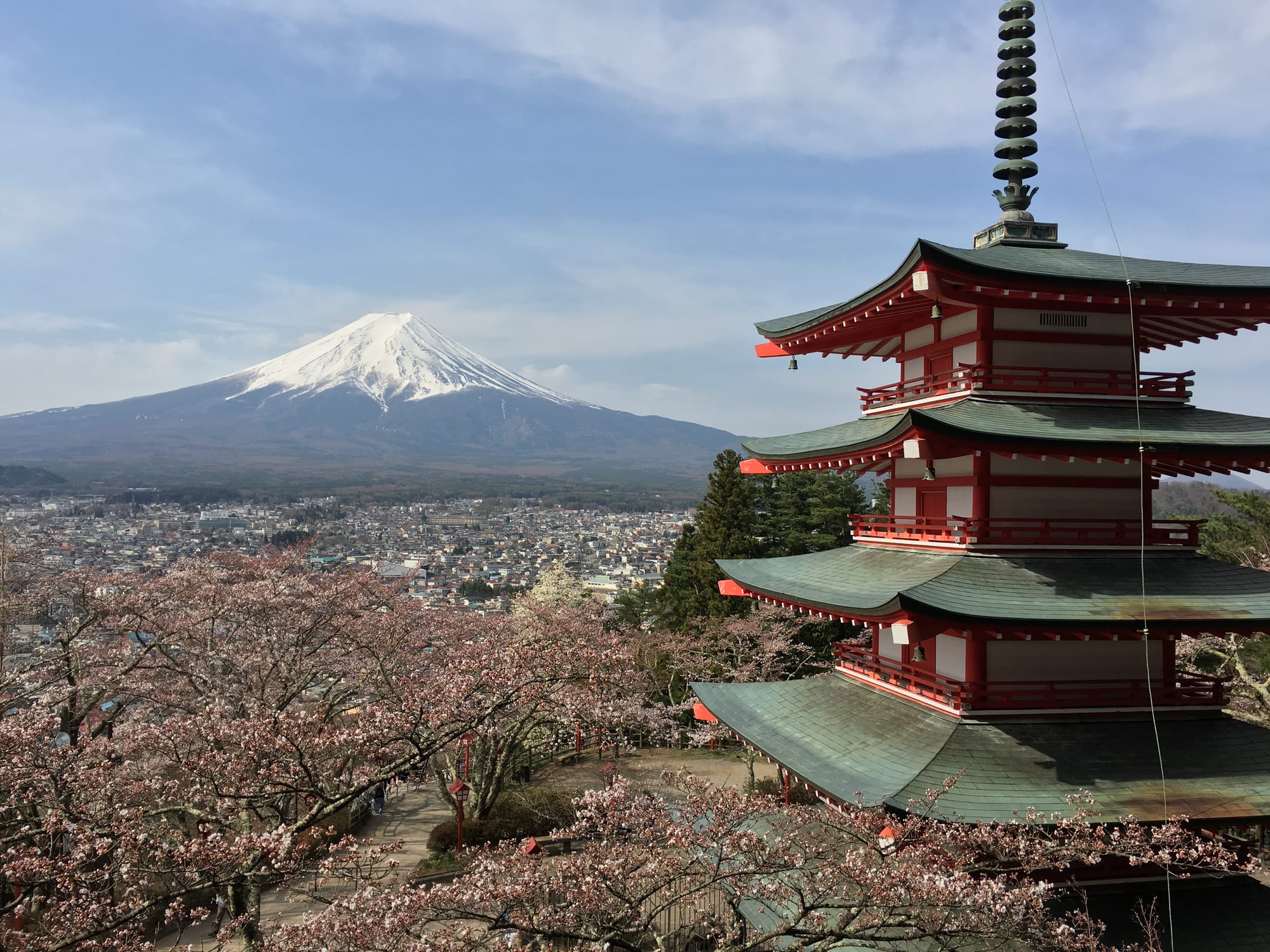
A five-storey red pagoda on a hillside above a town, with the snow-capped cone of Mount Fuji rising behind it

Japan

The Chureito Pagoda at Fujiyoshida, with Mount Fuji (3,776 m) behind — one of Japan's most photographed views. (bruchez (Flickr) / Wikimedia Commons · CC BY-SA 2.0)

An arc of mountainous islands off the coast of East Asia — an ancient imperial culture that spent centuries closed to the world, industrialised at breakneck speed, and now blends deep tradition with hyper-modern cities on a fault-riven, volcanic land.

Explore Japan

History

Japanese tradition dates the imperial line to 660 BC, and the current emperor is counted as the 126th. Classical court culture flowered at Nara and then Heian-kyō (Kyoto), which remained the imperial seat for over a thousand years. From the twelfth century, real power lay with warrior clans and their shogun, culminating in the Tokugawa shogunate (1603–1868), which unified the country and then sealed it off from almost all foreign contact for roughly 250 years.

American warships forced Japan open in 1853. The 1868 Meiji Restoration abolished the shogunate, restored the emperor as a symbol, and drove a rapid modernisation that turned Japan into an industrial and military power: it defeated China in 1895 and Russia in 1905 and colonised Korea and Taiwan. In the 1930s and 1940s it waged a brutal war of expansion across Asia and the Pacific, which ended with the atomic bombings of Hiroshima and Nagasaki and surrender in 1945.

Under US-led occupation, Japan adopted a pacifist constitution and a parliamentary democracy, with the emperor purely ceremonial. The post-war "economic miracle" made it the world's second-largest economy by the 1970s — Toyota, Sony, Panasonic — until an asset bubble burst around 1990, beginning the "Lost Decades" of low growth. Today's central challenges are a shrinking, ageing population, a tight labour market, and a more assertive China.

Culture & Customs

Shinto, an Indigenous tradition of kami (spirits) and shrines, coexists with Buddhism, and most Japanese take part in both — a shrine visit at New Year, a Buddhist funeral — without seeing a contradiction. Aesthetic ideals of simplicity, seasonality, and impermanence run through the tea ceremony, gardens, ikebana, calligraphy, haiku, and the theatre forms noh and kabuki; sumo is the traditional national sport.

Social norms prize politeness, group harmony, indirectness, punctuality (trains to the second), cleanliness, and not imposing on others. Bowing, removing shoes indoors, keeping quiet on trains, and not tipping are all expected, and small breaches by visitors are usually forgiven with a smile.

Contemporary Japanese culture — manga, anime, video games, J-pop, fashion, and a globally influential design and food sensibility — is a major export, existing alongside a famously demanding work culture of long hours.

Daily Life

Japan's roughly 124 million people are heavily concentrated in cities along the Pacific coast of Honshu, above all in Greater Tokyo, the world's largest metropolitan area at some 37 million. Osaka–Kobe–Kyoto, Nagoya, Fukuoka, and Sapporo anchor the other regions, while rural and mountainous areas are steadily losing population, leaving abandoned houses and closing schools.

The economy is large and advanced — cars, precision manufacturing, robotics, electronics, and a growing services sector — but has grown slowly for decades, and demographic decline is the defining long-term issue. The Liberal Democratic Party has governed almost continuously since 1955.

Daily life is orderly and efficient: the packed commuter train, the convenience store for everything from meals to bill payments, the after-work izakaya, the neighbourhood bathhouse or hot spring, and a calendar of seasonal festivals (matsuri) and observances.

Food

Japanese cuisine (washoku) is on UNESCO's heritage list and is built on rice, seafood, soy (miso, soy sauce, tofu), dashi stock, and seasonal vegetables, prepared to bring out rather than mask natural flavour. Beyond sushi and sashimi, the everyday range is huge: ramen in dozens of regional styles, udon and soba, tempura, tonkatsu, yakitori, okonomiyaki, curry rice, and the small-plate grazing of an izakaya.

At the refined end, kaiseki is a multi-course seasonal meal of great precision; at the humble end, a convenience-store rice ball or a station bento is genuinely good. Regional specialities — Osaka's street food, Hokkaido's seafood and dairy, Kyoto's tofu and pickles, Fukuoka's tonkotsu ramen — reward travelling with an appetite.

Sake, shōchū, Japanese whisky (world-class), and green tea (sencha, matcha, roasted hōjicha) are the drinks. Meals often end with fruit or a small sweet rather than a rich dessert, and the wagashi confections served with tea are an art of their own.

  • Japan: Food and the National Dish Raw fish over vinegared rice, refined into an internationally recognised art form, in a food culture that prizes seasonality and precision above almost anything else

Attractions & Natural Wonders

Tokyo mixes the ultra-modern — Shibuya's scramble crossing, Shinjuku's neon, teamLab's digital art — with the traditional: Asakusa's Sensō-ji temple, the Meiji Shrine in its forest, and the Imperial Palace gardens, plus day trips to the shrines of Nikkō and the Great Buddha of Kamakura. Kyoto is the cultural counterweight, with the vermilion torii tunnels of Fushimi Inari, the Golden Pavilion, the Arashiyama bamboo grove, the geisha district of Gion, and dozens of temples and gardens; nearby Nara has its great bronze Buddha and free-roaming deer.

Mount Fuji and the Fuji Five Lakes, the hot-spring resorts of Hakone, and the Japanese Alps and the thatched villages of Shirakawa-gō are within easy reach of the "Golden Route." Hiroshima's Peace Memorial and the "floating" torii of Miyajima form a sober, essential stop, and Osaka is the country's kitchen and nightlife capital.

Further afield: Kanazawa's samurai and geisha quarters and its celebrated garden; the Kii Peninsula's Kumano Kodō pilgrimage trails and the temple lodgings of Kōya-san; Hokkaido for nature, the powder skiing of Niseko, and the Sapporo Snow Festival; and the subtropical beaches and distinct Ryūkyū culture of Okinawa. The seasons themselves — cherry blossom in spring, maple leaves in autumn — are half the reason people come.

Planning basics

Budget

Japan is more affordable than its reputation suggests, especially with the weaker yen. Convenience-store meals, ramen and set-lunch (teishoku) restaurants, business hotels, and the rail passes keep costs reasonable; taxis, premium ryokan, and last-minute bullet-train fares are where money goes. It is rapidly adopting cashless payment but cash is still needed in rural areas and small restaurants.

Daily Budget Midrange
JPY 18,000–35,000 (business or mid-range hotel, restaurants, some Shinkansen travel, entry fees)
Daily Budget Shoestring
JPY 8,000–13,000 (hostel or capsule, konbini and cheap-eats food, local trains and IC card)

Get a Suica or Pasmo IC card for trains, buses, and konbini; and check whether a regional rail pass beats point-to-point fares for your route.

Visa Requirements

Citizens of around 70 countries — including the EU, the UK, the US, Canada, and Australia — enter visa-free for short stays, typically up to 90 days. An entry form and customs declaration can be completed online in advance (Visit Japan Web) to speed up arrival.

Typical Stay
Up to 90 days visa-free for most Western passports

Safety

Japan is one of the safest countries in the world, with very low crime; lost property is routinely handed in. The real hazards are natural: earthquakes (learn the drill — drop, cover, hold — and follow staff instructions), typhoons and heavy rain in late summer that disrupt transport, summer heat and humidity, and volcanic activity. Nightlife-district touts in parts of Tokyo and Osaka run overcharging scams, and drug possession carries severe penalties.

Download a disaster-alert app, carry cash as a backup, follow local etiquette (quiet on trains, shoes off indoors), and avoid touts steering you to bars in Kabukicho and Roppongi.

Climate

Mostly temperate with four sharp seasons. Summers (June–September) are hot and very humid, with a June–July rainy season and a late-summer and autumn typhoon season; autumn is crisp; winters are cold, with heavy snow on the Japan Sea side and in the north; spring brings the brief cherry blossom.

Tokyo Summer
hot and sticky, 30–35°C, humid
Tokyo Winter
cold and dry, 2–10°C, little snow in the city
Hokkaido And Japan Alps
heavy winter snow; a long ski season

Transportation

The rail network is superb: the Shinkansen bullet trains link the main cities at high speed, backed by dense local and private lines; cities have efficient subways and buses. An IC card covers most travel with a tap; regional and nationwide rail passes can save money on longer trips. Driving is on the left and only needed for rural regions.

Reserve Shinkansen seats in busy seasons, and note that the nationwide Japan Rail Pass is now expensive — do the maths against individual tickets.

Best Time to Visit

Spring (late March to April) for cherry blossom and autumn (late October to November) for foliage are the classic — and busiest and priciest — windows. May and early June, and December (outside the New Year holiday), are quieter. Winter suits skiing in Hokkaido and the Alps and hot-spring towns; avoid the humid peak of summer and the Golden Week and Obon holiday travel rushes.

Currency

The currency is the Japanese yen (JPY). Long a cash-heavy society, Japan now widely accepts contactless cards and IC cards, but many small restaurants, temples, and rural businesses are cash-only, and some guesthouses ask for cash on arrival.

Symbol
¥ / 円
Cash To Bring
Withdraw yen from post-office or 7-Eleven ATMs, which reliably take foreign cards
Currency Code
JPY — Japanese yen

Language

Japanese is the language, written with Chinese characters (kanji) alongside two phonetic scripts. English is taught but not widely spoken conversationally, though signage on transport and at major sights is increasingly bilingual and translation apps make travel straightforward. A few polite phrases are warmly received.

English
Limited spoken, but signage and apps make travel easy
Official Language
Japanese