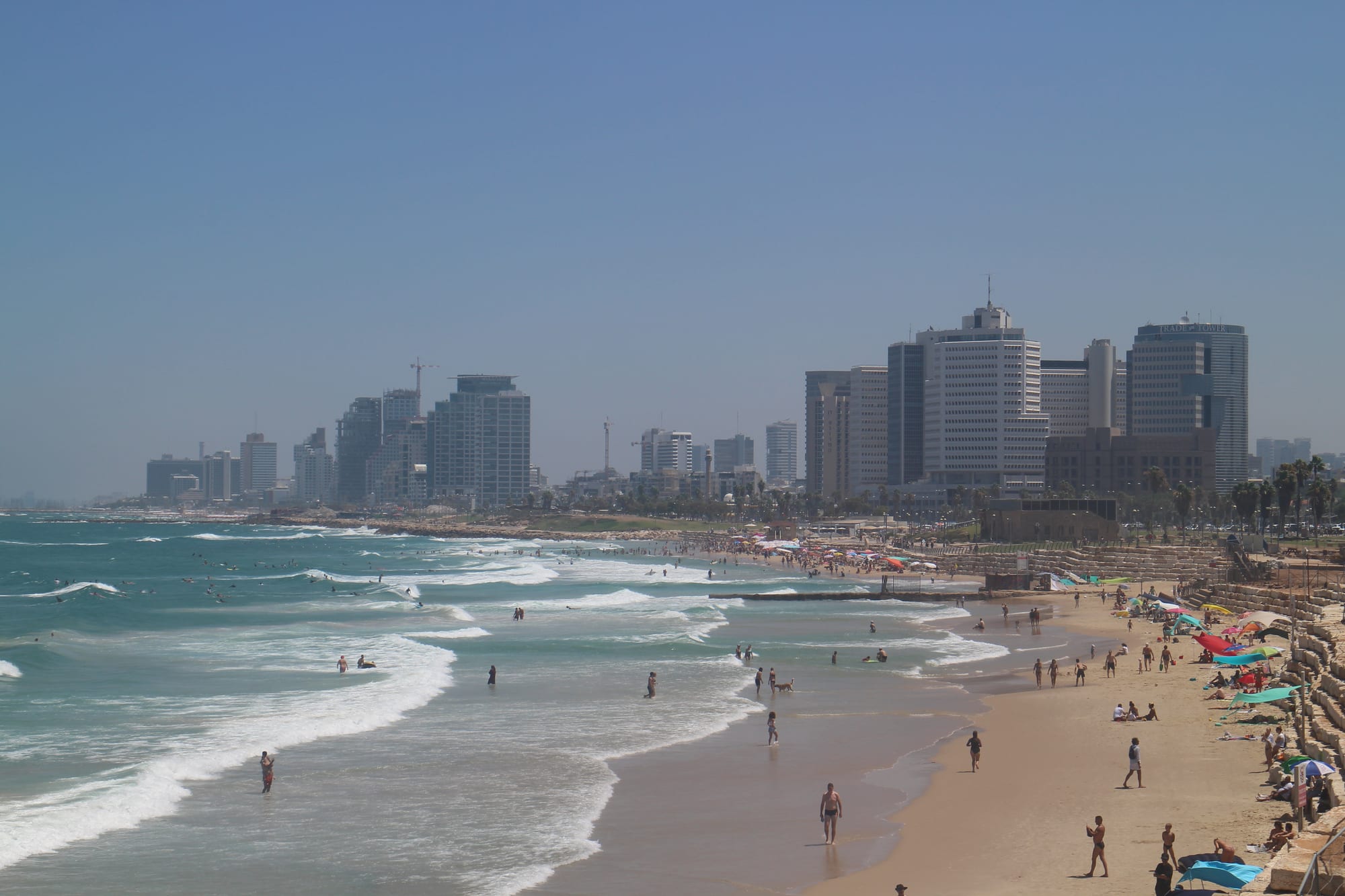
A cluster of glass office and residential towers rising above lower white buildings along a Mediterranean coastline

Israel

The Tel Aviv skyline on the Mediterranean — the country's financial and tech hub, and the core of a metropolitan area holding much of Israel's population. (Suicasmo / Wikimedia Commons · CC BY-SA 4.0)

A small country on the eastern Mediterranean, established in 1948, whose land holds sites central to Judaism, Christianity, and Islam — a high-tech society and a place of unresolved conflict with the Palestinians and, at times, the wider region.

Explore Israel

History

The land has been continuously inhabited for millennia and is the historic and religious heartland of the Jewish people, as well as holding sites central to Christianity and, in Jerusalem, to Islam. Ancient Israelite kingdoms gave way to Babylonian, Persian, Greek, and Roman rule; Rome destroyed the Second Temple in 70 CE and later dispersed much of the Jewish population. Byzantine, Arab, Crusader, Mamluk, and Ottoman rule followed, and the area became part of Ottoman, then British-administered, "Palestine."

Modern political Zionism emerged in late-nineteenth-century Europe as a response to persistent antisemitism, seeking a Jewish homeland in the historic land of Israel. Jewish immigration grew, accelerating as Nazi persecution and then the Holocaust — the murder of six million Jews — unfolded. A 1947 United Nations plan proposed separate Jewish and Arab states; Israel declared independence in 1948, the surrounding Arab states attacked, and in the ensuing war Israel expanded beyond the plan's lines while around 700,000 Palestinians fled or were expelled, an event Palestinians call the Nakba ("catastrophe"). Over the following years a comparable number of Jews left or were forced from Arab and Muslim countries, most settling in Israel.

Further wars came in 1956, 1967 (when Israel captured the West Bank, Gaza, East Jerusalem, the Golan Heights, and Sinai), and 1973, followed by peace treaties with Egypt and Jordan and, in 2020, the Abraham Accords with several other states. The conflict with the Palestinians is unresolved: Israel has occupied the West Bank since 1967, with a large settler population widely regarded as illegal under international law (a view Israel disputes); the Oslo Accords of the 1990s created a limited Palestinian Authority but the peace process stalled. Israel withdrew from Gaza in 2005; Hamas took control there in 2007, and recurring wars followed. A Hamas-led attack from Gaza on 7 October 2023 killed about 1,200 people in Israel and took roughly 250 hostages; Israel's ensuing military campaign in Gaza has killed tens of thousands of Palestinians and caused a humanitarian catastrophe, amid continuing regional escalation.

  • Israel: The Jewish State in the Levant Ancient Israelite kingdoms, two thousand years of diaspora, a modern national movement, statehood in 1948, and an unresolved conflict with the Palestinians over the same land

Culture & Customs

Israeli society is diverse and often internally divided. About three-quarters of citizens are Jewish — secular, traditional, religious-Zionist, and Haredi (ultra-Orthodox, a fast-growing, largely separate community) — and roughly a fifth are Arab citizens of Israel, mostly Muslim, with Christian and Druze communities. The Jewish religious calendar shapes public life: Shabbat closes much of the country each week, and the High Holy Days, Passover, and other festivals are national occasions.

Near-universal military service for Jewish (and Druze) men and women is a social leveller and a shared rite of passage. The style of public life is informal, direct, and argumentative — often summed up as chutzpah — and Israelis are quick to debate politics with strangers. A large technology sector has earned the country the "Start-Up Nation" tag.

The contrast between secular, liberal Tel Aviv and religious, contested Jerusalem is a recurring theme, and a 2023 plan to weaken the courts brought some of the largest protests in the country's history.

Daily Life

Most of Israel's roughly 9.8 million people live along the coastal plain, in the Tel Aviv metropolitan area, Haifa, and the cities between them; Jerusalem, inland, is the largest single city and the seat of government, and Beersheba is the gateway to the Negev desert that fills the south.

The economy is advanced and services-heavy, led by technology, defence, diamonds, pharmaceuticals, and agriculture (Israel pioneered drip irrigation), with a high cost of living, expensive housing, and sharp inequalities between communities. Water is intensively managed, much of it desalinated.

Daily life is punctuated by the weekly Shabbat shutdown, by the security situation in tense periods (sirens, shelters, reserve call-ups), and by a strong culture of family gatherings, the beach, hiking, and the market.

Food

Israeli food draws on Levantine cooking and the cuisines the Jewish diaspora brought from Europe, North Africa, the Middle East, and Ethiopia. Hummus, falafel, sabich (a pita of fried aubergine, egg, and salad), shakshuka, and the chopped "Israeli salad" are everyday staples, alongside grilled meats, borekas, and schnitzel.

Regional Jewish traditions add Ashkenazi dishes (gefilte fish, chicken soup, challah), North African and Yemenite specialities (couscous, jachnun, malawach, skhug chilli paste), and Iraqi and Persian rice dishes; Palestinian and Israeli-Arab cooking contributes maqluba, musakhan, and knafeh. Tel Aviv and Jerusalem have a celebrated, inventive restaurant scene.

Kosher rules — separating meat and dairy, no pork or shellfish — shape many kitchens and hotels, though plenty of restaurants are not kosher. Coffee culture is strong, and Israeli wines, craft beers, and arak are the local drinks.

  • Israel: Food and the National Dish Eggs gently poached in a spiced tomato sauce, a market culture built on fresh produce, and a table shaped by Jewish communities returning from dozens of different countries

Attractions & Natural Wonders

Jerusalem's Old City is the centrepiece: the Western Wall, the Temple Mount / Haram al-Sharif with the Dome of the Rock and al-Aqsa Mosque, the Church of the Holy Sepulchre, the Via Dolorosa, the four quarters, and the ramparts, with Yad Vashem, the Israel Museum and its Dead Sea Scrolls, and the view from the Mount of Olives nearby. Tel Aviv–Jaffa offers Mediterranean beaches, the Bauhaus "White City" (a UNESCO listing), nightlife, and the old port of Jaffa.

The Dead Sea, the lowest point on land, lets you float in its hypersaline water, with Herod's cliff-top fortress of Masada — the site of a Roman siege — and the oasis of Ein Gedi close by. In the north, the Sea of Galilee is ringed by Christian sites (Capernaum, the Mount of Beatitudes) and Nazareth, and the Golan and Galilee hills are green and good for hiking and wine.

Other draws include Haifa's terraced Bahá'í Gardens on Mount Carmel, the walled Crusader and Ottoman port of Akko (Acre), the Roman ruins of Caesarea, the Negev's Ramon Crater and the ancient Nabataean towns, and the coral reefs of Eilat on the Red Sea.

  • Israel: Eleven Attractions and Natural Wonders The walled Old City of Jerusalem, a desert fortress above the Dead Sea, a Bauhaus city by the Mediterranean, and a crater in the Negev — layered with several thousand years of history

Planning basics

Budget

Israel is expensive, closer to Western Europe than to its neighbours, especially for accommodation, restaurants, and Tel Aviv generally. Falafel and hummus stands, markets, and buses keep costs down; the Dead Sea resorts and Eilat are pricier. Card and phone payment is near-universal.

Daily Budget Midrange
ILS 550–1,000 (mid-range hotel, restaurants, car hire, sites)
Daily Budget Shoestring
ILS 250–400 (hostel, market and street food, buses)

Almost everything closes for Shabbat (Friday evening to Saturday evening), including public transport in most of the country — plan around it.

Visa Requirements

Citizens of the EU, the UK, the US, Canada, Australia, and many other countries enter visa-free for up to 90 days. Entry and exit stamps are issued on a separate paper slip, not in the passport, but evidence of a visit to Israel can still bar entry to some countries (Iran, Lebanon, Syria, and others).

Typical Stay
90 days, visa-free, for most Western passports

Keep the entry slip with your passport; you may be asked for it at hotels and on departure.

Safety

Everyday crime is low and, in calmer periods, most tourist areas function normally, but the security situation is volatile and can change quickly. Rocket fire and air-raid sirens are a recurring reality (know where the nearest shelter is), tension flares around Jerusalem's holy sites and on holidays, and there is a persistent risk of sudden regional escalation. Governments advise against all travel to Gaza (not accessible) and its surroundings, and give specific warnings for parts of the West Bank and the borders with Lebanon and Syria.

Source
US Department of State, UK FCDO, and other advisories — check for the latest wording.

Check your government's current travel advisory close to any trip — they are updated frequently — identify shelters near where you are staying, and avoid demonstrations and flashpoints.

Source: US Department of State, UK FCDO, and other advisories — check for the latest wording.

Climate

Mediterranean on the coast and in the hills — hot, dry summers and mild, wet winters — turning to desert in the Negev and around the Dead Sea, which are extremely hot in summer. Winters are short and cool, with occasional snow in Jerusalem and on Mount Hermon.

Coast And Hills
hot dry summers (28–33°C), mild wet winters (10–17°C)
Negev And Dead Sea
very hot in summer, often 40°C-plus; warm and pleasant in winter

Transportation

Ben Gurion Airport near Tel Aviv is the main gateway. Trains link the coastal cities and run to Jerusalem and Ben Gurion; an extensive intercity bus network (Egged and others) covers the country cheaply. Almost all public transport stops for Shabbat. A rental car gives the most freedom, especially for the Galilee and the Negev.

Book a sherut (shared taxi) or a rental car if you need to travel on Shabbat, when buses and most trains do not run.

Best Time to Visit

March to May and October to November for warm, comfortable weather and wildflowers or the autumn light, avoiding the summer heat and the crowds of the Jewish and Christian holidays. The Dead Sea and Eilat are winter destinations. The security situation, however, can override the season.

Currency

The currency is the new Israeli shekel (ILS). Cards and mobile payment work everywhere; carry a little cash for markets and small vendors. US dollars are accepted at some hotels and tourist sites but at a poor rate.

Symbol
Currency Code
ILS — new Israeli shekel

Language

Hebrew is the official language, revived from a liturgical language into a modern spoken one — a near-unique achievement. Arabic has a special legal status and is the first language of about a fifth of citizens. English is very widely spoken, and Russian and Amharic are common from major waves of immigration.

Official Language
Hebrew
Also Widely Spoken
Arabic, English, Russian