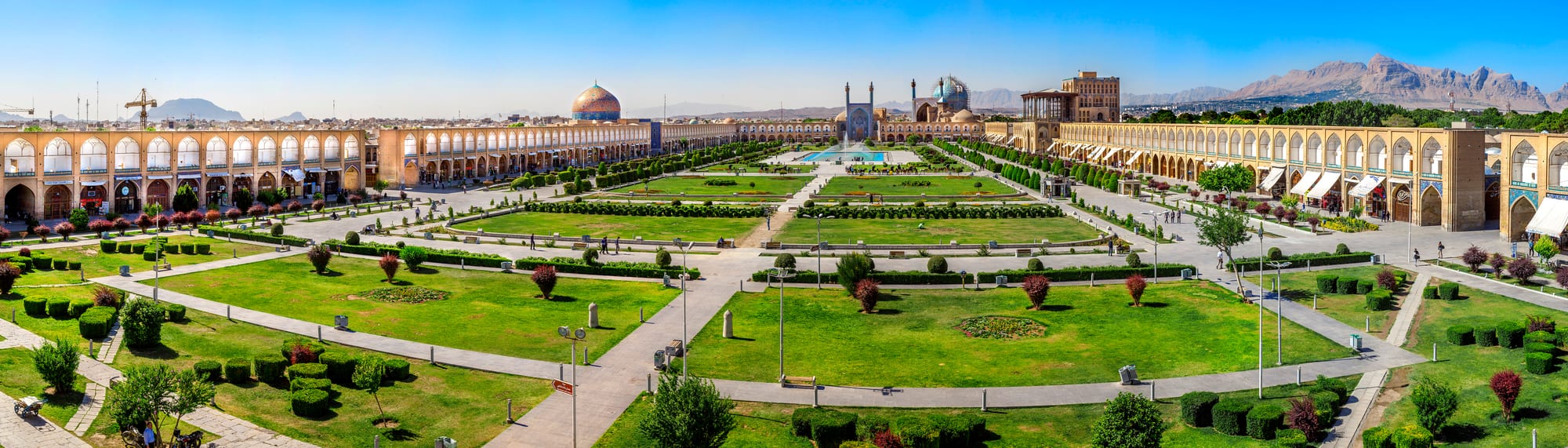
A vast rectangular plaza with a domed blue-tiled mosque at one end, arcades all around, and fountains down the centre

Iran

Naqsh-e Jahan Square in Isfahan, laid out around 1600 and ringed by the Shah Mosque, palace, and grand bazaar — a UNESCO World Heritage Site. (Arosha-photo (Reza Sobhani) / Wikimedia Commons · CC BY-SA 4.0)

Ancient Persia — one of the world's oldest continuous civilisations, with a distinct language, a Shia Islamic identity, and a landscape of deserts, mountains, and blue-tiled cities — governed since 1979 as an Islamic Republic.

Explore Iran

History

Persia was the seat of the first true world empire, the Achaemenid, founded by Cyrus the Great around 550 BC and ruling from the Nile to the Indus, with a ceremonial capital at Persepolis. Alexander of Macedon destroyed it, but Persian imperial traditions revived under the Parthians and then the Sasanians, who ruled until the Arab-Muslim conquest of the seventh century.

Islam took hold, but — unlike much of the region — the Persian language and a distinct Iranian identity survived and shaped a golden age of science, poetry, and philosophy. Turkic and Mongol dynasties followed, and in the sixteenth century the Safavids made Twelver Shia Islam the state religion, which still sets Iran apart from its mostly Sunni neighbours and gave Isfahan its great square and mosques.

The Qajar dynasty presided over decline and foreign interference; the Pahlavi shahs (from 1925) modernised and Westernised under an autocracy propped up by Britain and the United States — including a 1953 coup that removed a prime minister who had nationalised the oil industry. In 1979 a mass revolution overthrew the Shah and established an Islamic Republic under Ayatollah Khomeini, defined since by clerical rule under a Supreme Leader, the long Iran–Iraq War of the 1980s, hostility with the United States and Israel, nuclear disputes and sanctions, and recurring waves of domestic protest.

  • Iran: The Persian Plateau One of the world's oldest civilisations — the Achaemenid empire, the Islamic conquest and a Persian literary golden age, the Shia turn under the Safavids, a 1953 coup, and the 1979 revolution that made it a theocracy

Culture & Customs

Persian culture places poetry near its centre. Ferdowsi, Rumi, Hafez, Saadi, and Omar Khayyam are quoted in daily conversation, and many households keep a divan of Hafez for guidance. Carpet-weaving, miniature painting, calligraphy, and the formal Persian garden (a UNESCO listing) are the classic arts, and Iranian cinema has an international following.

Nowruz, the Persian new year at the spring equinox, has Zoroastrian roots and is the biggest celebration of the year, with the haft-sin table, house visits, and a two-week holiday. Taarof, an elaborate code of ritual politeness — offering, refusing, insisting — governs invitations, payments, and gifts and can baffle newcomers.

Hospitality to guests is intense and sincere; travellers are routinely invited home for tea and a meal. The tea house (chaikhaneh), the bazaar, and the family gathering are the settings of social life. Iranian society is also visibly divided between the norms of the state and a large, young, often Western-leaning population, a tension that surfaces in periodic protest movements.

Daily Life

Around a fifth of Iran's roughly 88 million people live in Greater Tehran, a sprawling city climbing the Alborz foothills; Mashhad, Isfahan, Karaj, Shiraz, and Tabriz are the other large cities. The country is highly urban, with a young, well-educated population and high female university enrolment.

The economy is built on oil and gas, but years of sanctions, mismanagement, and isolation from the international financial system have produced high inflation, a collapsing currency, and a large "brain drain" of young professionals. Much business runs through informal networks and the bazaar, and state and Revolutionary Guard-linked entities control large parts of the economy.

Daily life is shaped by the compulsory dress code, the separation of the state's rules from private life behind closed doors, the price of everything rising, and the constant hospitality and social visiting that Iranians maintain regardless.

Food

Persian cuisine is fragrant rather than fiery, built on rice, herbs, dried fruit, nuts, and slow-cooked stews. Chelo kabab — saffron rice with grilled lamb or minced-meat kababs — is the everyday restaurant staple. The stews (khoresht) include ghormeh sabzi (herbs, kidney beans, and dried lime), fesenjan (chicken or duck in a walnut and pomegranate sauce), and gheimeh (split peas and tomato).

Tahdig, the prized crisp golden crust from the bottom of the rice pot, is fought over at the table. Ash (thick soups), kuku (herb frittatas), dolmeh (stuffed vine leaves), and abgoosht/dizi (a lamb and chickpea stew mashed at the table) round out the repertoire, with sabzi khordan — a plate of fresh herbs, radish, and feta — alongside almost everything.

Tea, served black in small glasses with sugar cubes held between the teeth, is constant. Alcohol is illegal; the drinks are doogh (a savoury yoghurt drink), sharbat, and fresh pomegranate and carrot juice. Iranian sweets — gaz nougat from Isfahan, saffron ice cream, baklava — and dates and pistachios are the gifts and the pleasures.

  • Iran: Food and the National Dish Saffron-scented rice with a prized crisp golden crust, grilled meat skewers eaten alongside it, and a country that grows nearly all the world's saffron

Attractions & Natural Wonders

Isfahan is the showpiece: Naqsh-e Jahan Square, one of the largest in the world, framed by the Shah (Imam) Mosque, the exquisite Sheikh Lotfollah Mosque, the Ali Qapu palace, and the covered bazaar, with historic bridges spanning the (often dry) river and an Armenian quarter across it. Shiraz, city of poets, has the tombs of Hafez and Saadi, the vivid stained glass of the Nasir al-Mulk "Pink Mosque," the Vakil bazaar, and the ruins of Persepolis and the royal Achaemenid tombs an hour away.

Yazd, a mud-brick desert city with a skyline of badgir windcatchers, keeps a living Zoroastrian community, a fire that has burned for centuries, and the hilltop Towers of Silence, and is a UNESCO World Heritage Site in its entirety. Kashan has grand historic merchant houses and the classic Fin garden; Tehran has the crown jewels, the Golestan Palace, the Grand Bazaar, and the National Museum.

For landscape, the Alborz and Zagros mountains offer trekking and skiing, the Dasht-e Lut and Dasht-e Kavir deserts have some of the hottest recorded surface temperatures and dramatic yardang formations, the Caspian forests and rice terraces are lush and green, and the rock village of Kandovan and the stepped village of Masuleh are among the country's most striking settlements.

  • Iran: Eleven Attractions and Natural Wonders The blue-tiled mosques of Isfahan, the ceremonial capital of the Persian kings, mud-brick desert cities, and a desert of wind-sculpted sand towers — set against a country most governments advise against visiting

Planning basics

Budget

Iran is very inexpensive for foreign visitors because of the collapsed currency, but sanctions make money a real hurdle: foreign bank and credit cards do not work at all, so you must bring all the cash you need in euros or US dollars and change it locally. Some tour agencies issue a prepaid local debit card for visitors.

Source
Traveller reports, 2023–2024 — the currency and rules are volatile; verify before travelling.
Daily Budget Midrange
USD 45–90 (mid-range or boutique hotel, restaurants, a hired car with driver, internal flights)
Daily Budget Shoestring
USD 20–35 (guesthouse or mosaferkhaneh, local food, buses and shared taxis)

Calculate your whole trip's cash needs in advance and bring a comfortable margin; there is no way to withdraw more once inside.

Source: Traveller reports, 2023–2024 — the currency and rules are volatile; verify before travelling.

Visa Requirements

Most nationalities need a visa, arranged in advance or, for many, as a visa on arrival at major airports with a pre-approval "authorisation code" from a travel agency. Citizens of the United States, the United Kingdom, and Canada may only travel on a guided tour with a licensed guide for the whole trip, or with an approved private guide.

Typical Validity
30 days, extendable once inside the country

Use a reputable Iranian agency to obtain the authorisation code; an Israeli stamp or evidence of travel to Israel will bar entry.

Safety

Street crime is low and Iranians are famously hospitable, but the wider picture is difficult. Several governments strongly advise against travel, especially for dual nationals and journalists, citing the risk of arbitrary arrest and lengthy detention; there is no consular help for US, UK, or Canadian citizens. Protests and crackdowns, regional military escalation, and dangerous border areas add further risk.

Source
US Department of State, UK FCDO, and Canadian advisories — check for the latest wording.
Women Travellers
A headscarf and modest, loose clothing covering arms and legs are compulsory for all women in public.

Read your government's current advisory in full, avoid all demonstrations and any photography of security forces or sensitive sites, do not discuss politics with strangers, and be especially cautious if you hold Iranian nationality.

Source: US Department of State, UK FCDO, and Canadian advisories — check for the latest wording.

Climate

Mostly arid and semi-arid. Summers are very hot in the central deserts, the southwest, and along the Persian Gulf; winters are cold with heavy snow in the northwest and the mountains (there is skiing near Tehran). The Caspian coast is humid and green; the central plateau has hot days and cool nights.

Deserts
extreme summer heat; pleasant in winter
Plateau
hot dry summers, cold winters; big day-night temperature swings
Caspian Coast
mild and humid, wettest in autumn

Transportation

Iran is large; internal flights (cheap, if aging) link the main cities. Comfortable VIP buses and an expanding rail network connect Tehran with Isfahan, Shiraz, Yazd, Kerman, Tabriz, and Mashhad. Cities have metros (Tehran, Isfahan, Shiraz, others) and cheap taxis; a hired car with driver is common for sightseeing between towns.

Overland links to Turkey and Armenia function; the borders with Afghanistan, Pakistan, and Iraq are sensitive or dangerous.

Best Time to Visit

April–May and October–November for mild weather across most of the country and, in spring, blossom and the Nowruz new-year atmosphere. Summer is punishing on the plateau and in the south; winter suits the deserts and the warm south, and the ski resorts near Tehran.

Ramadan Note
During Ramadan, daytime eating and drinking in public is not done and many restaurants close until sunset.

Currency

The official currency is the Iranian rial (IRR), but Iranians quote prices in "toman" (one toman = ten rials), which constantly confuses visitors. The currency has lost most of its value; prices in rial or toman change fast.

Symbol
Cash To Bring
Euros or US dollars in cash; foreign cards do not work
Currency Code
IRR — Iranian rial (prices usually quoted in toman)

Language

Persian (Farsi), an Indo-European language written in a modified Arabic script, is the official language and the common tongue. Large populations speak Azerbaijani (in the northwest), Kurdish, Luri, Arabic (Khuzestan), Balochi, and Turkmen. English is spoken by some younger people and in the tourist trade but is not widespread.

English
Limited; learning the Persian numerals and a few phrases helps a lot
Official Language
Persian (Farsi)
Other Major Languages
Azerbaijani, Kurdish, Luri, Arabic, Balochi