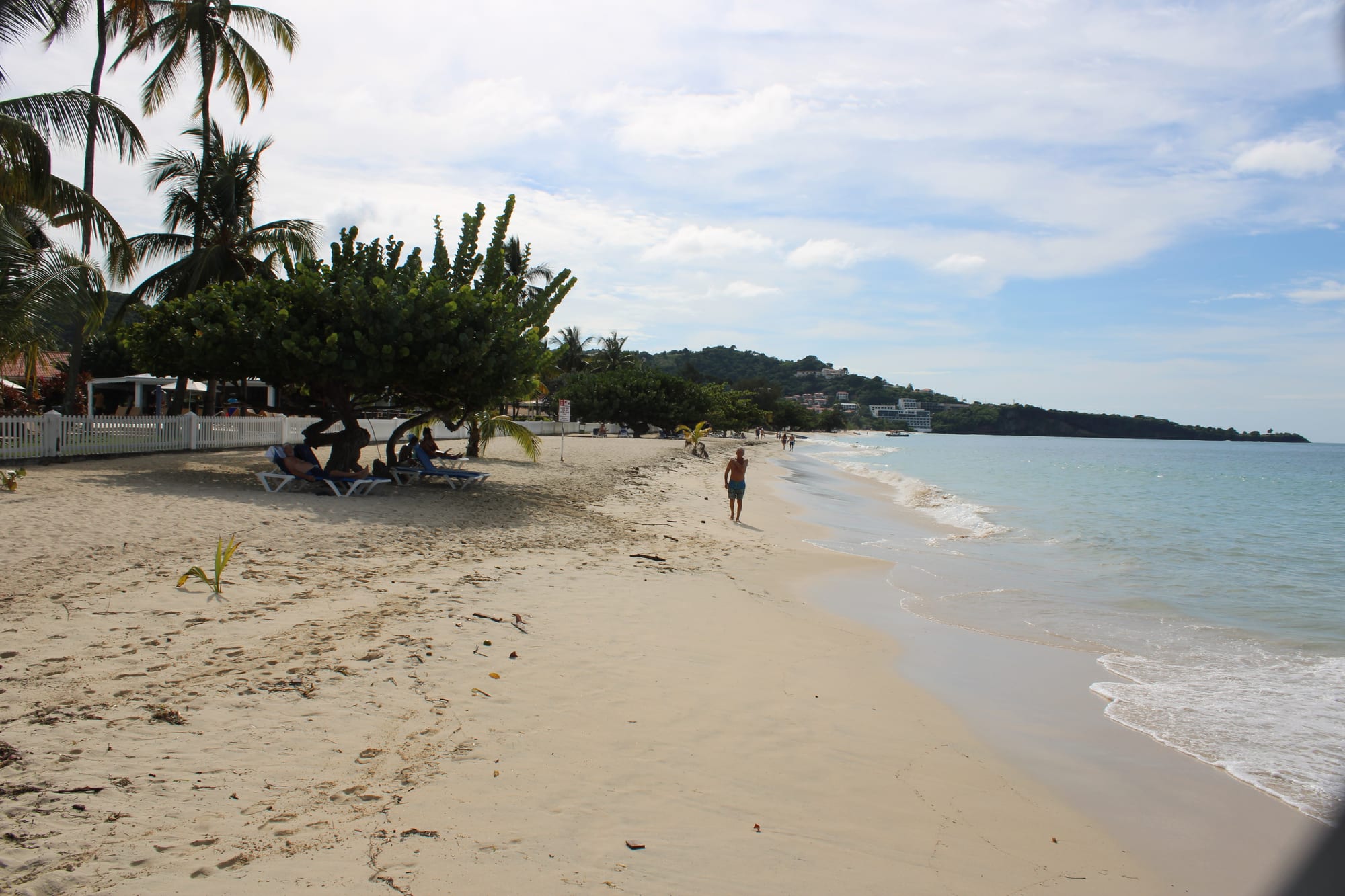
A long curve of pale sand meeting calm turquoise water, green hills and a few low buildings behind

Grenada

Grand Anse Beach, a two-mile stretch of sand south of the capital, St George's. (Ian Gratton / Wikimedia Commons · CC BY 2.0)

The "Spice Isle" of the southeastern Caribbean — a small volcanic island fragrant with nutmeg and cinnamon, with a horseshoe harbour capital, rainforested peaks, and a short, dramatic brush with Cold War history.

Explore Grenada

History

The Indigenous Kalinago (Island Carib) fiercely resisted European settlement, and Grenada was not colonised until the French took it in the 1650s after violent conflict. The French laid out plantations of sugar, then coffee, cocoa, and spices, worked by enslaved Africans. Britain took the island in 1763, lost it briefly, and regained it in 1783; a major enslaved and free-coloured revolt led by Julien Fédon in 1795–96 nearly drove the British out.

After emancipation in 1834 the estates turned increasingly to nutmeg, introduced in the 1840s, which flourished so well that Grenada became one of the world's leading producers — the nutmeg is on the national flag. The island moved through "associated statehood" to full independence from Britain in 1974 under Eric Gairy.

In 1979 the leftist New Jewel Movement, led by Maurice Bishop, seized power in a near-bloodless coup and built ties with Cuba and the Soviet bloc. In October 1983 a hardline faction arrested and executed Bishop and several colleagues; days later, a United States-led force invaded, citing the safety of American medical students and regional stability. Elections resumed in 1984, and Grenada has been a stable parliamentary democracy since, though Hurricane Ivan in 2004 destroyed most of its buildings and its nutmeg trees.

Culture & Customs

Grenadian culture is Afro-Caribbean and Anglophone, with a French Catholic inheritance visible in place names, saints' festivals, and the older Patois. Most Grenadians are Christian — Catholic, Anglican, and a growing number of evangelical and Adventist congregations — and church and family are the anchors of community life.

Spicemas, the August carnival, is the cultural high point: calypso and soca competitions, steel bands, the mud-and-oil-covered "Jab Jab" devils of J'ouvert, and the parade of costumed bands. The "big drum" or Nation Dance of Carriacou, tracing families back to specific African peoples, is a distinctive survival.

Life is unhurried and neighbourly, built around the rum shop, the fish fry (the Friday night one at Gouyave is famous), cricket, and Sunday church. Ties to a large diaspora in the UK, the US, and Canada run deep, and remittances and returnees are woven into island life.

Daily Life

Around a third of Grenada's roughly 113,000 people live in and around St George's, the capital, whose pastel warehouses ring the deep Carenage harbour beneath Fort George. The rest live in coastal villages and hillside farming settlements, and on the smaller islands of Carriacou and Petite Martinique to the north.

The economy runs on tourism, spices (nutmeg, mace, cinnamon, cloves), a fast-growing fine-chocolate industry built on Grenada's high-quality cocoa, fishing, and the offshore St George's University medical school, a major employer. The citizenship-by-investment programme adds revenue. Rebuilding after Ivan, and climate resilience, remain long-term priorities.

Daily life follows the fishing and farming rhythm, the minibus into town, the market for produce and spices, and a strong weekend of sport, church, and the liming (hanging out) that is a shared Caribbean institution.

Food

Grenadian cooking is Creole and spice-forward, unsurprisingly. The national dish is "oil down," a one-pot stew of breadfruit, salted meat or fish, dumplings, callaloo, and vegetables simmered in coconut milk until the liquid is absorbed, traditionally cooked outdoors over wood.

Around it are callaloo soup, "pelau" (seasoned rice with meat and pigeon peas), saltfish "souse," curried goat and chicken, and plenty of fresh fish — Gouyave's fish fry serves it straight off the boats. Nutmeg turns up everywhere, including in ice cream and in the syrup on rum punch.

Local drinks include cocoa tea (spiced hot chocolate made from local beans), sorrel at Christmas, mauby, fresh nutmeg-topped rum punch, and Carib and Stag beer. Grenada's craft chocolate makers run tastings and tours on the estates.

  • Grenada: Food and the National Dish A one-pot feast simmered until the liquid disappears, and a Caribbean island whose nutmeg trade shapes almost everything else on the table

Attractions & Natural Wonders

St George's is one of the prettiest harbour towns in the Caribbean, worth a wander for the Carenage waterfront, the hilltop forts, the market square, and the small national museum. Just south, Grand Anse is the island's showpiece beach, and offshore lies the Molinere Underwater Sculpture Park, the world's first, where divers and snorkellers visit submerged figures now colonised by coral.

The mountainous interior is protected in the Grand Etang National Park, with a crater lake, rainforest trails, mona monkeys, and a string of waterfalls — Annandale, Concord, and the Seven Sisters — reachable on short hikes. Spice and cocoa estates such as Belmont and Dougaldston, and the old nutmeg processing stations at Gouyave and Grenville, show the crop that defines the island.

To the north, a ferry or short flight reaches Carriacou, a quiet island of boatbuilding, clear water, and the Big Drum tradition, and tiny Petite Martinique. The windward east coast, wilder and less visited, has surf beaches and the ruins of old estate great houses.

Planning basics

Budget

Grenada is mid-range for the Caribbean and has less all-inclusive development than many islands, so guesthouses, local restaurants, and buses make an independent trip feasible. Imported goods, dive trips, and the smarter hotels along Grand Anse are the main costs. Cards work in tourist areas; carry cash for buses and markets.

Daily Budget Midrange
USD 170–320 (hotel, car hire, restaurants, a boat or dive trip)
Daily Budget Shoestring
USD 75–120 (guesthouse, local food, minibuses)

Visa Requirements

Citizens of the US, Canada, the UK, the EU, and most Commonwealth countries do not need a visa and are typically admitted for up to three months. An onward or return ticket may be requested.

Typical Stay
Up to 3 months on entry, visa-free, for most Western passports

Safety

Grenada is one of the safer Caribbean islands, with low levels of violent crime, though petty theft, occasional burglary of rooms and villas, and opportunistic robbery do occur. The main practical hazards are rough currents on the windward (Atlantic) coast and driving the mountain roads.

Use hotel safes, don't leave valuables on the beach, take care after dark in quiet parts of St George's, and swim on the calm leeward beaches.

Climate

Tropical, warm year-round, and cooled by the trade winds. The drier season runs roughly January to May; June to December is wetter and more humid and overlaps the Atlantic hurricane season. Grenada lies far enough south that direct hits are relatively rare, though not unknown.

Dry Season
Jan–May, around 26–29°C, less rain
Wet Season
Jun–Dec, humid, short heavy showers, some storm risk

Transportation

Maurice Bishop International Airport, on the southwest tip, has direct flights from North America and Europe, plus regional connections. There is no railway. Shared minibuses run fixed routes cheaply from St George's; taxis have set fares; and a rental car (drive on the left, local permit required) suits touring the interior.

Driving
On the left; roads are narrow, steep, and winding once you leave the coast

Best Time to Visit

January to May for the driest, sunniest weather, and the peak season for prices. Spicemas, the island's carnival, falls in early-to-mid August. The quieter, wetter months from June to November are cheaper, with the countryside at its greenest.

Currency

The currency is the East Caribbean dollar (XCD), shared across the eastern Caribbean and pegged to the US dollar at 2.70. US dollars are widely accepted, with change usually given in EC dollars.

Symbol
$ (EC$)
Currency Code
XCD — East Caribbean dollar (2.70 to 1 USD)

Language

English is the official language, used in government, schools, and daily life. Many Grenadians also speak Grenadian Creole English, and an older French-based creole (Patois) survives among some in rural areas.

Everyday Speech
Grenadian Creole English
Official Language
English