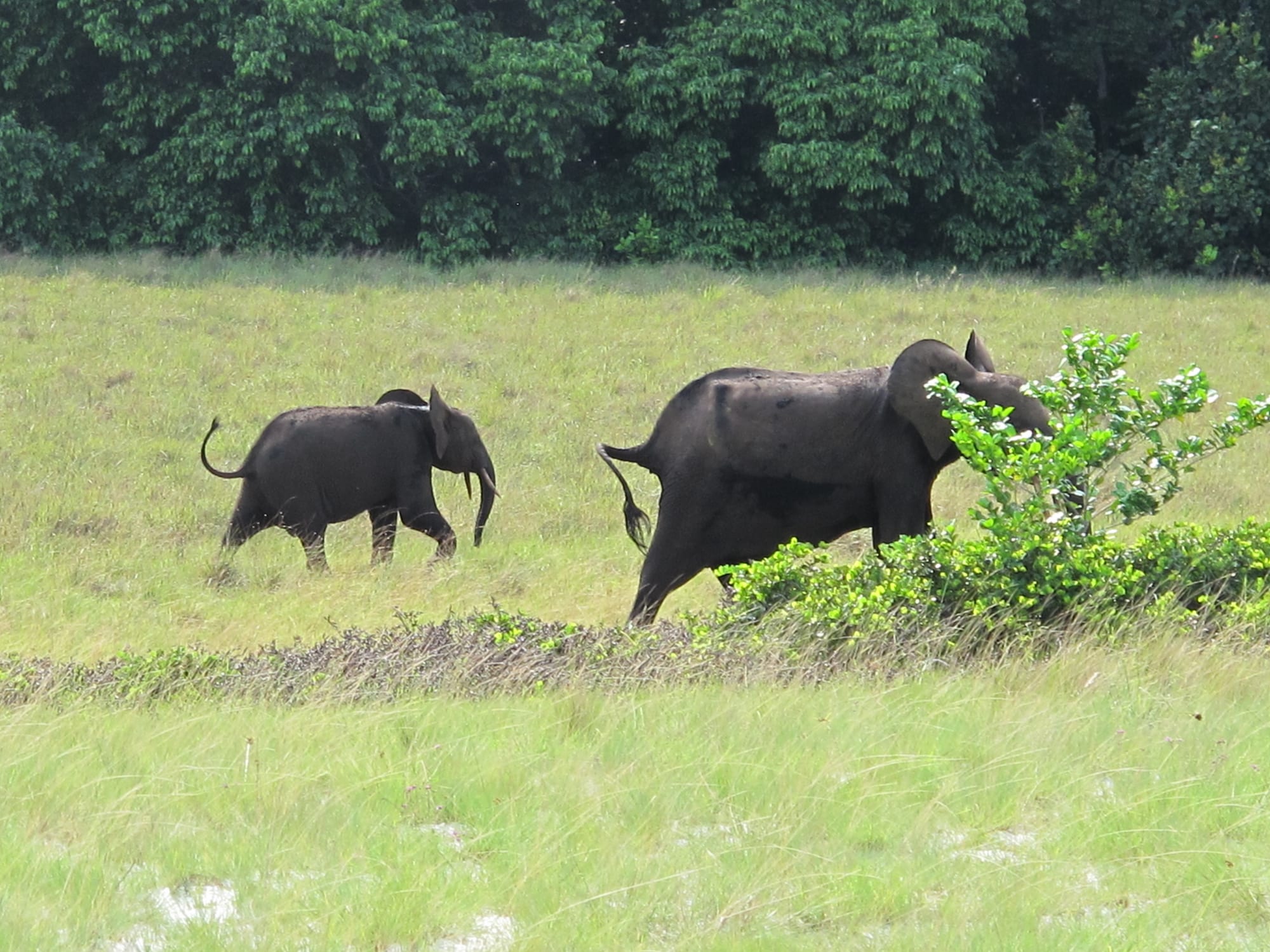
An adult forest elephant and a calf standing in a grassy clearing at the edge of dense rainforest

Gabon

Forest elephants in Loango National Park, where rainforest, savanna, lagoon, and Atlantic beach meet. (Kurt Dundy / Wikimedia Commons · CC BY 3.0)

A thinly populated, heavily forested country on the Equator and the Atlantic — oil-rich, ruled for over half a century by one family until a 2023 coup, and home to a network of national parks where forest elephants walk the beaches.

Explore Gabon

History

Bantu-speaking peoples, the Fang and others, moved into the forests over the past two thousand years, living in dispersed villages and trading along the rivers and coast. From the fifteenth century the Atlantic coast, especially around the Gabon Estuary, became a centre of European trade, including a long and brutal role in the slave trade; Libreville was founded in 1849 as a settlement for people freed from a slave ship.

France declared the area a colony in the 1880s — the explorer Pierre Savorgnan de Brazza was central to its acquisition — and ran it as part of French Equatorial Africa, extracting timber, especially okoumé, with forced labour. Independence came in 1960.

Gabon's second president, Omar Bongo, took power in 1967 and ruled for 42 years, one of the longest tenures in the world, cushioned by oil revenue and close ties to France. His son Ali Bongo succeeded him in 2009 and won three disputed elections before the military removed him in a coup in August 2023, ending the family's 55-year hold on power and installing a transitional government under General Brice Oligui Nguema.

  • Gabon: The Forest Republic A thinly peopled, heavily forested slice of the Equator — a coastal trading world, a French timber and oil colony, and 56 years ruled by a single family

Culture & Customs

Gabonese society is Bantu, dominated numerically by the Fang in the north, with the Myene, Punu, Nzebi, Kota, and others, plus small populations of Baka and Babongo forest hunter-gatherers. Most Gabonese are Christian, mainly Catholic, with a Muslim minority and widely practised traditional spirituality.

The best-known tradition is Bwiti, an initiatory religious practice centred on the psychoactive root iboga, with all-night ceremonies of music, dance, and ritual; elements of it have blended with Christianity in some communities. Mask traditions are strong — the white-faced okuyi (Mukudj) mask of the Punu, danced on stilts, is internationally known — along with the harp-zither mvet epic and polyphonic song.

Because the country is small in population and heavily urban, cultural life is concentrated in Libreville and Port-Gentil, and a large share of the elite has been educated in France, giving public life a strongly Francophone character.

Daily Life

Gabon is one of the least densely populated countries in Africa: most of its roughly 2.4 million people live in Libreville, the coastal capital, and the oil city of Port-Gentil, with the forested interior nearly empty. Around 88 percent of the country is forest.

Oil has made Gabon an upper-middle-income country on paper, with one of the higher GDP-per-person figures in Africa, but the wealth is very unevenly shared, poverty and youth unemployment are high, and much food is imported despite abundant land. Timber (with a ban on raw-log exports pushing local processing), manganese, and, increasingly, conservation-based tourism are the other pillars.

Daily life in Libreville features heavy traffic, seafront markets, and a Franco-Gabonese café and restaurant culture; in the interior, it is village farming, fishing, and small-scale logging, with the Trans-Gabon railway a lifeline.

Food

Gabonese cooking is Central African, built on cassava (as bâton de manioc, steamed in leaves), plantain, and rice, eaten with sauces of groundnut, palm nut (sauce graine), or greens, and with fish, chicken, or bushmeat. Nyembwe chicken, cooked in palm-fruit sauce, is a national dish.

The Atlantic and the rivers provide excellent fish and seafood — odika (wild-mango-seed) sauce with fish is a speciality — and smoked fish flavours many dishes. Grilled fish and chicken with fiery piment and fried plantain are the everyday street and maquis food.

Palm wine and locally brewed drinks appear in villages; imported French wine and Régab, the ubiquitous local lager, are the drinks of the towns, along with strong coffee.

  • Gabon: Food and the National Dish Chicken simmered in a rich palm-nut sauce, cassava prepared a dozen different ways, and a Congo Basin rainforest cuisine layered with French colonial habits

Attractions & Natural Wonders

Gabon set aside 13 national parks in 2002, covering more than a tenth of the country, and they are its main draw for the few visitors who come. Loango National Park, on the central coast, is the showpiece — the place where forest elephants, buffalo, and gorillas can be seen on the beach itself, with hippos surfing the lagoon mouth, humpback whales offshore, and habituated western lowland gorillas tracked on foot.

Lopé National Park, in the centre and reachable by train, is a mosaic of rainforest and relict savanna, a UNESCO World Heritage Site for both its wildlife — mandrills in huge troops, elephants, buffalo — and its Iron Age and rock-art archaeology. Ivindo National Park protects the thundering Kongou and Mingouli falls and the forest clearings (bais) of Langoué, where elephants and other animals gather.

Closer to the capital, Pongara National Park across the estuary has leatherback turtle nesting and beach-and-mangrove walks, and Akanda protects coastal wetlands rich in birds. Libreville itself offers the seafront, markets, the Saint-Michel church with its carved wooden pillars, and the arts and mask collections of the national museum.

Planning basics

Budget

Gabon is expensive. Libreville has some of the highest hotel and restaurant prices in Central Africa, imported goods are costly, and the national parks are reached by charter flight or long 4x4 transfers and served by premium-priced lodges. Cash in CFA francs is essential outside the capital.

Source
Operator pricing and traveller reports, 2022–2024 — verify against current rates.
Daily Budget Midrange
USD 200–400 in the capital; park lodges run several hundred USD per night, all-inclusive
Daily Budget Shoestring
USD 70–120 (simple Libreville hotel, local food, shared transport) — parks not included

Park visits are booked as packages including flights and permits; arrange them through the national parks agency or a specialist operator.

Source: Operator pricing and traveller reports, 2022–2024 — verify against current rates.

Visa Requirements

Most nationalities need a visa. Gabon offers an e-visa: apply online, then collect the visa on arrival at Libreville airport after biometric capture. A yellow fever vaccination certificate is mandatory.

Typical Validity
Usually up to 90 days, single or multiple entry

Complete the e-visa application before travel; arrival without pre-approval is difficult.

Safety

Libreville and the main towns are relatively calm, with street crime — muggings, phone theft, and break-ins — the main concern, especially after dark. Following the August 2023 military takeover there is a heavier security presence and occasional restrictions; borders with the Republic of the Congo and Equatorial Guinea are sensitive.

Source
US Department of State and French diplomatic advisories — check for the latest wording.

Use hotel or arranged transport at night, carry ID and your yellow fever certificate, avoid photographing government and military sites, and check current advice on the political situation.

Source: US Department of State and French diplomatic advisories — check for the latest wording.

Climate

Equatorial, hot and humid all year. There is a long dry season from about June to September (cooler, overcast, and the best time for forest travel), a short rainy season to December, a shorter dry spell around January–February, and heavy rains from March to May.

Rains
March–May are the wettest; roads and forest trails become difficult
Long Dry Season
June–September, overcast and relatively cool, best for parks

Transportation

Libreville's Léon-Mba Airport is the gateway. The Trans-Gabon railway runs inland from Owendo through Lopé to Franceville, a scenic and useful route. National parks are reached by domestic flight or charter and then 4x4 and boat; roads elsewhere are a mix of new highway and rough laterite.

The train to Lopé National Park is one of the more reliable and rewarding ways to travel in the country.

Best Time to Visit

June to September, the long dry season, for forest access, easier wildlife viewing, and — off the coast — humpback whales and nesting sea turtles. Leatherback turtles nest at Pongara and Mayumba roughly November to January; whale sharks and mantas pass in the same season.

Currency

The currency is the Central African CFA franc (XAF), shared by six countries and pegged to the euro at a fixed rate.

Symbol
FCFA
Cash To Bring
Euros in cash
Currency Code
XAF — Central African CFA franc

Language

French is the official language and is very widely spoken, more so than in most of the region because of a long, dense colonial presence and high urbanisation. The main Indigenous languages are Fang in the north, plus Myene, Nzebi, Punu, and others. English has been promoted in schools and officialdom in recent years but is not widely spoken.

English
Limited
Official Language
French
Main Local Languages
Fang, Myene, Nzebi, Punu