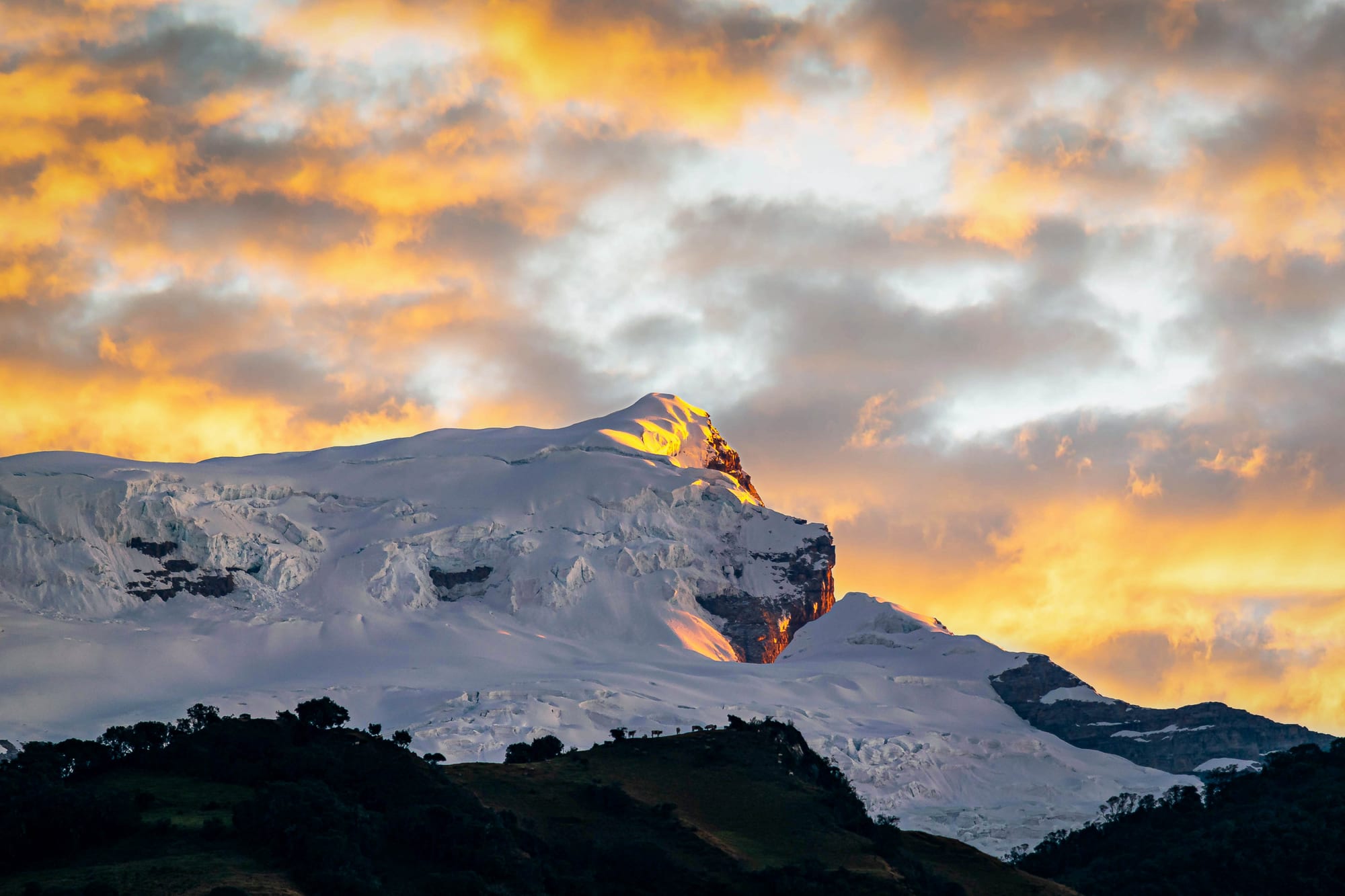
A glacier-covered Andean peak catching the first orange light of sunrise beneath a sky of glowing gold and grey clouds, with dark green foothills in the foreground

Colombia

Sunrise lights the snow and ice of the Sierra Nevada del Cocuy, Colombia. (Jfelipeducon / Wikimedia Commons · CC BY-SA 4.0)

The only South American country with coasts on both the Caribbean and the Pacific — a land of Andes, Amazon, plains, and colonial cities that has emerged from decades of armed conflict into a confident tourism destination.

Explore Colombia

History

Before the Spanish, the highlands were home to the Muisca, whose gold offerings to a sacred lake gave rise to the legend of El Dorado. Spanish conquest from the 1530s founded Bogotá, Cartagena, and Popayán, and Cartagena became the fortified main port for shipping South American silver and gold to Spain — and a major slave market.

Independence was won between 1810 and 1819 under Simón Bolívar, whose victory at Boyacá secured it. The union he led, Gran Colombia, soon broke apart, leaving a country that spent the nineteenth century in civil wars between Liberals and Conservatives. That rivalry culminated in "La Violencia," a decade of partisan bloodshed after 1948 that killed some 200,000 people.

From the 1960s, leftist guerrillas — the FARC and the ELN — right-wing paramilitaries, and, from the 1980s, the Medellín and Cali drug cartels turned Colombia into one of the most violent countries in the world. The cartels were broken in the 1990s; a 2016 peace accord demobilised the FARC after a 52-year war, though smaller armed groups and the ELN fight on. Gustavo Petro, a former guerrilla, became the country's first leftist president in 2022.

  • Colombia: El Dorado and the Long Conflict Goldworking chiefdoms, the treasure port of Cartagena, the republic that split into three, and half a century of war among guerrillas, cartels, paramilitaries and the state

Culture & Customs

Colombia is really several regional cultures. The Caribbean coast — costeño — is relaxed, African-influenced, and musical; the Andean interior, centred on Bogotá, is more formal; Medellín and Antioquia (paisa) are entrepreneurial and proud; Cali is the salsa capital; and the Pacific coast is predominantly Afro-Colombian.

Music runs deep: cumbia and vallenato from the coast, salsa in Cali, and a strong contemporary pop and reggaeton scene. The country's literary giant is Gabriel García Márquez, whose Macondo is drawn from the banana-zone towns of the Caribbean lowlands. Coffee, grown on small farms in the central Andes, is a source of national identity as much as an export.

Colombians have a reputation for warmth, formality in address, and resilience — and a weariness with foreigners who know the country only through its narco past. Catholicism remains strong, and festivals, from Barranquilla's Carnival to countless local ferias, fill the calendar.

Daily Life

About three-quarters of Colombians live in cities, chiefly Bogotá, Medellín, Cali, and Barranquilla. Medellín, once synonymous with cartel violence, has become a showcase of urban transformation, with metro cable cars connecting hillside comunas to the centre.

The economy runs on oil, coal, coffee, flowers, and increasingly tourism and services, with a large informal sector. Decades of conflict left millions internally displaced, and the country has since absorbed nearly three million Venezuelans fleeing their own crisis.

Everyday life features the menú del día lunch, strong sweet tinto coffee sold from thermoses on the street, football, and Sunday ciclovía, when major city roads close to cars for cyclists, joggers, and skaters.

Food

Colombian cooking is regional and generally mild, built on maize, rice, beans, plantain, potato, and meat. The bandeja paisa of Antioquia piles beans, rice, minced beef, chicharrón, sausage, a fried egg, plantain, avocado, and an arepa onto one plate. Ajiaco, a Bogotá chicken-and-potato soup with the herb guascas and a spoon of capers and cream, is the highland comfort dish.

Arepas — flat maize cakes — take a different form in every region, and the coast adds coconut rice, fried fish, and sancocho stew. Street food means empanadas, buñuelos, arepas de huevo, and skewered meat, with fresh tropical-fruit juices in water or milk everywhere.

Colombian specialty coffee is now widely available at home after years of the best beans being exported, and aguardiente, an anise spirit, is the traditional party drink, alongside rum from the coast and chicha, a fermented maize drink.

  • Colombia: Food and the National Dish A combination plate large enough to feed a hard day's work, a Bogotá chicken soup thickened with three kinds of potato, and a coffee-growing country that only recently started drinking its own best beans

Attractions & Natural Wonders

Cartagena is the headline: a walled colonial city on the Caribbean, with balconied streets, the fortress of San Felipe, and boats to the white sand and clear water of the Rosario Islands. Along the coast, Tayrona National Park backs jungle-fringed beaches with the mountains behind, and a multi-day trek leads to the "Lost City," Ciudad Perdida, of the Tayrona people.

The coffee region around Salento, Manizales, and Armenia offers farm stays, green hills, and the Cocora Valley, where wax palms 60 metres tall rise from the pasture. Medellín and its transformed comunas, the whitewashed hill town of Guatapé beneath its giant climbable rock, and the desert of La Guajira in the far north add variety.

Bogotá has the Gold Museum, one of the great collections of pre-Columbian goldwork, and the Salt Cathedral carved into a working mine nearby. Farther out lie the pink-and-red "liquid rainbow" of Caño Cristales in the eastern plains, the Amazon around Leticia, whale-watching on the Pacific coast at Nuquí and Bahía Solano, and the archipelago of San Andrés and Providencia.

Planning basics

Budget

Colombia is good value. Local food, buses, and guesthouses are inexpensive; Cartagena, the coffee-region boutique hotels, and domestic flights are where costs rise. Card payment is common in cities; carry cash for small towns, buses, and street vendors.

Set Lunch
USD 3–6 for a 'menú del día' — soup, main, juice
Daily Budget Midrange
USD 70–140 (hotel, some flights, restaurants, guided trips)
Daily Budget Shoestring
USD 30–50 (hostel, set-menu lunches, buses)

Visa Requirements

Citizens of the EU, the UK, the US, Canada, Australia, and most of Latin America enter visa-free for up to 90 days as tourists, usually extendable to 180 in a calendar year. An onward or return ticket may be requested.

Typical Stay
90 days, visa-free, extendable to 180 per year

Fill in the Check-Mig online migration form before both entry and exit.

Safety

Colombia is far safer for visitors than its reputation, and the main cities and tourist regions are well travelled, but crime requires attention. Street robbery, phone theft, and "express kidnappings" occur in Bogotá, Medellín, and Cali, and drink-spiking (often with scopolamine) targets nightlife and dating-app users.

Source
US Department of State and UK FCDO travel advisories — check for the latest wording.
Conflict Areas
Some rural areas — parts of the Pacific coast, Catatumbo, Cauca, the Venezuelan border, and coca-growing zones — remain affected by armed groups and are best avoided.

Locals say "no dar papaya" — don't make yourself an easy target: keep phones and jewellery out of sight, use app taxis, don't accept drinks or food from strangers, and check regional security before rural trips.

Source: US Department of State and UK FCDO travel advisories — check for the latest wording.

Climate

Tropical, but governed by altitude rather than season, so places have a steady temperature year-round. There are wetter and drier periods rather than summer and winter: broadly, drier around December–March and July–August, wetter April–May and September–November, varying by region.

Tierra FríA
Bogotá — cool, 8–19°C, often grey
Tierra Caliente
Cartagena, the Amazon, the llanos — hot and humid, 28–34°C
Tierra Templada
Medellín, the coffee region — spring-like, 18–24°C

Transportation

Mountainous terrain makes overland travel slow, so domestic flights (Avianca, LATAM, and low-cost carriers) are widely used and often cheap if booked ahead. Long-distance buses are comfortable and extensive. Bogotá and Medellín have large bus-rapid-transit systems, and Medellín's metro and cable cars are a sight in themselves.

Fly for the long hauls (Bogotá–Cartagena, Bogotá–Leticia); the roads through the Andes take many hours.

Best Time to Visit

December to March is the most reliably dry across much of the country and the peak season on the Caribbean coast. July and August are a second drier window and good for the Amazon and the coffee region. The Andean cities are visitable any time.

Events
Barranquilla Carnival (February–March); the Medellín Flower Fair (August); Cali's salsa festival (late December)

Currency

The currency is the Colombian peso (COP). Like several regional currencies it carries many zeros, so prices run into the thousands and tens of thousands. ATMs are widespread; withdraw inside banks or malls by day.

Cards
Accepted in cities; cash needed in rural areas and for transport
Symbol
$
Currency Code
COP — Colombian peso

Language

Spanish is the official language, spoken with a clear accent often considered among the easiest to understand in Latin America, though coastal speech is faster. Around 65 Indigenous languages survive, and English-based creole is spoken on the islands of San Andrés and Providencia. English is limited outside tourism and business.

English
Common in tourism and among younger city professionals; limited generally
Official Language
Spanish (Colombian)