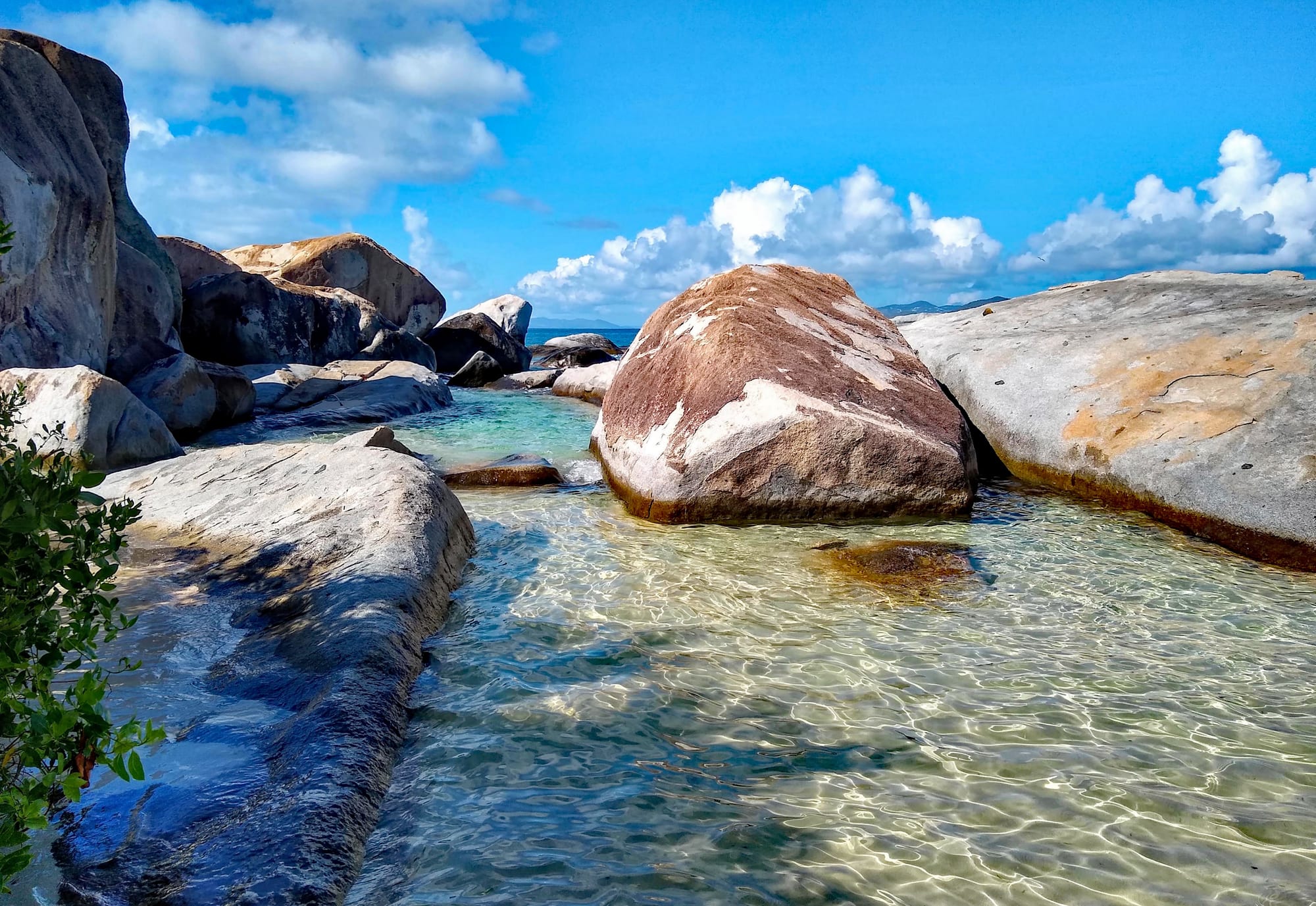
House-sized rounded granite boulders piled on a white-sand beach beside clear turquoise water under a blue sky

British Virgin Islands

The Baths on Virgin Gorda, where a jumble of giant granite boulders forms grottoes, tidal pools, and a sheltered beach. (P. Hughes / Wikimedia Commons · CC BY-SA 4.0)

A cluster of about 60 islands and cays east of Puerto Rico, a British Overseas Territory — the self-styled "sailing capital of the world", one of the largest offshore company-registration centres, and a quieter, more upmarket neighbour to the US Virgin Islands.

Explore British Virgin Islands

History

Amerindian peoples — Arawak, then Kalinago — lived here before Columbus passed in 1493 and named the islands for Saint Ursula and her legendary 11,000 virgins. Dutch and then English planters settled from the seventeenth century, growing sugar and cotton with enslaved African labour. After emancipation in 1834 the plantations failed and most planters left, and the freed population settled on smallholdings as a land-owning peasantry of farmers and fishermen — a pattern that still shapes the BVI.

Governed as part of the Leeward Islands and then as a separate colony from 1960, the territory turned to new industries from the 1960s: upmarket tourism, led by Laurance Rockefeller's Little Dix Bay, and yacht chartering out of Tortola. From the 1980s the BVI became one of the world's largest offshore incorporation centres, and hundreds of thousands of "BVI companies" now generate the bulk of government revenue.

Hurricane Irma devastated the islands in September 2017. In 2022, after the elected premier was arrested in the United States on drug-trafficking charges, a UK-appointed commission of inquiry recommended direct rule; London held off pending governance reforms, and elected government has continued.

Culture & Customs

BVI "Belonger" identity is English-speaking, Christian — Methodism runs deep — and descended from enslaved Africans and the post-emancipation smallholders. Fungi (or "scratch") bands, using a gourd "squash", ukulele, and washboard, provide the traditional music, and the August Emancipation Festival is the territory's carnival, marking the end of slavery on 1 August 1834.

Boat-building and sloop racing are part of the heritage, and islanders are keen to distinguish themselves from the more Americanised US Virgin Islands to the west. It is a small, conservative resident community living alongside a large transient world of yacht crews, charter guests, and finance professionals.

Daily Life

About 32,000 people live in the BVI, most on Tortola, where Road Town is the capital; Virgin Gorda, Anegada, and Jost Van Dyke are the other inhabited islands. The economy rests on financial services and on tourism — yacht charter, villas, and day trips — with no income tax and a high cost of living.

A large share of the workforce holds permits and comes from across the eastern Caribbean. Daily life is car-dependent, tied to the ferry timetable, and, since 2017, still shaped by the long recovery from Irma, which flattened much of the building stock and infrastructure.

Food

The food is Caribbean and sea-focused: conch (as fritters or "in butter sauce"), fresh fish, whelks, "fish and fungi" (with a cornmeal-and-okra polenta), roti, salt-fish pates, callaloo, and johnnycake. Anegada is renowned for its spiny lobster, grilled on the beach at the island's lobster restaurants.

The rum tradition is strong — the Callwood distillery on Tortola still works cane in a copper pot — and the Painkiller cocktail was created at the Soggy Dollar Bar on Jost Van Dyke, so named because swimmers arrive with wet, "soggy" dollars from wading ashore.

Attractions & Natural Wonders

The Baths on Virgin Gorda are the signature sight: a shoreline maze of house-sized granite boulders forming caves, tunnels, and pools that you scramble and wade through to reach a hidden beach. But the main attraction is the sailing — the sheltered Sir Francis Drake Channel, dotted with easy anchorages, is why the BVI became a chartering centre.

Jost Van Dyke is famous for its beach bars — White Bay, the Soggy Dollar, and Foxy's — and the tidal Bubbly Pool. Anegada, the only flat coral island, sits inside a large reef with flamingos, rock iguanas, huge empty beaches, and the lobster. The wreck of the RMS Rhone, sunk in an 1867 hurricane off Salt Island, is one of the Caribbean's premier dive sites.

Virgin Gorda also offers Gorda Peak and the yachting hub of the North Sound, and Tortola has Cane Garden Bay, the rainforest of Sage Mountain, and Road Town's small museum and botanic garden. Norman Island, said to be an inspiration for Treasure Island, has caves to snorkel and a floating bar.

Planning basics

Budget

Expensive. Villas and resorts are pitched high, and the classic way to visit — a bareboat or crewed yacht charter — costs thousands a week. Tortola has some guesthouses and small hotels, and the ferries and beach bars are affordable once you are there.

Daily Budget Midrange
USD 400–900 (small hotel or villa share, restaurants, day sails and dive trips)
Daily Budget Shoestring
USD 150–280 (Tortola guesthouse, self-catering, ferries and 'safari' taxis)

Base on Tortola, use the inter-island ferries and day charters, and treat a full yacht charter as the splurge it is.

Visa Requirements

Citizens of the UK, EU, US, Canada, Australia, and many other countries enter visa-free, usually for up to 30 days, extendable to six months. A passport valid for six months, an onward or return ticket, and proof of funds and accommodation are expected.

Typical Stay
Up to 30 days visa-free for most Western passports, extendable

Carry proof of onward travel and where you are staying; the immigration form asks for a local address.

Safety

Very safe for visitors. Petty theft from dinghies, cars, and villas is the main issue; the 2022 governance scandal and drug trafficking through the islands do not affect tourists. Strong currents occur at some Atlantic-facing beaches, the reefs around Anegada are a boating hazard, and hurricanes are a summer-autumn risk.

Health
Tap water is desalinated or cistern-collected; many drink bottled; medical care is limited and serious cases go to Puerto Rico or the US mainland

Secure your dinghy and valuables, respect current and reef warnings, and take out insurance that covers medical evacuation.

Climate

Tropical, warm and relatively dry year-round at around 27–31°C, cooled by the trade winds. September to November is the wettest stretch, and the hurricane season runs June to November — Hurricane Irma struck in September 2017.

Wetter
September–November (hurricane season)
Dry And Breezy
December–April

Transportation

Terrance B. Lettsome Airport on Beef Island, joined to Tortola by a bridge, takes regional flights; many visitors fly into St Thomas or San Juan and take a ferry. Ferries link Tortola with Virgin Gorda, Jost Van Dyke, Anegada, and the US Virgin Islands. On land, hire a car or ride the open "safari" taxis; driving is on the left. On the water, charter yachts and day-boats.

Check ferry schedules in advance — they thin out on Sundays and holidays — and remember driving is on the left despite the US dollar and US-style cars.

Best Time to Visit

December to April is the dry, breezy peak sailing season, with the highest prices. May, June, and November are good-value shoulder months. The August Emancipation Festival is the big local event; avoid the August-to-October hurricane peak.

Events
The August Emancipation Festival (the BVI's carnival, marking 1 August 1834); the Spring Regatta and Sailing Festival (March/April); the Foxy's Old Year's Night on Jost Van Dyke

Currency

The US dollar is the official currency. Cards are accepted at hotels and larger restaurants; carry cash for ferries, taxis, and beach bars.

Symbol
$
Currency Code
USD — United States dollar

Language

English is the official and universal language, spoken in a local Caribbean-creole form. Spanish is spoken by part of the migrant workforce from the wider region.

Official Language
English