💰 Budget
Bosnia and Herzegovina is one of the cheaper countries in Europe. Meals in a ćevabdžinica, coffee, buses, and small guesthouses cost little; Sarajevo and Mostar are dearer than the rest. Cards work in cities and hotels; carry cash for small eateries, markets, buses, and rural areas.
- Bosnian Coffee
- EUR 1.50–2.50, served slowly in a džezva
- Daily Budget Midrange
- EUR 70–130 (mid-range hotel, restaurants, a rental car, day trips)
- Daily Budget Shoestring
- EUR 35–55 (hostel or guesthouse, grill food, buses)
Use convertible marks, not euros — where euros are taken at all, the rate is poor.
✈️ Visa Requirements
Visa-free short stays of up to 90 days in any 180 for citizens of the EU/Schengen area, the UK, the US, Canada, Australia, and many others. Holders of a valid multiple-entry Schengen visa are also admitted. The country is not in the EU or Schengen, so time here does not count against Schengen days.
- Typical Stay
- 90 days in any 180-day period, visa-free, for most Western passports
🛡️ Safety
Everyday crime is low and violent crime against tourists is rare; the main nuisances are pickpocketing in Sarajevo's tourist crowds and taxi overcharging — use marked, metered cabs or an app. The country is stable day to day but politically tense at the top, with periodic secessionist rhetoric from Republika Srpska that rarely touches visitors.
- Landmines
- Bosnia was heavily mined in the 1990s. All roads, towns, trails, and tourist sites are safe, but suspect areas remain in the countryside — never enter fenced or marked land, and stay on established paths when hiking.
Let locals raise the subject of the war rather than probing, and treat cemeteries and memorials with obvious care.
🌦️ Climate
Continental in the north and interior — cold, snowy winters and warm summers, with a notorious winter smog in the Sarajevo valley. Herzegovina, in the south toward the coast, is Mediterranean, with hot, dry summers (Mostar is one of the hottest places in the region) and mild, wet winters.
- Sarajevo
- around -2°C in January, 20–30°C in July; real snow and a long ski season in the mountains
- Herzegovina
- 35–40°C possible in summer; mild, rainy winters
🚆 Transportation
Sarajevo is the main airport, with smaller ones at Tuzla, Banja Luka, and Mostar; many visitors also fly into Dubrovnik, Split, or Zagreb and come overland. Intercity buses are the backbone of travel and reasonably frequent between main towns. Trains are slow and sparse, though the Sarajevo–Mostar line through the Neretva canyon is scenic when running.
- Driving
- Mostly two-lane mountain roads, so journeys take longer than the map suggests; a car suits the waterfalls and villages
The two entities have somewhat separate bus networks; a few routes need a change.
📅 Best Time to Visit
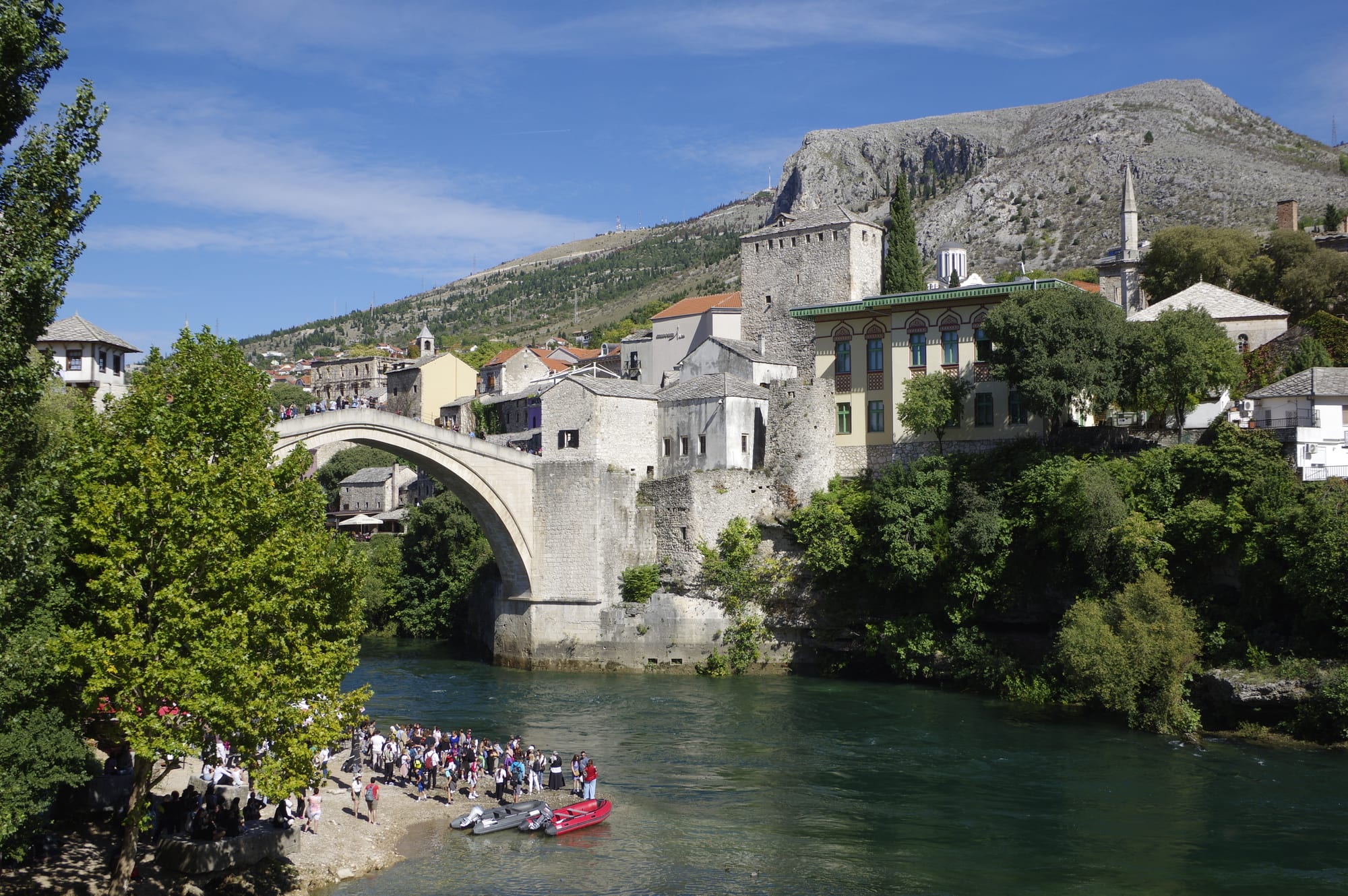
May–June and September–October — warm but not baking, rivers full, and the rafting and hiking seasons open, with fewer crowds than midsummer. July and August are hot, very hot in Herzegovina, and busiest at the Mostar bridge and Kravice falls. December–March is for skiing at Jahorina and Bjelašnica.
- Events
- Sarajevo Film Festival (August), born during the siege and now the region's largest
💱 Currency
The convertible mark (KM, code BAM) is pegged to the euro at a fixed rate of about 1.96, originally set one-to-one with the German mark. It is the currency to use throughout the country.
- Cards
- Widely accepted in cities and hotels; cash for small places and Republika Srpska petrol stations
- Symbol
- KM
- Currency Code
- BAM — convertible mark
💬 Language
Bosnian, Croatian, and Serbian are all official and are, linguistically, one language with minor differences. Bosnian and Croatian use the Latin alphabet; Serbian uses both Latin and Cyrillic, with Cyrillic dominant on official signage in Republika Srpska. English is widely spoken by younger people and in the tourism trade; German is a common fallback.
- English
- Common in Sarajevo, Mostar, and among the young
- Scripts
- Latin everywhere; Cyrillic also used in Republika Srpska
- Official Languages
- Bosnian, Croatian, Serbian