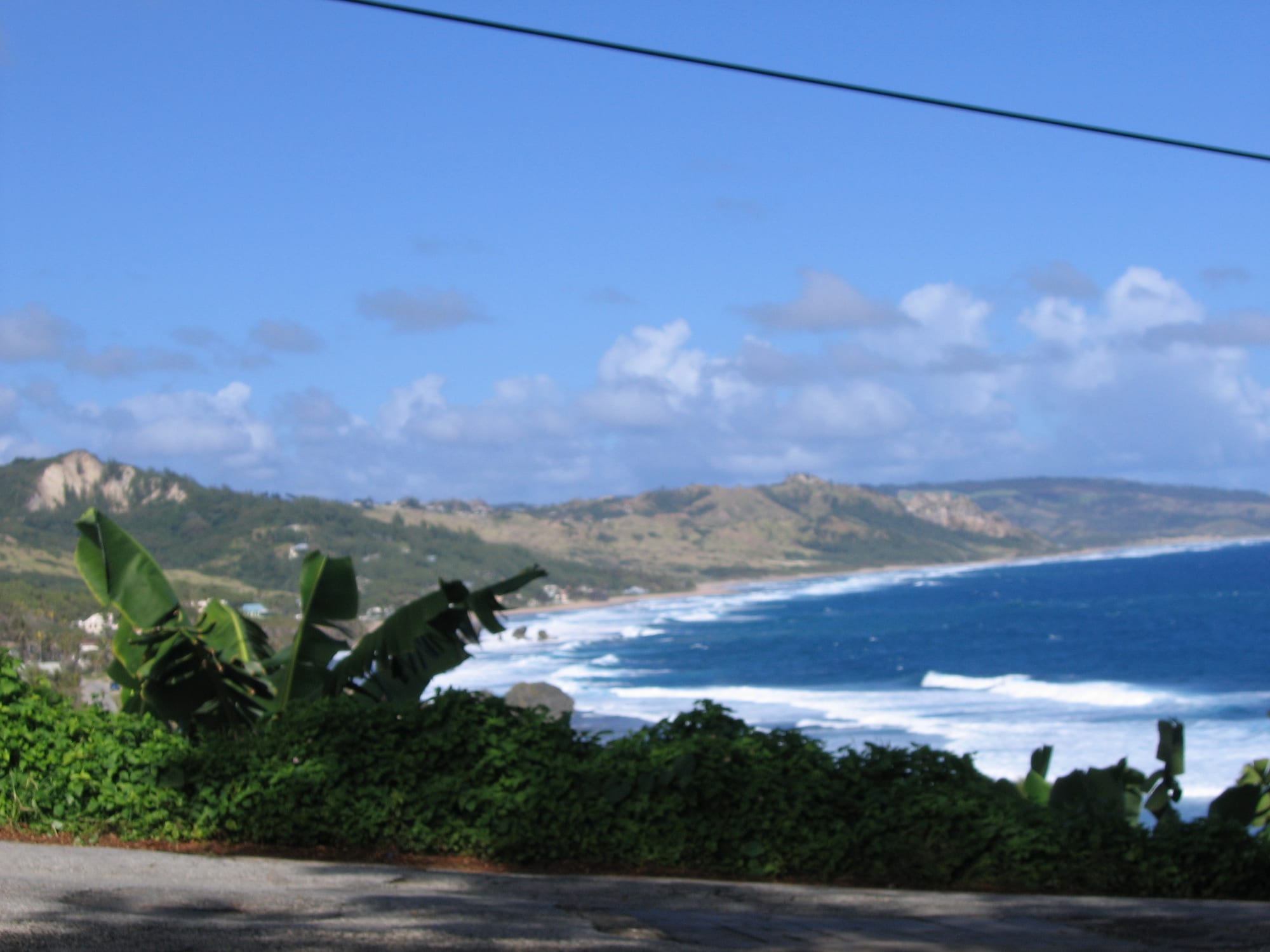
Large weathered rock formations standing in shallow surf along a rugged beach at Bathsheba on the Atlantic coast

Barbados

The Atlantic-battered coast at Bathsheba, on the rugged east side of Barbados, with its mushroom-shaped coral boulders. (Postdlf / Wikimedia Commons · CC BY-SA 3.0)

The easternmost Caribbean island — a low cap of coral limestone with calm western beaches and a wild Atlantic coast, an old parliamentary tradition, and a cricket-and-rum culture.

Explore Barbados

History

Indigenous peoples had largely left the island by the time an English ship landed in 1625 and claimed it. From the 1640s Barbados pioneered the English sugar-and-slavery plantation model that was then exported across the Caribbean, becoming for a time the richest colony in English America, worked by enslaved Africans who soon vastly outnumbered the English planters.

Emancipation came in 1834–38, but power stayed with a small white plantation elite for another century. The 1937 riots, the rise of the labour movement under figures such as Sir Grantley Adams and later Errol Barrow, and the extension of the vote led to self-government and then independence from Britain in 1966.

Barbados kept the British monarch as head of state until 30 November 2021, when it became a parliamentary republic within the Commonwealth, with a ceremonial president. Its assembly dates to 1639, making it one of the oldest continuous parliamentary bodies outside Britain. Sugar's long decline has been replaced by tourism and financial services, and in recent years the country has drawn international attention for Prime Minister Mia Mottley's advocacy on climate finance.

  • Barbados: Sugar Island to Republic The colony that invented the English plantation system — three centuries of sugar and slavery, then a Black-majority democracy, and in 2021 a republic

Culture & Customs

Bajan culture is Afro-Caribbean and Anglophone, and — from more than three centuries of unbroken British presence — outwardly more "British" in some respects than most of the region: cricket, Anglican churches, place names, driving on the left, and a parliamentary tradition.

Cricket is close to a civil religion. Barbados has produced an extraordinary roll of greats, from Sir Garfield Sobers and the "three Ws" to Wes Hall, Gordon Greenidge, and Malcolm Marshall, and Kensington Oval in Bridgetown is a shrine that hosted the 2007 World Cup final. Crop Over is the big festival, rooted in the celebration marking the end of the sugar harvest and running from July to a costumed street parade on Grand Kadooment Day in early August.

The Landship — a friendly society that gently parodies the Royal Navy with "crews," uniforms, and a dance performed to tuk band music — is a uniquely Bajan institution. Christianity dominates, and the rum shop as village hub, the "lime" (hanging out), and Sunday church-and-family are the social rhythm. The singer Rihanna, born in Bridgetown, is a National Hero.

Daily Life

Most of the roughly 280,000 Bajans live in the parishes spreading out from Bridgetown, the only city, whose historic centre and the nearby Garrison are a UNESCO World Heritage Site. It is one of the more densely populated countries in the world, but low-rise and green, with sugar cane still covering parts of the interior.

Tourism and financial services are the economic mainstays, supported by good schools and health care and a strong civil service. Life runs on the bus into Bridgetown, the market, the rum shop, the cricket, and Sunday worship, with close ties to relatives in the UK, the US, and Canada.

Barbados imports most of what it consumes, so the cost of living is high, and it watches the Atlantic hurricane season from June to November, though its position far to the east and south spares it more often than much of the region.

Food

The national dish is cou-cou and flying fish: cou-cou a smooth cornmeal-and-okra polenta, served with flying fish — once so abundant here that Barbados is "the land of the flying fish" — steamed in a spiced tomato gravy or fried. Fish cakes (salt-cod fritters) with "bakes," macaroni pie, and rice and peas are everyday staples.

"Pudding and souse" — steamed sweet-potato pudding with pickled pork — is a Saturday tradition, and "cutters," sandwiches in a salt-bread roll, are the standard quick lunch. The Friday-night fish fry at Oistins, a south-coast fishing village, is a national ritual of grilled marlin and mahi-mahi, sides, rum, and music at communal tables.

Barbados claims to be the birthplace of rum: Mount Gay traces its origins to 1703, and the island has more than a thousand rum shops. Bajan seasoning, a green herb-and-scotch-bonnet marinade, and a mustard-based Bajan pepper sauce are on every table, alongside local drinks such as mauby (a bittersweet bark infusion) and sorrel at Christmas.

  • Barbados: Food and the National Dish A cornmeal-and-okra staple paired with the fish the island is named for, a Saturday tradition of pickled pork, and the birthplace of rum itself

Attractions & Natural Wonders

The west "Platinum" coast — Holetown, Paynes Bay, Mullins — has the calm swimming, turtle snorkelling, and upmarket resorts; the south coast around St. Lawrence Gap is livelier and cheaper; and the rugged east, above all Bathsheba with its mushroom-shaped boulders and the "Soup Bowl" surf break, is for scenery and Atlantic drama rather than swimming.

Bridgetown and the Garrison hold National Heroes Square, the Parliament Buildings, one of the oldest synagogues in the Americas, and the Garrison Savannah horse-racing track ringed by colonial military buildings; George Washington House is where the future president made his only trip outside what became the United States, in 1751. Harrison's Cave is a drivable limestone cavern of streams and formations.

Historic plantation houses and gardens are scattered across the island — St. Nicholas Abbey, a Jacobean great house with its own rum distillery; Sunbury; Andromeda Gardens; Hunte's Gardens — and the Barbados Wildlife Reserve is home to free-roaming green monkeys. Catamaran cruises, dive sites, and the shipwrecks of the Carlisle Bay marine park round out the water-based options.

Planning basics

Budget

Barbados is a relatively expensive Caribbean destination, though cheaper and more varied than the exclusive resort islands. Buses, local restaurants, and rum shops keep costs down; the west-coast hotels and imported goods push them up. Cards are widely accepted.

Fish Cutter
USD 4–6 from a village shop
Daily Budget Midrange
USD 200–400 (hotel, car hire, restaurants, a catamaran or dive trip)
Daily Budget Shoestring
USD 90–140 (guesthouse, buses, local food and rum shops)

The Oistins Friday fish fry is the best-value good meal on the island; buses reach it cheaply from the south coast.

Visa Requirements

Citizens of the US, Canada, the UK, the EU, and most Commonwealth and Latin American countries do not need a visa and are typically granted up to six months on entry. An onward or return ticket and an address are usually required. A 12-month "Welcome Stamp" remote-work visa is also available.

Typical Stay
Up to 6 months on entry, visa-free, for most Western passports

Have your accommodation address and return ticket ready at immigration.

Safety

Barbados is one of the safer Caribbean destinations, with a stable society and low levels of violent crime affecting tourists, though gang- and gun-related crime has risen in specific residential areas of and around Bridgetown that visitors have no reason to enter.

Water
The west and south coasts are calm; the Atlantic east coast has dangerous currents and surf — swimming there is discouraged.

Use hotel safes, don't leave valuables on the beach, avoid isolated beaches and unlit areas after dark, and be firm with persistent vendors on the south-coast beaches.

Climate

Tropical and warm, steadied by the trade winds so it rarely feels oppressive. The dry season runs roughly December to May; June to November is wetter and more humid, with brief heavy showers rather than all-day rain, and coincides with the Atlantic hurricane season.

Dry Season
Dec–May, around 26–29°C, low rainfall, steady breeze
Hurricanes
Direct hits are relatively infrequent this far east and south, but not unknown
Wet Season
Jun–Nov, hotter and more humid, short downpours

Transportation

Grantley Adams International Airport is a major regional hub with direct long-haul flights. There is no railway. Getting around means government blue buses and privately run yellow buses and white "ZR" vans — cheap, frequent, and lively on fixed routes from Bridgetown — plus unmetered taxis and rental cars.

Driving
On the left; a temporary local driving permit is required, sold by car-hire firms

Roads are narrow, winding, and poorly signed off the highways; buses stop by mid-evening.

Best Time to Visit

Mid-December to April for the driest, brightest weather and the winter season, at peak prices. Late April to June is a good-value shoulder. Crop Over in July–August is hot and humid but a major draw. September–October is quietest, cheapest, and wettest.

Events
Crop Over festival (June/July to Grand Kadooment Day in early August); Holetown Festival (February)

Currency

The Barbadian dollar (BBD) is pegged to the US dollar at a fixed 2 to 1. US dollars are widely accepted, with change often given in local currency. ATMs are common.

Cards
Accepted at hotels, restaurants, and shops; carry small local notes for buses and vendors
Symbol
$ (Bds$)
Currency Code
BBD — Barbadian dollar (2:1 with USD)

Language

English is the official language, used in government, education, and business. In everyday life most Bajans speak Bajan, an English-based creole with West African grammatical roots; conversation with visitors is usually close to standard English.

English
Universal
Everyday Speech
Bajan (Barbadian Creole)
Official Language
English