History · Ukraine
Ukraine: The Borderland That Became a Nation
The land of Kyivan Rus, partitioned for centuries between Poland, Russia and Austria — a brief independent republic crushed in 1920, a Soviet republic that suffered a man-made famine and the heaviest fighting of the Second World War, independent since 1991, and since 2014 at war with Russia
By Worldlore Editorial · 19 September 2026
A large country on a contested frontier
Ukraine is the largest country lying wholly within Europe, a broad expanse of fertile plains — the famous "black earth" — between the Carpathians and the Russian border, with a population of about 38 million (falling sharply since 2022). Its name is often glossed as "borderland", and for most of the last thousand years its territory has been divided among larger powers: Kyivan Rus, then Lithuania and Poland, then the Russian and Habsburg empires, then the Soviet Union. Since 1991 it has been an independent state, and since 2014 it has been fighting a war with Russia over that independence. This account outlines the history and attributes contested points rather than settling them.
A short history
- 882–1240
Kyivan Rus
A powerful East Slavic state centred on Kyiv; Christianised in 988.
- 1240
The Mongol sack of Kyiv
Rus fragments; its lands pass to Lithuania and Poland.
- 1648–1764
The Cossack Hetmanate
A self-governing Cossack polity, later absorbed by Russia.
- 18th century
Partition
Most of Ukraine goes to Russia; the west (Galicia) to Austria.
- 1917–1921
The failed republic
Ukrainian statehood is declared and then defeated.
- 1932–1933
The Holodomor
A man-made famine kills millions; regarded by Ukraine and many states as genocide.
- 1941–1944
The Second World War
Ukraine is devastated; millions of soldiers and civilians die.
- 1991
Independence
Over 90% vote yes as the USSR dissolves.
- 2004 & 2013–14
Orange Revolution; Euromaidan
Mass protests over elections and EU ties.
- 2014 & 2022
Russian invasions
Crimea annexed and the Donbas war; then a full-scale invasion.
Rus, Cossacks, and empires
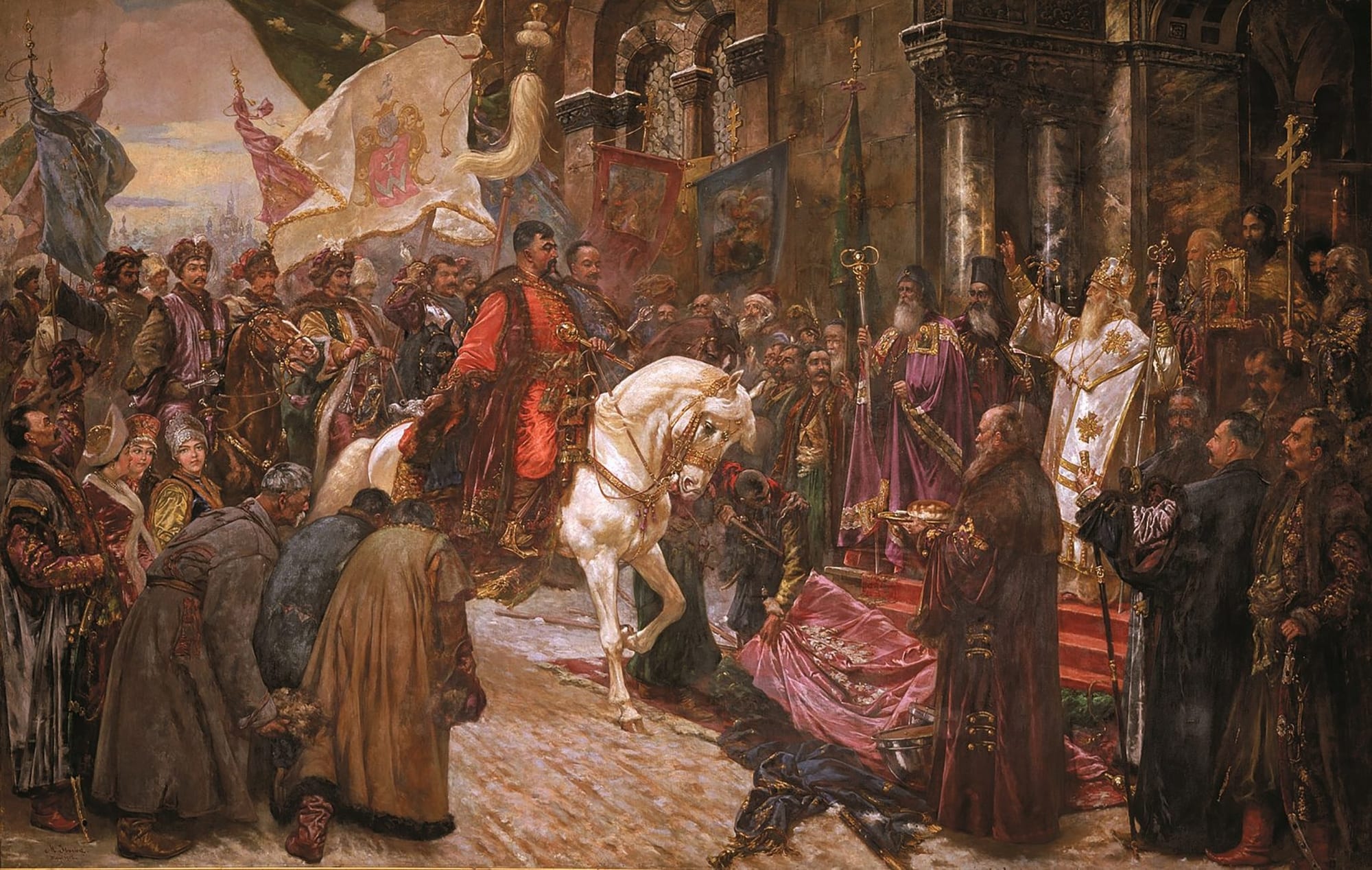
Kyivan Rus, formed along the Dnipro trade route in the 9th century, adopted Orthodox Christianity from Byzantium in 988 under Prince Volodymyr and became, for a time, one of the largest and most sophisticated states in Europe. The Mongol invasion destroyed Kyiv in 1240, and over the following centuries the Rus lands were absorbed by the Grand Duchy of Lithuania and then the Polish-Lithuanian Commonwealth. In the 16th and 17th centuries a distinct society formed on the southern steppe frontier: the Cossacks, free warrior communities who in 1648 rose against Polish rule under Bohdan Khmelnytsky and created a self-governing Hetmanate. Seeking protection, Khmelnytsky allied with Moscow in 1654 — an agreement Ukrainian and Russian historians have interpreted very differently ever since. The Hetmanate's autonomy was whittled away and abolished by the Russian Empire in the 18th century, which also partitioned Poland and took most of Ukraine, while Austria acquired the western region of Galicia.
The Soviet century
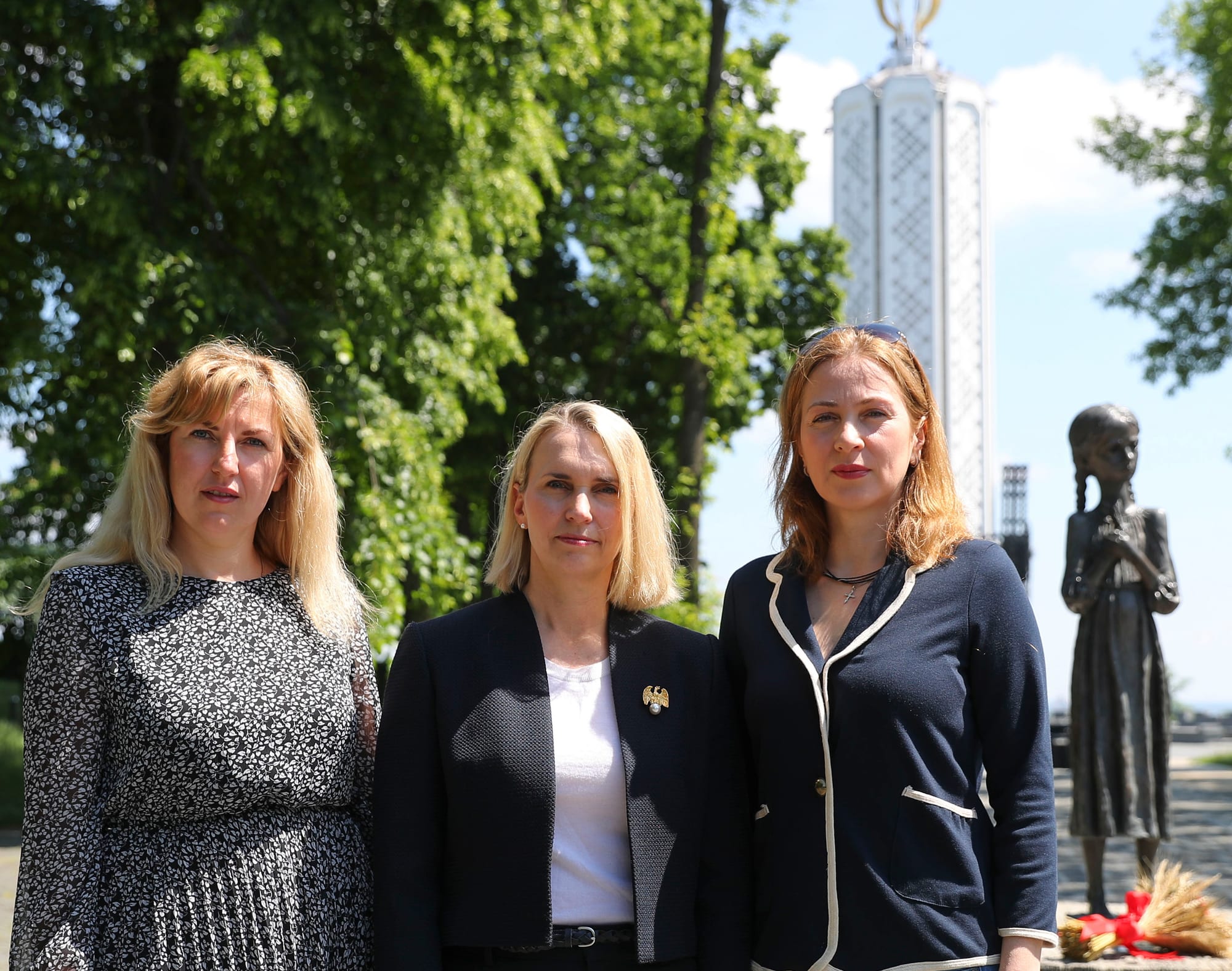
The collapse of the Russian and Austrian empires in 1917–18 produced a scramble of rival Ukrainian governments — the Central Rada, the Hetmanate, the Directory, the west Ukrainian republic — fighting Bolsheviks, Whites, Poles and anarchists. All were defeated by 1921, and Ukraine was split between a Soviet republic and Poland. The Soviet 1920s allowed a flowering of Ukrainian language and culture, then reversed it violently: Stalin's collectivisation triggered the Holodomor of 1932–33, and the purges of the later 1930s destroyed the Ukrainian political and cultural elite. In 1939 the USSR annexed western Ukraine from Poland. The Second World War was catastrophic here — the front passed over the whole country twice, Nazi occupation murdered the great majority of Ukraine's 1.5 million Jews, millions were deported for forced labour, and total Ukrainian war deaths ran to perhaps seven million; a nationalist insurgency (the UPA) fought both Germans and Soviets, and its record, including massacres of Poles, remains bitterly contested. After the war Soviet Ukraine was rebuilt as an industrial and agricultural powerhouse; Crimea was transferred to it from Russia within the USSR in 1954. The 1986 Chornobyl disaster deepened public distrust of Moscow.
Independence and revolutions
On 1 December 1991, over 90 per cent of Ukrainians — including majorities in every region, Crimea included — voted for independence, and the USSR dissolved weeks later. The 1990s brought a deep economic slump, hyperinflation, and the rise of oligarchs. Ukraine gave up the nuclear weapons stationed on its soil in 1994 in exchange for security assurances (the Budapest Memorandum) from Russia, the US and the UK. Politics polarised between constituencies favouring closer ties with the EU and with Russia. In 2004 the fraud-tainted election of the pro-Russian Viktor Yanukovych was overturned by the mass protests of the Orange Revolution; he returned to the presidency in 2010.
The war with Russia
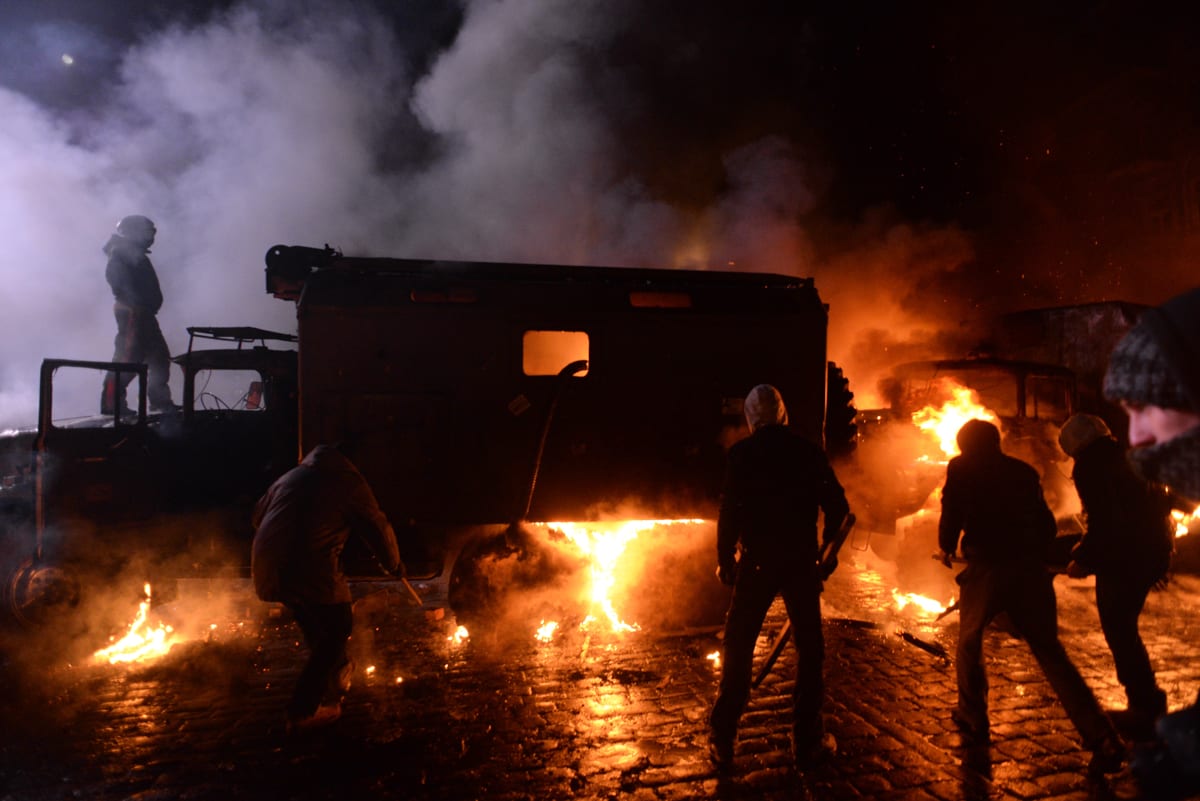
After Yanukovych fled in February 2014, Russia seized and annexed Crimea and fostered an armed separatist revolt in the eastern Donbas region; the resulting war killed about 14,000 people over eight years and was never resolved by the Minsk agreements. On 24 February 2022 Russia launched a full-scale invasion aimed at capturing Kyiv and replacing the government. The assault on the capital failed; Ukraine, armed and financed by Western states, held and then recaptured territory in the north-east and south, while Russia annexed four more regions it did not fully control and subjected Ukrainian cities to sustained missile and drone attacks. Russia describes the war as a "special military operation" to "denazify" and "demilitarise" Ukraine and prevent NATO expansion; Ukraine and most other states regard it as an unprovoked war of aggression and a bid to erase Ukrainian statehood. By the mid-2020s the war had killed or wounded hundreds of thousands of soldiers on both sides, killed tens of thousands of Ukrainian civilians, displaced over ten million people, and settled into attrition along a long front, with negotiations intermittent and inconclusive.
What Ukraine carries
Ukraine's history has repeatedly raised the same question: whether it is a nation in its own right or a part of a greater Russian one. Kyivan Rus, the Cossack Hetmanate, the 1917–20 republic and the 1991 referendum are the Ukrainian answer; the partitions, the Holodomor and the 2022 invasion are the pressure against it. The current war is, in the most direct terms yet, a fight over that question.