Culture & Customs · South Korea
South Korea: Two Hands for the Elders
A society where age shapes the very words people choose, where a glass is offered with both hands and a bow marks every greeting, and where a warm, stubborn bond called jeong ties people together
By Worldlore Editorial · 30 September 2026
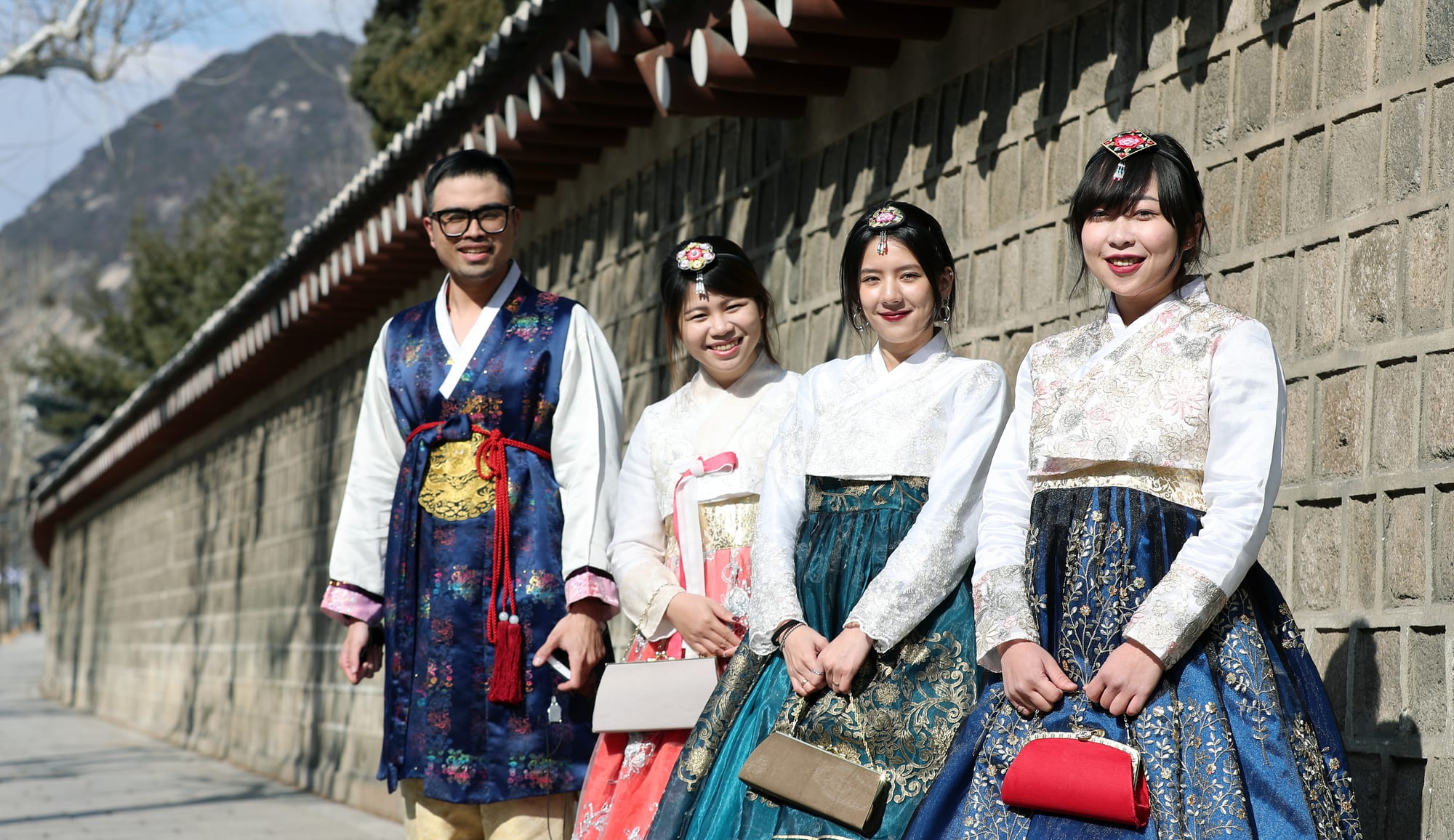
It is the morning of Seollal, the Lunar New Year, and a family has gathered at the grandparents' home. After the ancestral rites, the younger generation line up in order of age, many dressed in hanbok, and one by one make a formal bow to their elders. The grandparents answer with words of blessing for the year ahead and hand the children envelopes of money. Then everyone sits down to a bowl of rice cake soup. The whole scene lasts only a few minutes, but it holds much of what matters in Korean culture: family before the individual, a clear order of age and respect, and a warmth that runs underneath the formality and gives it meaning.
Faith, identity and values
South Korea is a country where formal religion and inherited belief sit side by side. Around half the population reports no religious affiliation. About three in ten people are Christian, roughly two thirds of them Protestant and one third Catholic, and around one in six is Buddhist. Confucianism is rarely counted as a religion at all; many Koreans see it as a way of looking at life that sits comfortably alongside whatever faith they hold, or none. Its influence is felt everywhere, from the respect shown to parents to the ancestral rites that many families still hold at the two great holidays of the year.
Confucian thought gives society its shape. Relationships are understood as hierarchical but mutual: those below owe respect and loyalty, and those above owe care and fairness in return. Age is the first measure of where a person stands, and filial piety — deep respect and devotion towards parents and elders — is still regarded as a core virtue. Closely linked is chaemyeon, or face: the standing and reputation a person presents to others, which can be gained through achievement and lost through embarrassment, and which Koreans take care to protect in themselves and in others.
Two further ideas are often used to explain the national character. Han is often described as a collective sense of sorrow and resentment built up over a long and often painful history, sometimes linked to the country's drive and strong work ethic. Jeong is its warmer counterpart: the feeling of attachment that grows between people who share their lives, whether as family, neighbours, classmates or colleagues. It shows itself in small acts of care — a landlady cooking birthday soup for a lodger, a mother fussing over her children's friends as if they were her own, a host heaping more food onto a guest's plate. Jeong grows slowly and is not easily broken, and it helps explain why so much of Korean social life turns on long-standing relationships. Younger Koreans are increasingly questioning rigid hierarchies and traditional gender roles, but the underlying sense of belonging to a group remains strong.
Greetings and meeting people
The bow is the everyday greeting, and its depth reflects the occasion. A casual greeting may be no more than a dip of the head; a more formal bow bends the upper body to around thirty degrees; and a deep bow of around forty-five degrees expresses sincere thanks or apology. Handshakes are also used. The right hand is preferred, and to show extra respect a person may support their right wrist or forearm with the left hand while shaking. Women greeting elders sometimes place the left hand over the right.
Age and status shape not only gestures but language. Korean has several speech levels, broadly divided into jondaenmal, the polite forms used with elders, strangers and in professional settings, and banmal, the casual speech used between close friends of similar age or by an older person to a younger one. Even everyday phrases change depending on who is being addressed. This is why new acquaintances often ask questions about age, job or family early on: the answers help each person know how to speak to the other. People are addressed by a title or job title with their surname, and first names are kept for close relationships unless someone invites otherwise.
Communication tends to be indirect. Koreans pay close attention to tone, posture and expression, and will often soften or understate a point rather than risk causing offence. Steady eye contact is normal in friendly conversation, but lowering the eyes is appropriate when being corrected by an elder or senior. Some gestures differ from Western habits: people are beckoned with the palm facing down and the fingers fluttering, and pointing is done with an open hand rather than a single finger. The left hand on its own carries negative associations, so the right hand, or both, is used for gestures and for passing things. Blowing one's nose in company is considered rude, and it is better to step away to do so.
Hospitality and being a guest
Shoes come off at the door of a Korean home, and hats are removed indoors. Gifts, like anything else handed over, are offered and received with both hands, or with the right hand alone — never with the left hand on its own.
Meals follow the order of age. The eldest person at the table is served first, and nobody begins eating until they have started. Spoons are used for soup and chopsticks for everything else, and food is not eaten with the fingers. The most senior person is traditionally seated farthest from the entrance.
Drinking together is a social ritual with its own etiquette, much of it built around respect for seniors. People fill each other's glasses rather than their own; in formal company, a person with an empty glass waits for someone else to notice, and returns the favour by keeping a senior's glass topped up. Drinks are poured and received with both hands, or with one hand supporting the other arm. When clinking glasses with someone older, the junior person holds their glass a little lower, and when drinking in front of a senior, it is customary to turn the head slightly away and shield the glass with the hands. Heavy drinking was long a feature of company dinners, but attitudes are changing: many younger Koreans now reject pressure to drink, and a polite refusal, ideally with a genuine reason such as health or faith, is widely understood.
Festivals and life's big moments
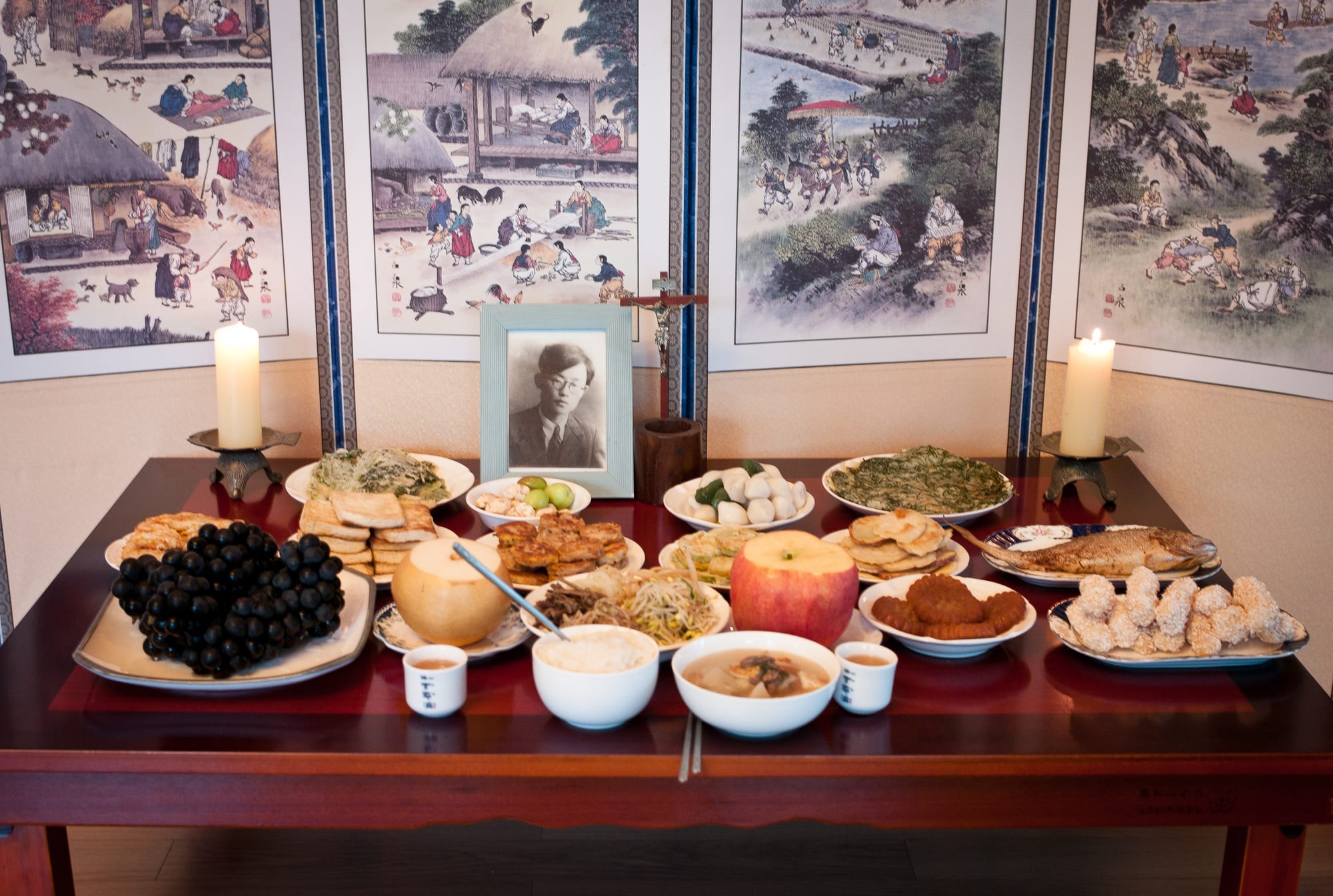
The two great holidays follow the lunar calendar and send much of the country travelling back to family hometowns. Seollal, the Lunar New Year, falls on the first day of the lunar year. Families hold charye, the ancestral rite, in the morning, often dressed in new clothes; the younger generation then bow to their elders in the ritual known as sebae and receive blessings and gifts of money, called sebaetdon, in return. Rice cake soup, eaten for a fresh start, is the dish of the day, and families play yunnori, a board game of thrown sticks. Traditionally, everyone was counted a year older at the new year, whatever their actual birthday, a custom South Korea formally dropped for official purposes in 2023.
Chuseok, on the fifteenth day of the eighth lunar month, is the autumn harvest festival. Families again hold charye, setting out freshly harvested food and songpyeon, small half-moon rice cakes, and carry out seongmyo, visiting ancestral graves to clear the weeds and pay their respects. Many people wear hanbok for the occasion, and folk games and performances fill the holiday.
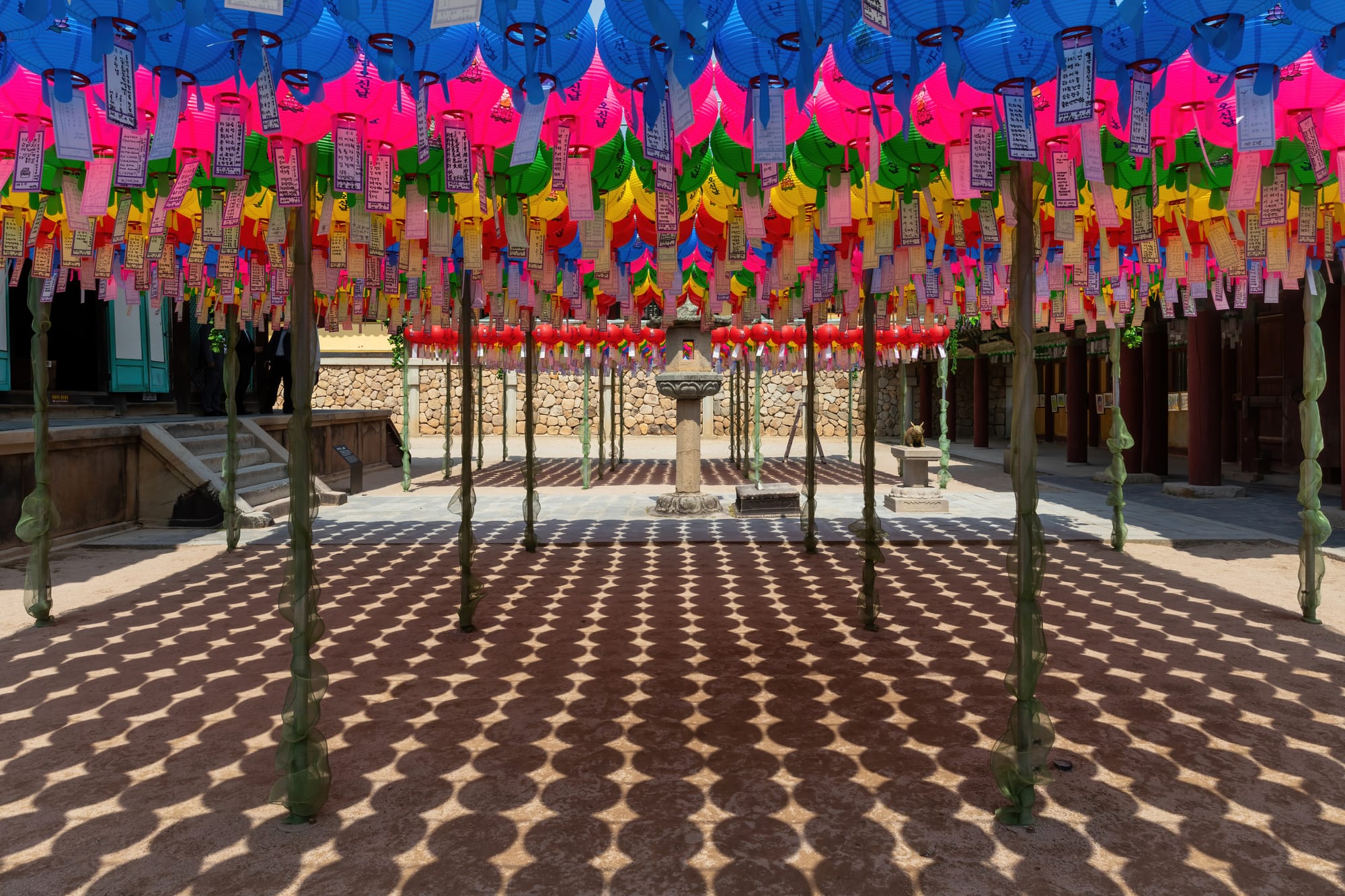
In spring, the Buddha's birthday, on the eighth day of the fourth lunar month, brings Yeondeunghoe, the lantern-lighting festival now on UNESCO's list of intangible cultural heritage. It begins with the ritual bathing of an image of the infant Buddha, streets and temples are hung with lotus lanterns, and processions of people carrying handmade lanterns fill the streets. Once a purely religious rite, it has become a spring festival open to everyone.
A child's first birthday, dol, is one of the most important family celebrations. Its highlight is doljabi, in which objects are laid out in front of the baby, and whichever the child picks up is said to foretell their future: thread for a long life, money for wealth, a brush for scholarship. Today, families often add modern objects such as a stethoscope, a microphone or a computer mouse.
Marriage is understood as the joining of two families, and guest lists often reach well beyond the couple's own friends to include relatives, colleagues and family acquaintances invited by the parents. Guests sign a guestbook and give their congratulatory money at the reception desk. Younger couples increasingly choose smaller ceremonies with close family only. Funerals usually last three days and are most often held in dedicated funeral halls, many of them inside hospitals. Mourners wear black or dark clothes, bring condolence money in an envelope, light incense and bow twice before a portrait of the person who has died. White lilies and chrysanthemums are the customary flowers, and the bereaved family serves a simple meal to everyone who comes.
Arts, crafts and music
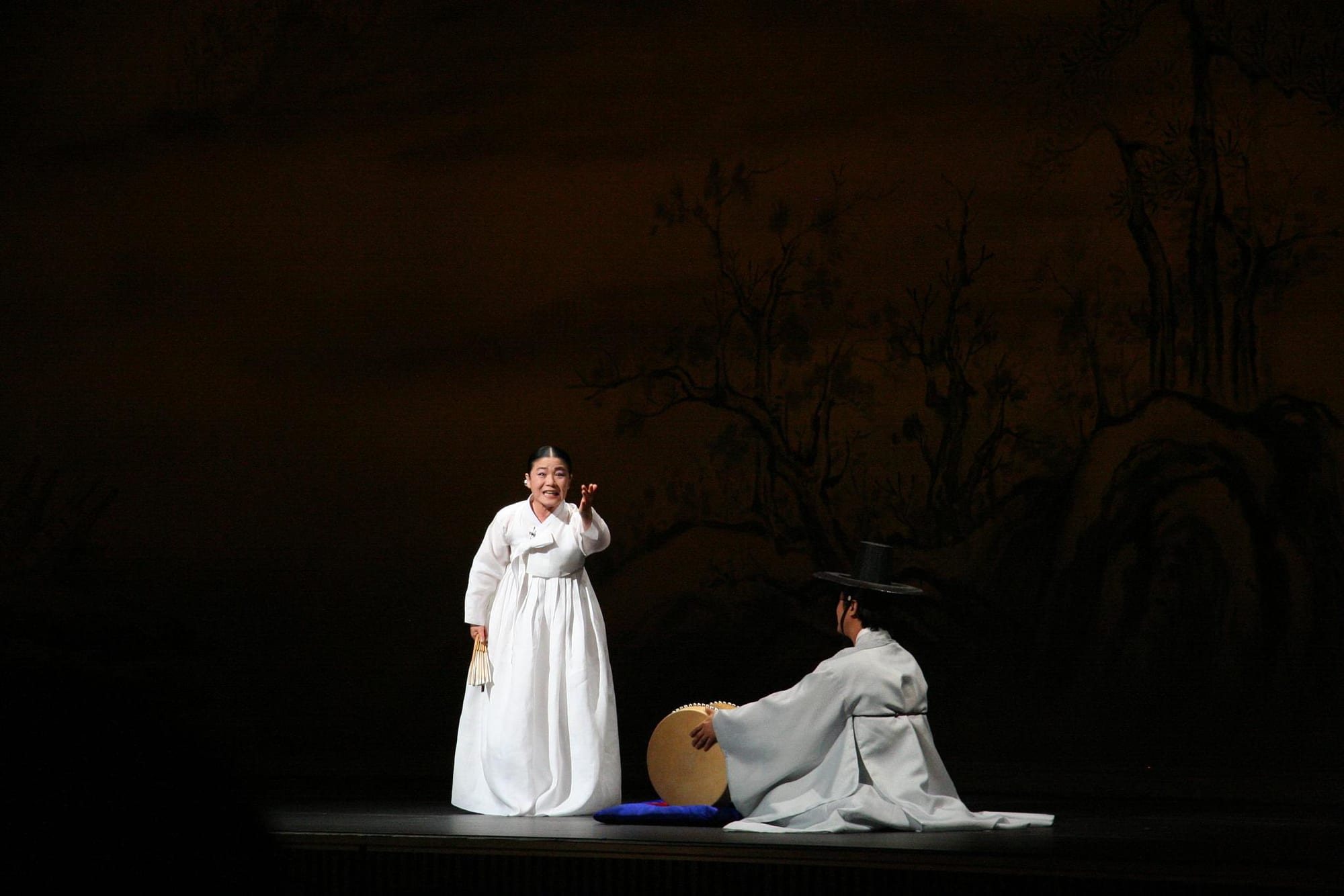
Korea's traditional arts are carefully protected and still widely performed. More than twenty Korean traditions are inscribed on UNESCO's Representative List of the Intangible Cultural Heritage of Humanity. Among them is pansori, a form of epic musical storytelling performed by a single singer and a drummer with a barrel drum. The singer moves between expressive song, stylised speech and gesture, and a complete performance of one tale can last up to eight hours.
The list also includes the royal ancestral ritual at Jongmyo Shrine, with its ceremonial music; arirang, the lyrical folk song; talchum, the masked dance dramas; and nongak, the community band music, dance and ritual. Crafts and skills on the list range from traditional wooden architecture and the weaving of fine ramie cloth to tightrope walking and ssireum, Korean wrestling, inscribed jointly with North Korea.
Alongside these traditions, South Korea has become one of the world's most influential exporters of popular culture. Since the late 1990s, the "Korean wave" has carried K-pop, television dramas, films and webtoons to audiences around the globe, and it sits alongside the older arts rather than replacing them.
Dos and don'ts for visitors
- Do return a bow with a bow, or combine a handshake with a slight nod of the head.
- Do give and receive things, including drinks, with both hands or the right hand alone.
- Do take off shoes when entering a home, and remove hats indoors.
- Do wait for the eldest person at the table to start eating before beginning.
- Do pour drinks for others rather than for oneself, and turn slightly away when drinking in front of someone senior.
- Do use titles and surnames until invited to do otherwise.
- Don't point or beckon with one finger; use an open hand, palm down, to call someone over.
- Don't blow the nose at the table; step away to do it.
What to take away
Korean etiquette can seem built entirely on rank and ritual, but at its heart is jeong — the belief that relationships are worth tending — and visitors who show a little care for age, a second hand on the glass and patience with a slow-growing friendship will find that warmth readily returned.