History · Poland
Poland: The Country That Moved
A great medieval kingdom and a vast noble commonwealth — erased from the map for 123 years, reborn in 1918, invaded from both sides in 1939, shifted bodily westward in 1945, and freed by a shipyard strike
By Worldlore Editorial · 19 September 2026
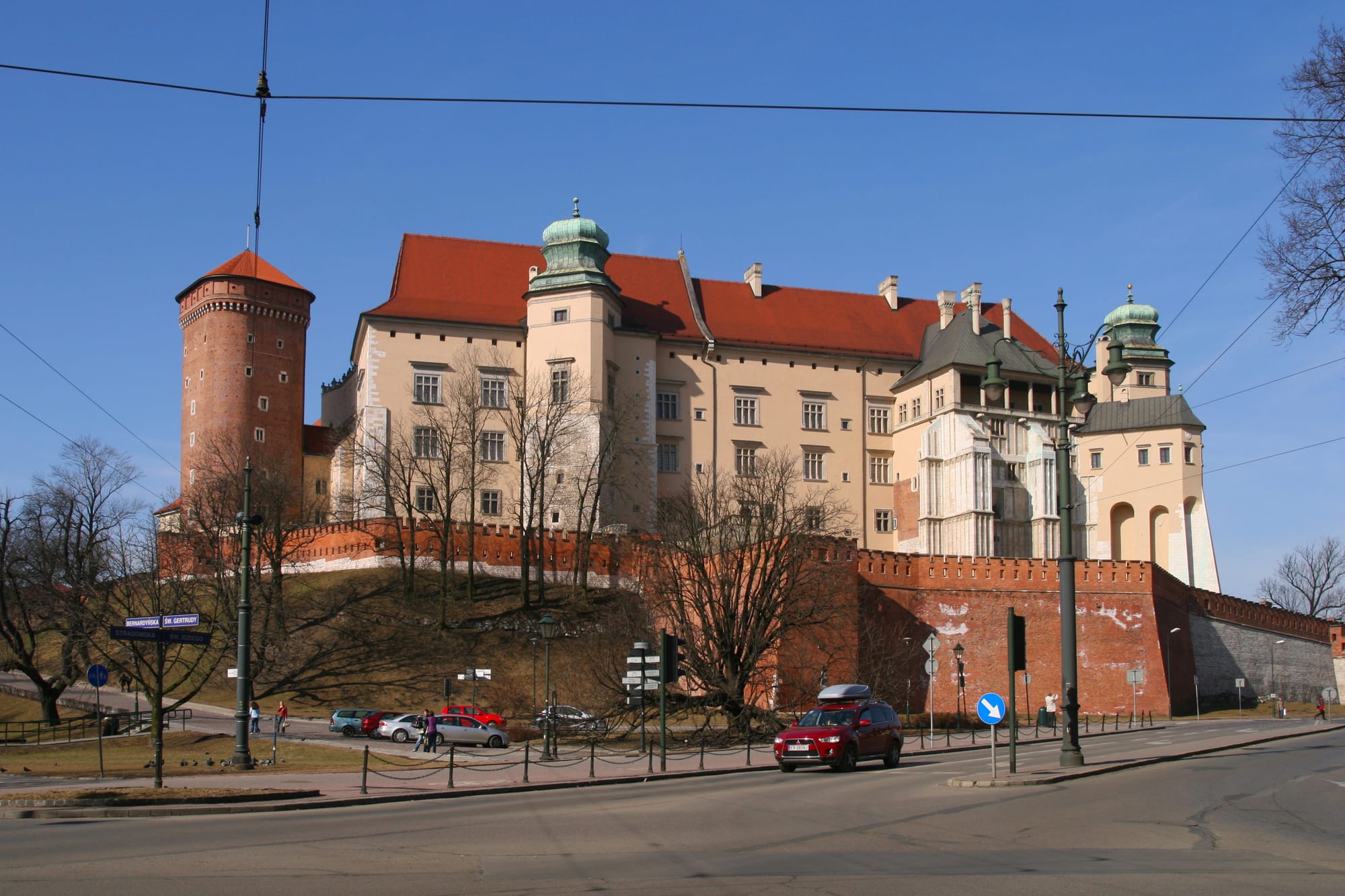
A nation without fixed borders
Poland today is a country of about 37 million people on the North European Plain, ethnically and religiously homogeneous, a member of the EU and NATO. For most of its history it was neither of those things. Its borders have moved enormously — east into Ukraine and Belarus, then west to the Oder — and for 123 years, between 1795 and 1918, there was no Polish state at all. That experience of partition, occupation and displacement is the central fact of the national story.
A short history
- 966
Baptism of Mieszko I
The Piast dukes adopt Latin Christianity; Poland enters Europe.
- 1385
Union with Lithuania
A dynastic union creates a huge multi-ethnic realm.
- 1569–1795
The Commonwealth
An elective monarchy dominated by the nobility.
- 1772, 1793, 1795
The Partitions
Russia, Prussia and Austria divide Poland out of existence.
- 1918
The Second Republic
Poland is reconstituted after the First World War.
- 1939
Invasion
Germany attacks on 1 September, the USSR on 17 September.
- 1939–1945
Occupation
Around six million Polish citizens die, half of them Jews.
- 1945
The shift west
Poland loses its east to the USSR, gains German land in the west.
- 1947–1989
Communist rule
A Soviet-aligned People's Republic.
- 1980
Solidarity
A shipyard strike launches the bloc's first free trade union.
Kingdom and commonwealth
The Polish state began with the baptism of Duke Mieszko I in 966, which anchored it to the Latin West. The Piast and then the Jagiellonian dynasties built a major power, and the 1385 union with Lithuania created one of the largest states in Europe, stretching from the Baltic towards the Black Sea. The Polish–Lithuanian Commonwealth, formalised in 1569, was an unusual polity: the king was elected by the szlachta (nobility), who made up nearly a tenth of the population and guarded their "Golden Liberty" jealously; it was also, by the standards of the age, strikingly tolerant, a refuge for Jews and for religious dissenters. But the elective system and the nobles' veto made central government almost impossible, and by the 18th century the Commonwealth was a helpless giant.
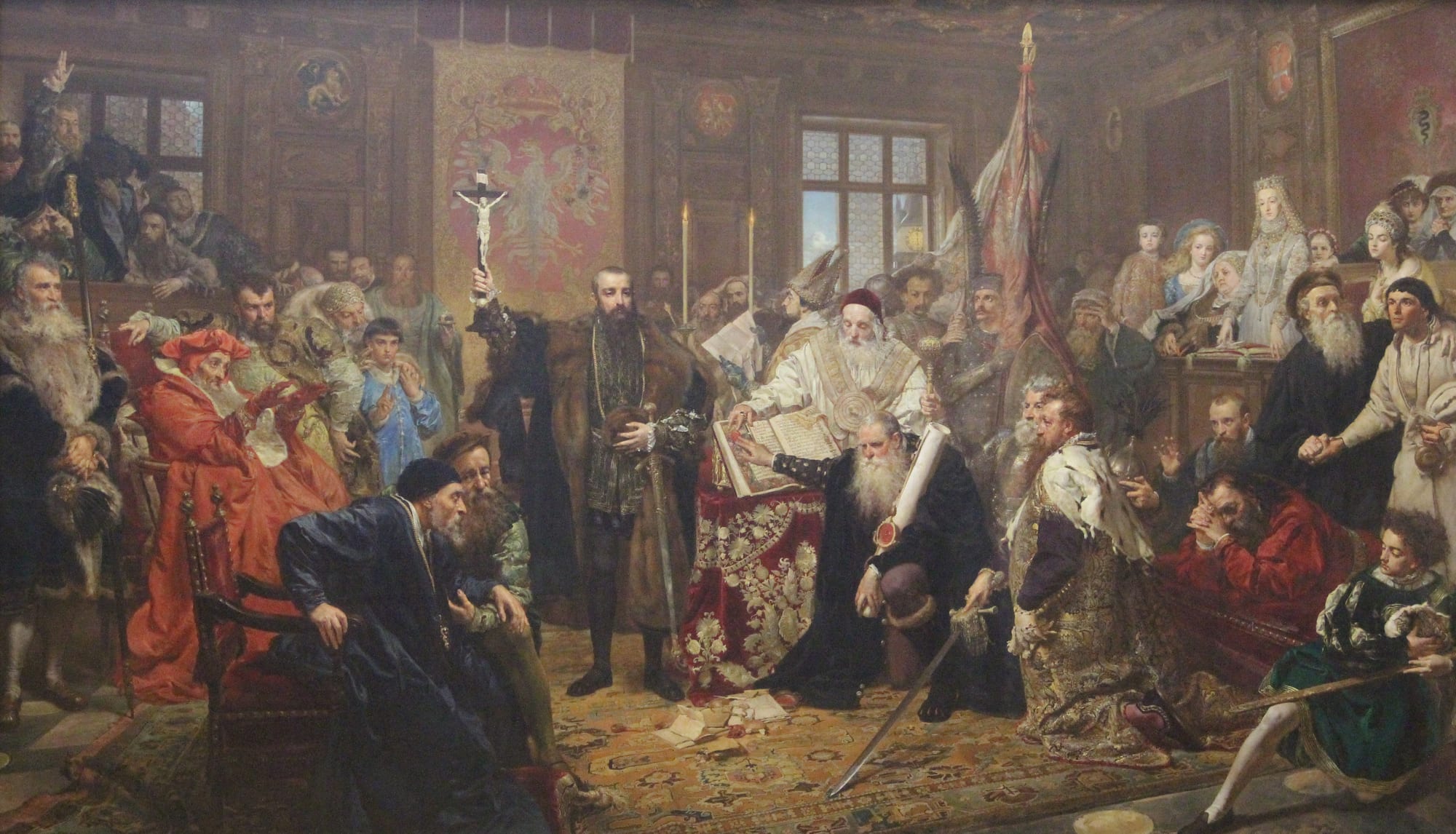
Erased from the map
Between 1772 and 1795 Poland's three neighbours — Russia, Prussia and Austria — annexed it in three stages until nothing was left. A reform movement produced Europe's first codified national constitution on 3 May 1791, but it came too late and provoked the final partitions. For the next 123 years Poles lived as subjects of three empires, mounting failed uprisings (1830, 1863) and keeping national identity alive through the Catholic Church, the language and Romantic literature. Poland was restored only when all three partitioning empires collapsed at the end of the First World War; the Second Republic was declared in November 1918 and had to fight border wars, including a 1920 war that halted a Soviet advance at Warsaw.
The war that fell hardest on Poland
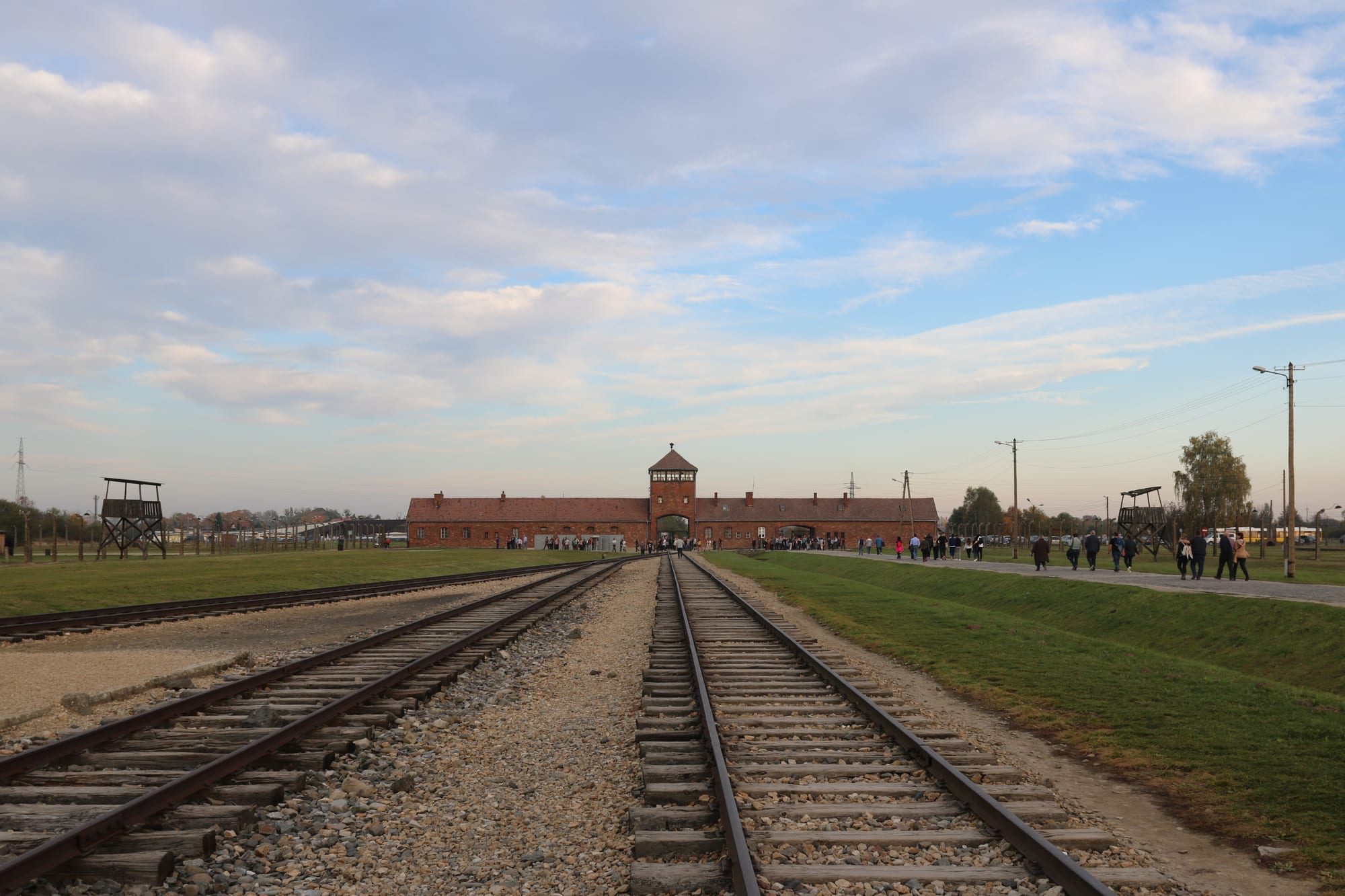
On 1 September 1939 Germany invaded Poland, starting the Second World War in Europe; on 17 September the Soviet Union invaded from the east under the Nazi–Soviet pact. The country was again partitioned and subjected to occupation regimes of exceptional violence: mass executions of the Polish elite, forced labour, the Katyn massacre of Polish officers by the Soviets, and — on Polish soil — the Nazi extermination camps in which most of Europe's Jews were murdered. Poland lost about six million citizens, roughly a fifth of its pre-war population, half of them Polish Jews. The non-communist resistance mounted the Warsaw Uprising in 1944, crushed while the Red Army waited across the river.
Moved westward
At the 1945 Yalta and Potsdam conferences the Allies redrew Poland's borders wholesale: the Soviet Union kept the eastern territories it had seized in 1939, and Poland was compensated with formerly German land in the west and north, up to the Oder–Neisse line. Millions of people were moved — Poles expelled westward from the lost east, Germans expelled from the new west, Ukrainians deported east — so that the country ended up smaller, shifted about 200 kilometres west, and for the first time nationally homogeneous. A Soviet-backed government imposed one-party communist rule, nationalised the economy, and collectivised agriculture only partially in the face of resistance.
Solidarity and after
Communist Poland was marked by recurring worker revolts (1956, 1970, 1976) and by the Catholic Church's unusual strength, boosted by the 1978 election of a Polish pope, John Paul II. In August 1980 a strike at the Lenin Shipyard in Gdańsk, led by the electrician Lech Wałęsa, forced the government to legalise Solidarity — the Soviet bloc's first independent trade union, which swelled to some ten million members. Martial law suppressed it in 1981, but the movement survived underground, and by 1989 an exhausted regime negotiated Round Table talks that led to partly free elections, a Solidarity-led government, and the fall of communism across the region. Poland joined NATO in 1999 and the EU in 2004, and has since been one of Europe's fastest-growing economies, though recent politics has been polarised over courts, media and the country's relationship with Brussels.
What Poland carries
Poland's history has made borders feel provisional and sovereignty feel fragile: the state has been divided among its neighbours, wiped out entirely, occupied by two totalitarian powers at once, and physically relocated. The lesson many Poles drew — about the reliability of great-power guarantees, and the value of independence — still shapes the country's fierce defence spending, its wariness of Russia, and its arguments with the EU.