Culture & Customs · Pakistan
Pakistan: Honour, Tea and the Sufi Shrine
A deep-rooted sense of family honour, a hospitality that will not take no for an answer, and a Sufi devotional tradition whose music has carried far beyond the shrines where it began
By Worldlore Editorial · 30 September 2026
A visitor steps into a Pakistani home and slips off their shoes at the door. The host's first concern is not conversation but comfort: a cup of tea arrives almost at once, followed by a plate of something to go with it, and when the cup is empty the host insists, and insists again, on refilling it. The eldest person in the room is greeted first and served first, the guest is praised and made much of, and when a meal is later shared outside the house, the host will quietly make sure the guest never sees the bill. Behind this generosity sits an idea that shapes almost every social exchange in the country: that the way a guest is treated reflects on the honour of the host and of the whole family.
Faith, identity and values
Islam is the foundation of national life. In the 2017 census, 96.5 per cent of Pakistanis identified as Muslim. The large majority are Sunni, most following the Hanafi school of Islamic law, while an estimated 10 to 15 per cent are Shia, one of the largest Shia populations in the world. The remaining 3.5 per cent or so include Christians, Hindus, Ahmadis and Parsis. Religion is treated with great seriousness in law as well as in daily life: the country's blasphemy laws restrict speech and action considered offensive to Islam and carry severe penalties, up to and including death, and minority groups have reported discrimination under them.
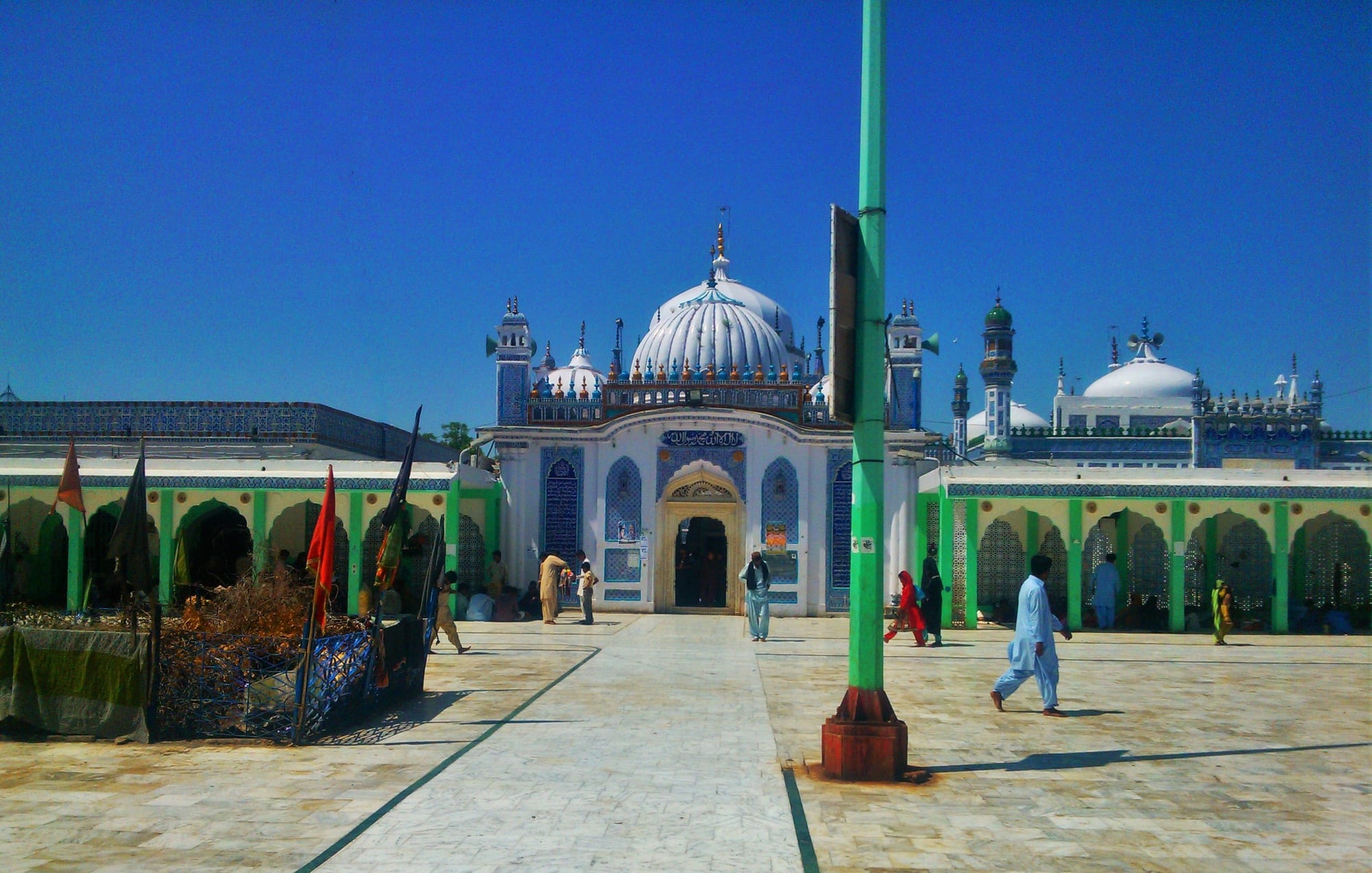
Alongside mainstream practice runs a strong and long-established Sufi tradition, which emphasises a personal, devotional connection with God. Many Pakistani Muslims regard themselves as followers of Sufi saints, and visiting their shrines is a widespread practice. Sufism has shaped the country's poetry and music more deeply than almost any other influence, and a saint's shrine, with its courtyard, its visitors and its music on feast days, is one of the most characteristic sights of Pakistani religious life.
Among the values that guide behaviour, none matters more than izzat, or honour. A person's honour is bound up with that of their family and community, so an individual's conduct is seen as a reflection of where they come from, and sharam, shame, can have lasting social consequences. Loyalty to the family is strong, and households are usually headed by the senior man, followed by the senior woman. Generosity and hospitality are prized across the country, and a great deal of resilience and adaptability has been built into everyday life by decades of political upheaval. Pakistan is also a country of many peoples, including Punjabis, Pashtuns, Sindhis, Muhajirs and Baloch, each with its own language and customs, bound together by Islam and by Urdu, the national language.
Greetings and meeting people
First meetings tend to be formal and serious. Elders are always greeted first, and it is polite to stand when someone enters the room. Among Muslims, the standard greeting is "As-salamu alaykum", "peace be upon you". Men usually shake hands with the right hand, and many then place it over the heart as a sign of sincerity; men who know each other well may embrace, and female friends may kiss on both cheeks. Physical contact between men and women is generally kept to family and close friends, and a man should shake a woman's hand only if she offers it first. Some people prefer a spoken greeting without any contact at all.
On first acquaintance, a man is addressed by his surname followed by "Sahib", or the shortened "Saab", roughly equivalent to "Mr", and professional titles such as "Doctor" are used before the surname. Urdu speakers often begin in a formal register, keeping the familiar forms for friends and younger relatives. Asking after someone's health and family is an essential part of any greeting, though in conservative circles it is wiser to ask only about male relatives unless the family is well known, since questions about a man's female relatives can be taken as intrusive.
Communication is typically indirect and courteous, designed to avoid confrontation. A flat "no" is rare, as it can sound like the end of a relationship; a reply such as "I'll see what I can do", or "Inshallah", "if God wills", often signals uncertainty or polite refusal. Lowering the gaze is a sign of respect, while prolonged direct eye contact can come across as arrogant. People are beckoned or pointed to with the whole open hand rather than a single finger, and the right hand is used for waving, eating and handing things over. Criticising someone in public is a serious affront to their honour and is best avoided altogether.
Hospitality and being a guest
Hospitality is central to Pakistani culture, and guests are treated with great ceremony. Shoes are removed on arrival, and it is courteous to praise the host's home and to take an interest in any children present. A small gift, such as chocolates or flowers, is appropriate, given and received with both hands or the right hand. Alcohol is never a suitable gift and any food brought should be halal. It is also customary to leave a tip for household staff when departing.
In more conservative families, men and women may eat separately, while in more relaxed or intimate settings the family sits together with its guests. Elders are served first, and no one begins eating until they have started. Many dishes are eaten with the hands, but only ever with the right hand; the left may help steady a plate but is not used to eat or to serve. Tea should be accepted graciously, and a host will usually press more on a guest more than once. When friends and relatives eat out, one person generally pays for the whole party, and the proper response is to reciprocate on another occasion rather than to offer money on the spot. During Ramadan, eating, drinking and smoking in public during daylight hours should be avoided.
Festivals and life's big moments
The official calendar blends religious and national observances. The two Eids, Eid ul-Fitr at the end of Ramadan and Eid ul-Azha, the festival of sacrifice, are the biggest celebrations of the year, marked with congregational prayers and family gatherings. Eid Milad-un-Nabi, the Prophet's birthday, is also a public holiday. The ninth and tenth days of Muharram, Ashura, are marked as a period of mourning for Imam Husain, the grandson of the Prophet Muhammad, especially by Shia communities, with processions and the recitation of elegies; forty days later, Chehlum brings further processions. National days include Pakistan Day on 23 March, Independence Day on 14 August, Allama Iqbal Day in honour of the national poet, and Quaid-e-Azam Day on 25 December, the birthday of the country's founder, which coincides with Christmas. Christians also have 26 December as a holiday, and optional holidays allow members of minority faiths to mark festivals such as Easter, Holi and Diwali. Nowruz, the spring new year, is celebrated in parts of the country and is on UNESCO's list as a tradition shared with other nations.
At Sufi shrines, the anniversary of a saint's death, the urs, draws large crowds for prayer and devotional music, and remains one of the liveliest expressions of popular faith.
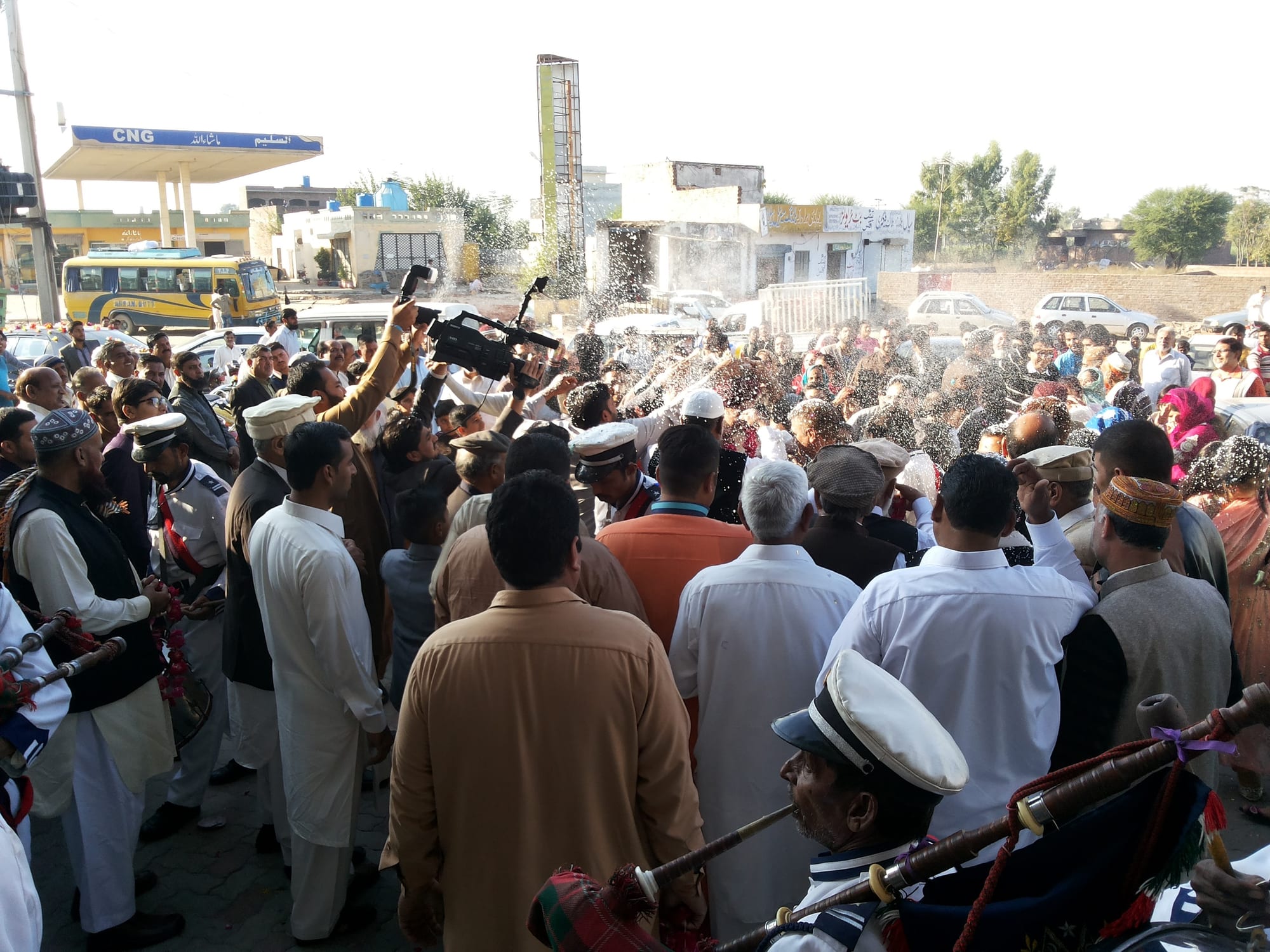
Weddings are the social highlight of most families' lives. Many marriages are still arranged by family elders, and even where young people choose their own partners, parental approval remains important. The busy season runs through the cooler months from November to February, a period nicknamed "Decemberistan", when weddings crowd the calendar. A wedding usually means at least three events and often more: a mayun, at which turmeric paste is applied to the bride; a mehndi, a night of henna, music and drumming; the nikah, the religious marriage contract; the baraat, the groom's procession to the wedding; the emotional rukhsati, when the bride leaves her family home; and the walima, a reception hosted by the groom's family after the marriage.
Birth is marked with religious ritual. In Muslim families the call to prayer is whispered into the newborn's ear, and many hold an aqiqah on the seventh day, when the baby's head is shaved, the name is announced and a sheep or goat may be sacrificed. Funerals begin with the janaza, the funeral prayer, which people make a point of attending as an act of religious merit. Mourning continues with gatherings for prayer and recitation of the Quran, notably the soyem on the third day and the chaliswan on the fortieth, and the death anniversary, the barsi, is also remembered. By custom, the bereaved household feeds the many relatives and neighbours who come to offer condolences, a practice some Pakistani commentators argue places too heavy a burden on grieving families.
Arts, crafts and music
The best-known sound of Pakistani devotion is qawwali, the Sufi devotional music traditionally performed at saints' shrines. Seated on the ground facing the saint's tomb, a lead singer, supporting soloists and a chorus sing poetry to the accompaniment of harmonium, tabla and hand clapping, the rhythm building steadily towards an emotional climax. In the late twentieth century, the Pakistani singer Nusrat Fateh Ali Khan carried qawwali from the shrine to concert halls and film soundtracks around the world while remaining, at heart, a traditional qawwali performer. Poetry is a national passion in its own right, and the country's official calendar honours its national poet, Muhammad Iqbal, with a public holiday.
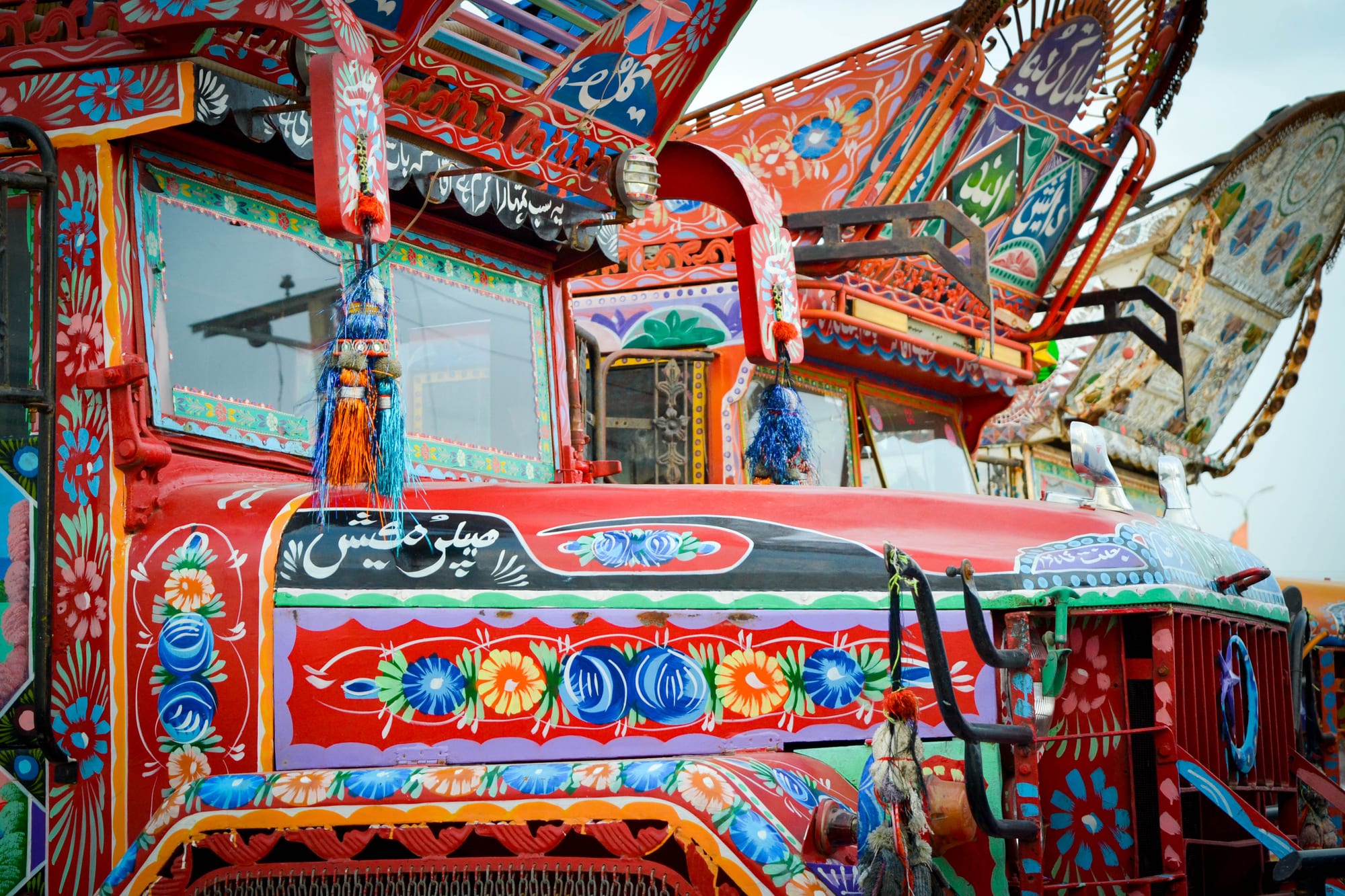
The country's most visible folk art travels on its roads. Pakistan's trucks, the backbone of its freight transport, are hand-painted and embellished with peacocks, lions, eagles, flowers, portraits, mirrorwork and embossed metal, while chains hanging from the bumpers jingle as the vehicles move. Many carry lines of Urdu poetry in flowing calligraphy, often on themes of separation and longing. Styles and motifs differ from one part of the country to another, owners compete to have the most eye-catching vehicle, and protection against the evil eye, in the form of black scarves, painted eyes or an old shoe hung from the bumper, is part of the design.
UNESCO recognises several of Pakistan's living traditions. Its list of heritage in urgent need of safeguarding includes the boreendo, an ancient folk musical instrument whose melodies and playing skills are in danger of disappearing, and Suri Jagek, a traditional meteorological and astronomical practice based on observing the sun, moon and stars. Pakistan also shares UNESCO recognition for falconry with other countries.
Dos and don'ts for visitors
- Do check the latest government travel advice before any trip; governments advise against all travel to Balochistan, to districts of Khyber Pakhtunkhwa near the Afghan border and to areas near the Line of Control, citing insurgency, terrorism and cross-border shelling.
- Do greet the eldest person first and ask after health and family, avoiding questions about female relatives unless the family is well known.
- Do wait for a woman to offer her hand before shaking it, and use the right hand for greeting, eating and passing things.
- Do remove shoes on entering a home, and accept the tea that will almost certainly be offered.
- Do dress conservatively, without shorts; women should carry a headscarf, and couples should avoid holding hands or other physical contact in public.
- Do avoid eating, drinking and smoking in public during daylight hours in Ramadan.
- Don't criticise religion or insult anyone in public; both cause deep offence, the blasphemy laws carry penalties up to death, and an accusation alone can provoke mob violence.
- Don't bring or drink alcohol: it is banned for Muslims, and only non-Muslims with a permit may buy it; drug penalties are severe and can include death.
- Don't photograph government buildings, military sites, infrastructure or airports, and ask permission before photographing people.
What to take away
In Pakistan, honour and hospitality are two sides of the same coin, and visitors who accept the tea, greet the elders first and treat faith with respect will find a warmth that is hard to match anywhere.