Culture & Customs · North Korea
North Korea: A Nation Choreographed
A state ideology that shapes almost every public ritual, older Korean customs kept alive in the home, and a set of strict rules for the few visitors ever admitted, from how to bow before a statue to how to hold a newspaper
By Worldlore Editorial · 30 September 2026
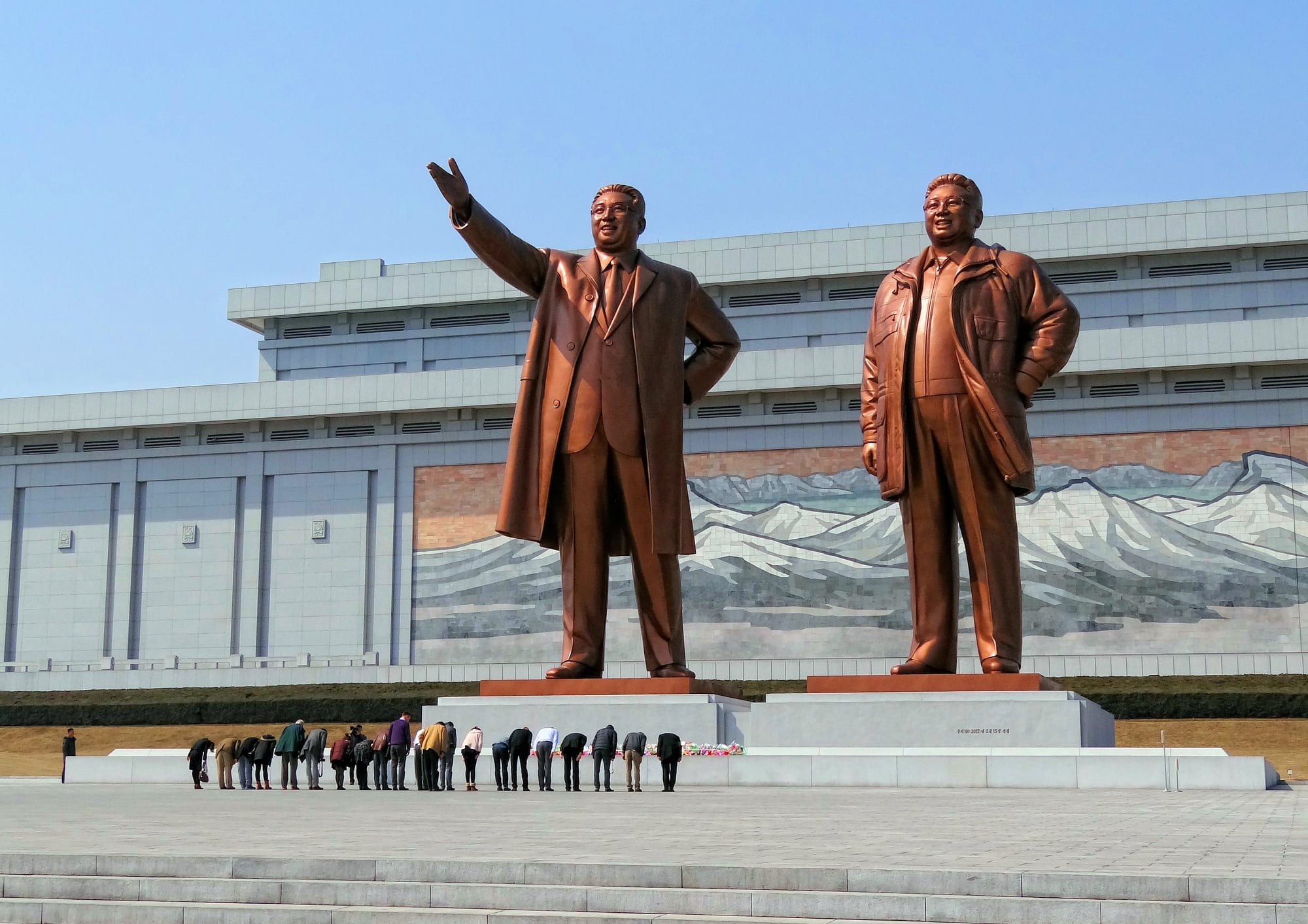
On Mansu Hill in Pyongyang, a small group of foreign visitors forms a line on the wide stone plaza. Above them stand two bronze figures, many times life size: Kim Il-sung, the country's founder, and his son Kim Jong-il. One member of the group walks forward to lay a bouquet at the base of the plinth, then returns to the line. Hats and sunglasses have been removed and jackets buttoned. At a quiet signal from the guide, everyone bows together. Tour operators describe the moment plainly: those who are not willing to bow are not taken to the monument at all. It is a small scene, but it captures how culture works in North Korea, where public life is closely choreographed by the state and even outsiders are expected to follow its steps. Worldlore covers North Korea so that it can be understood, not to encourage travel there. Much of what is known about the country comes from United Nations inquiries, human-rights organisations, defector testimony and specialist media, and it is presented here as reported by those sources.
Faith, identity and values
The organising belief of public life is loyalty to the ruling Kim family and to Juche, the state ideology of self-reliance. Daily NK, a Seoul-based outlet that reports from inside the country, describes the Ten Principles for the Establishment of the One-Ideology System as the closest thing North Korea has to a supreme law, taking precedence over the constitution in practice. First drawn up in the 1970s, they run to ten main articles and 65 sub-clauses, and are memorised by citizens. They set out, in detail, the loyalty and obedience owed to the leadership. Portraits of the first two leaders hang in homes, schools and workplaces, and adults are widely reported to wear a small badge bearing the image of one or both of them on the left breast. In 2024 officials were seen in public for the first time wearing badges showing Kim Jong-un, according to NBC News.
Religion occupies a narrow and closely watched space. The UN Commission of Inquiry, reporting in 2014, found "an almost complete denial of the right to freedom of thought, conscience and religion", and described state propaganda used to manufacture absolute obedience to the Supreme Leader. The same inquiry found that the state regards the spread of Christianity as a particularly serious threat. The US Commission on International Religious Freedom reports that a small number of state-controlled churches and a larger number of Buddhist and Chondoist temples exist, many of the temples maintained chiefly as heritage sites, but that independent religious practice is not tolerated. The UK Foreign Office warns visitors that promoting any faith carries very severe penalties.
Even the calendar has carried political meaning. From 1997 the state counted years from 1912, the birth year of Kim Il-sung, in the Juche calendar; in October 2024, according to The Korea Times, the official press quietly stopped using it, a change analysts read as a move to put more weight on the current leader's own authority. Beneath this official layer, older Korean habits persist: respect for age and seniority, the importance of family obligations, and the observance of folk holidays that predate the state by many centuries.
Greetings and meeting people
Everyday forms of address carry the stamp of the political system. Two words meaning "comrade" are used in place of many older titles: dongji for someone older or of higher standing, and dongmu for someone of equal or lower standing, often attached to a surname. Young Pioneer Tours likens their everyday use to the Australian "mate", a marker of familiarity as much as of politics. Age still shapes how people speak and behave with one another, and New Year brings sebae, the traditional bow of respect to elders. According to Liberty in North Korea, a group that works with North Korean refugees, this takes place on 1 January rather than at the lunar new year, and the usual greeting is a simple "congratulations on the new year".
Foreign visitors meet very few people outside their guides, hotel staff and officials. Guides accompany visitors almost everywhere, and unsanctioned conversations with residents are not permitted. Operators advise pointing with an open hand stretched towards a person or object rather than with a single finger, which is considered impolite and especially inappropriate towards the leaders' monuments. North Koreans are often described as private and wary of cameras, and permission should always be asked before anyone is photographed. The UK Foreign Office advises asking the guide before taking any picture at all.
Hospitality and being a guest
Visitors are almost never guests in a private home, so hospitality is experienced mainly at restaurants and hotel tables alongside guides and drivers. The etiquette follows the older Korean pattern. According to Young Pioneer Tours, people pour for others rather than for themselves, the host is served first, and a younger person clinks glasses below the rim of an older companion's glass as a mark of respect. Small gifts for hosts are appreciated though not expected; the same operator names bottles of spirits, beauty products and foreign cigarettes as common choices.
Behaviour at the country's political sites is far more formal than at the table. At the Mansudae Grand Monument, Koryo Tours lists no chewing gum, smoking, running, shouting or sitting on the ground. Photographs must show both statues in full, with no cropping and no selfies, and anyone posing in front of them is expected to stand with arms at their sides, without hand gestures. At the Kumsusan Palace of the Sun, where the embalmed bodies of the first two leaders lie in state, the rules are stricter still. Men wear a collared shirt and tie, women cover their shoulders and wear knee-length skirts or smart trousers, and denim is not allowed. Phones are switched off and photography is forbidden inside. In each chamber visitors bow at the feet and at both sides of the body, but not at the head, and the visit is conducted in silence. Operators describe the atmosphere as closer to a funeral than to a museum.
Festivals and life's big moments
The official calendar is built around political anniversaries, above all the birthdays of Kim Il-sung on 15 April and Kim Jong-il on 16 February, together with the founding days of the state and the ruling party. These are marked by mass rallies, flower offerings and performances. Folk holidays sit alongside them. At the lunar new year, Liberty in North Korea reports, people have a three-day break from work, families make rice cakes, dumplings and noodles, and play yut, a board game using four wooden sticks thrown like dice, while local authorities organise kite flying and top spinning. The same source says that on New Year's morning people are expected to visit statues or portraits of the leaders before calling on local officials.
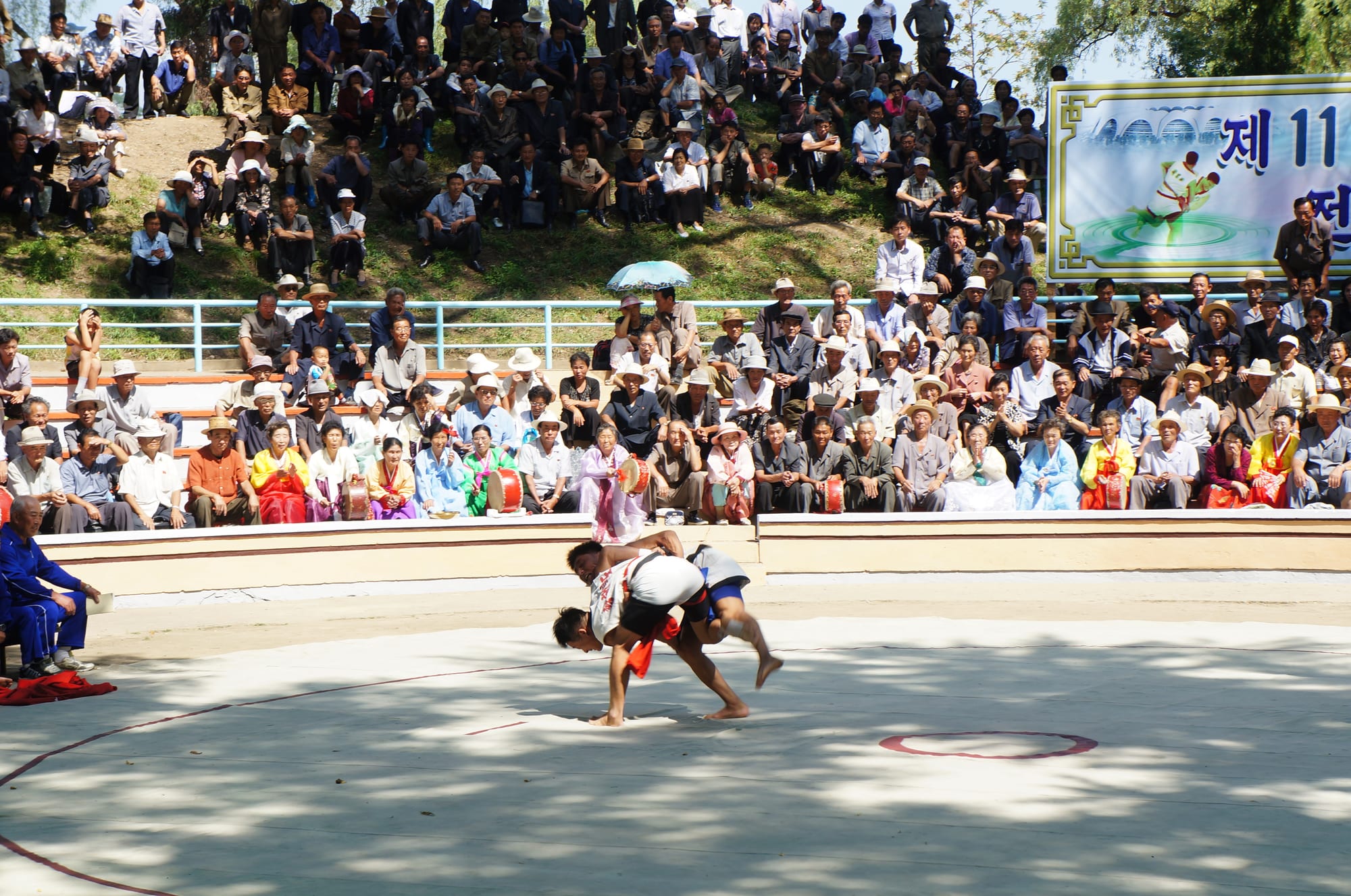
Chuseok, the autumn harvest festival, has traditionally been the day for honouring ancestors: food is laid out in memorial rites and families climb to hillside graves to tend them. Daily NK reported in 2024 that a government order to remove hillside graves and cremate remains, officially to restore the forests, had moved many of these rites indoors. Folk holidays have also long been occasions for ssirum, the Korean wrestling in which opponents grip a cloth strap tied around the waist and thigh. According to UNESCO, the winner traditionally receives a bull, and in 2018 the two Koreas were inscribed together for the first time on UNESCO's list with a joint nomination for the sport.
Family milestones remain important despite economic pressure. Weddings have traditionally included a feast given by each family and outdoor photographs of the couple, often watched by neighbours, though Daily NK reports that many young people now rent their wedding clothes, hold a single small reception or skip the photographs to save money. A 60th birthday is a major occasion marked with a feast for relatives and friends; failing to hold one is still widely seen as a lapse in filial duty, and businesses that rent out table settings for weddings and birthday feasts continue to do well. Funerals, according to Daily NK, are usually held at home over three days, sometimes shortened to one or two, with men wearing black armbands and women white ribbons. Neighbours and colleagues once helped the bereaved family with the arrangements, a custom said to be fading as more of the process has to be paid for.
Arts, crafts and music
The arts are directed by the state and overwhelmingly devoted to its themes, but many draw on older Korean forms. Arirang, the folk song with its familiar refrain, is on UNESCO's list for North Korea. UNESCO describes it as a lyrical song of parting and reunion, sorrow and joy, learned by children from parents and neighbours and sung at family gatherings and festivities, as well as in symphonic arrangements by professional troupes in Pyongyang.
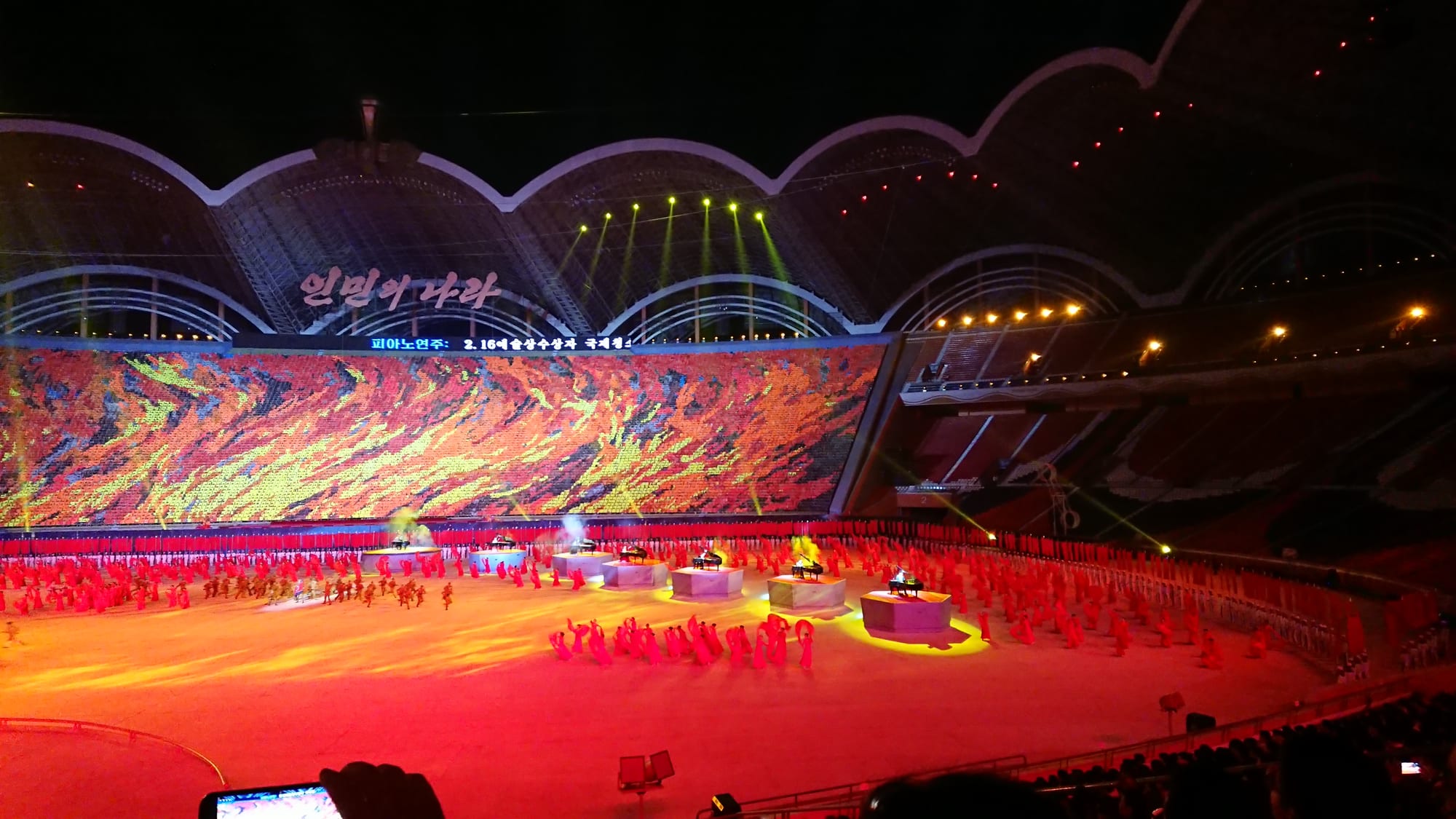
The best-known spectacle is the Mass Games, a display of synchronised gymnastics, dance and song performed by tens of thousands of people. According to Koryo Tours, the Arirang Mass Games ran most years from 2002 to 2013, and after a pause returned in 2018 as "The Glorious Country", followed in 2019 by "People's Country". Popular music is also shaped from above. The Moranbong Band, an all-female group formed in 2012 at the direction of Kim Jong-un, performs synthesiser-backed songs in praise of the country and its leader, in the tradition of earlier state ensembles. Foreign music and film, by contrast, are banned. Human Rights Watch has documented long labour sentences for people caught sharing South Korean films.
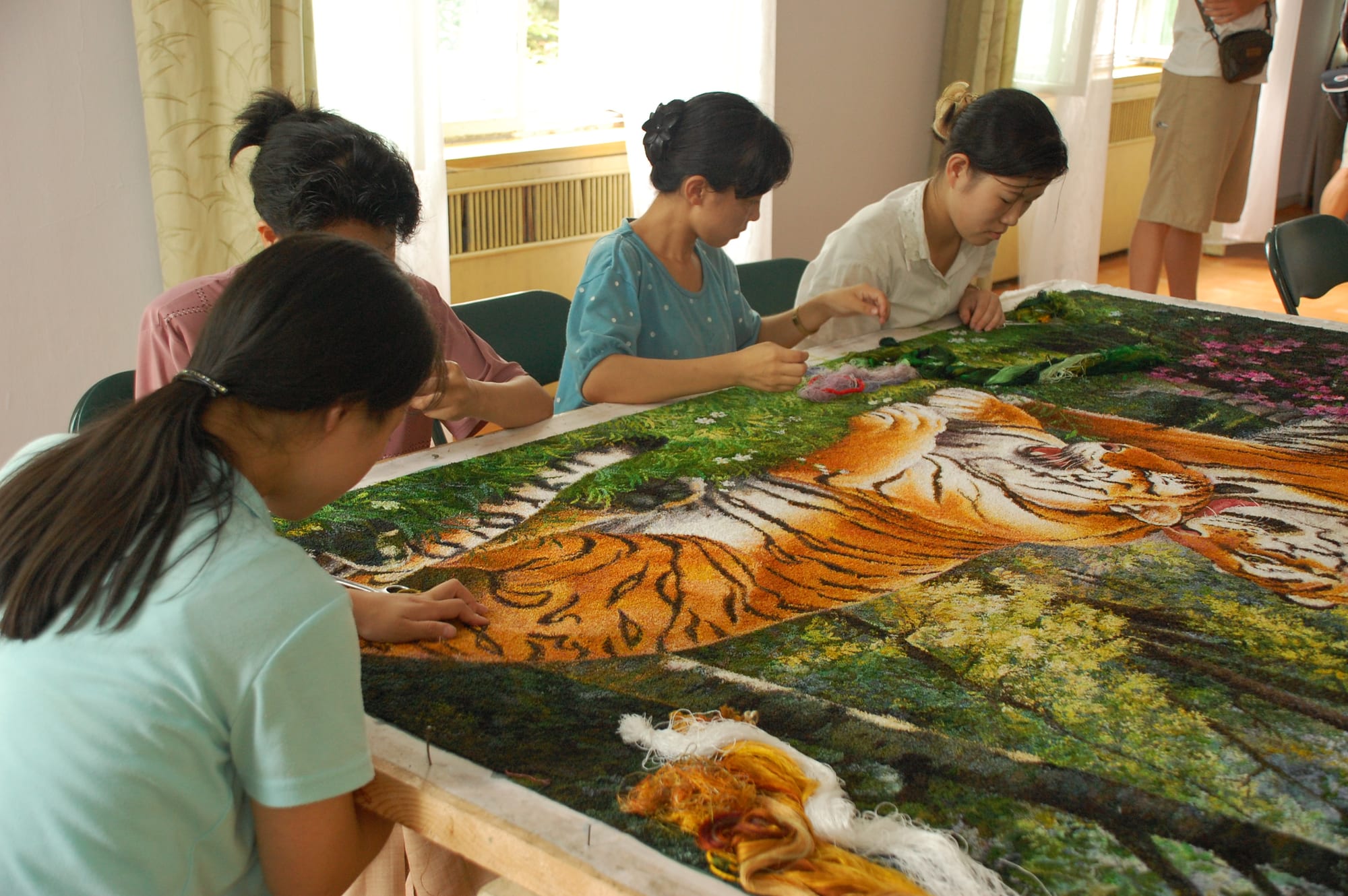
The visual arts are dominated by the Mansudae Art Studio in Pyongyang, founded in 1959. The Korea Herald describes it as one of the largest art production studios in the world, with around 4,000 workers, a quarter of them artists, producing monuments, mosaics, paintings and posters. Its exports of statues were sanctioned by the UN in 2016. Older crafts continue alongside it. The custom of Korean costume, added to UNESCO's list in 2024, covers the knowledge of designing, cutting, sewing and embroidering the traditional jacket, skirt and trousers, which are worn for birthdays, weddings, festivals and holidays. UNESCO notes that women are its leading practitioners and that the skills pass from experts to apprentices in costume workshops. Embroidery is also practised as a fine art in its own right. Kimchi-making and the Pyongyang raengmyon noodle custom are among North Korea's other entries on the UNESCO list.
Dos and don'ts for visitors
- Do check the latest government travel advice before any trip; most governments advise against all travel to North Korea, US citizens are barred from travelling there, and tourism has been almost entirely closed since 2020, apart from small Russian groups since 2024 and a brief reopening to other foreign tourists, in Rason only, in February and March 2025.
- Do stay with the assigned guides and within permitted areas at all times, and follow the instructions of the tour operator and the local authorities.
- Do handle any image of the leaders, including in newspapers and books, with care; the UK Foreign Office warns that foreigners may be arrested for failing to show sufficient respect.
- Do join the group bow at the leaders' monuments, with hats and sunglasses off, arms at the sides and both statues kept whole in any photograph.
- Do dress formally for the Kumsusan Palace of the Sun, switch phones off and remain silent inside.
- Do ask the guide before taking any photograph, and never point a camera at officials, soldiers or guarded buildings.
- Don't joke about the political system or its leaders, and don't bring in material to promote any religion or belief.
- Don't point with a finger; gesture with an open hand, and at the table pour for others rather than for oneself.
What to take away
North Korea's customs are, to an unusual degree, set by the state rather than simply inherited, yet beneath the choreographed public rituals older Korean habits of family duty, seasonal festivals and respect for elders persist in the home.