Culture & Customs · Libya
Libya: Under the Father's Cloak
A Sunni Muslim society shaped by Sufi lodges and desert peoples, where hospitality is an obligation, a length of woven wool marks both weddings and funerals, and good manners start with patience
By Worldlore Editorial · 30 September 2026
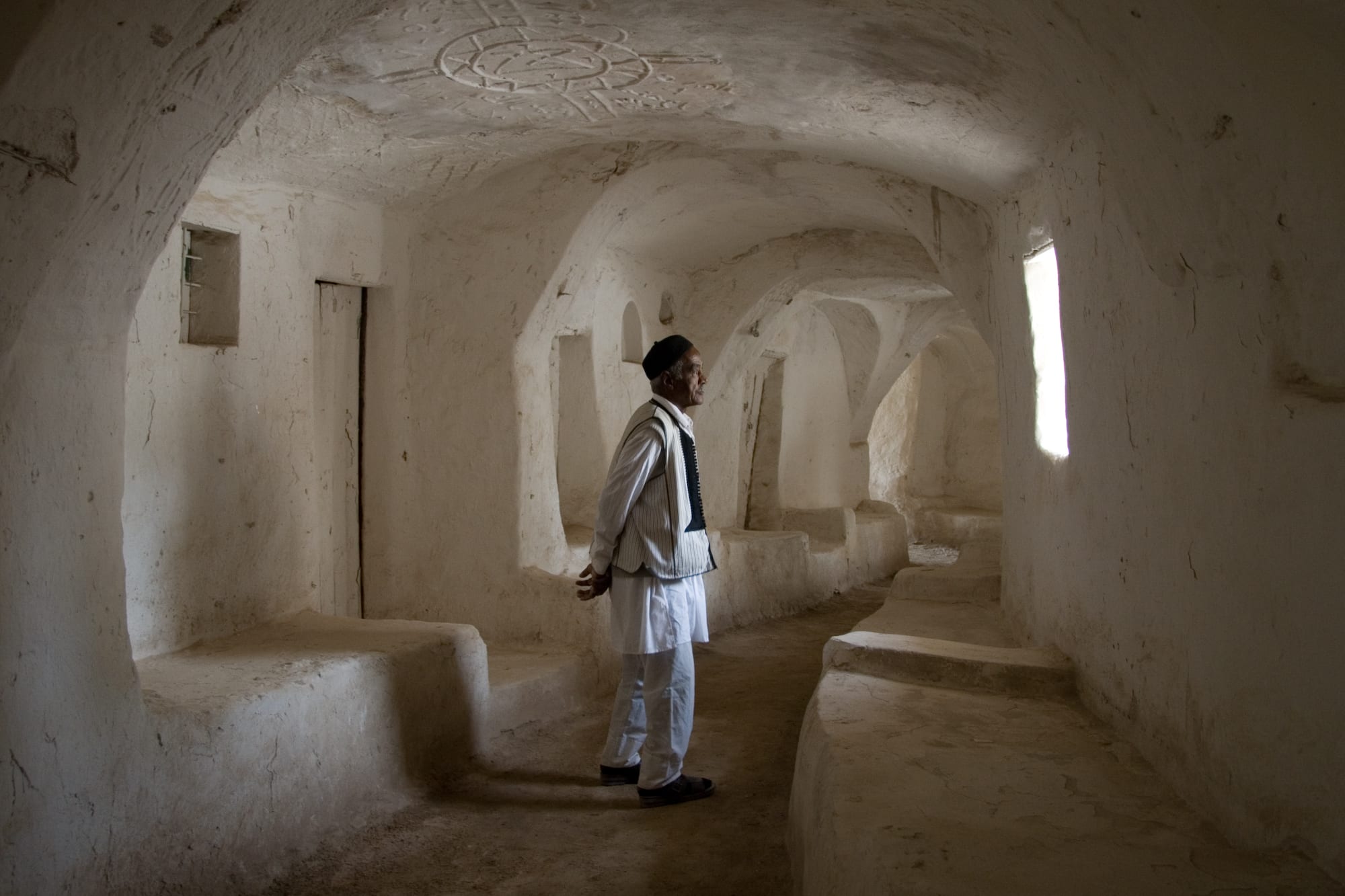
On the day a Libyan bride leaves her parents' home, one old custom asks her father to hold up his jard, the long cloak of woven wool that Libyan men have worn for centuries, so that she can pass beneath it on her way to her new life. The gesture takes a moment and needs no words. The same length of cloth appears at the other end of life, too: at a man's funeral, it is customary for his coffin to be covered with a jard. Between those two moments sits much of what Libyans value — family as a source of protection, continuity with the past, and a sense that the most important occasions should be marked in the same way that parents and grandparents marked them.
Faith, identity and values
Islam is the foundation of public and private life. According to the US State Department, between 90 and 95 per cent of Libyans are Sunni Muslims and between 4.5 and 6 per cent are Ibadi Muslims, many of them from the Amazigh (Berber) minority; nearly all non-Muslim residents are foreigners. Libya has traditionally followed the Maliki school of Islamic law, the school that predominates across North Africa. Beyond the rules of worship, the faith is understood to carry a code of conduct built on generosity, fairness, honesty and respect for others, and it forbids alcohol, pork, gambling and usury. Alcohol is illegal in Libya, and missionary work and conversion away from Islam are effectively prohibited.
Sufism has shaped Libyan religious life for centuries. In the traditional understanding, holy men and women possess baraka, a personal blessedness that could be passed on and that was believed to remain at their tombs after death, so the burial places of saints became places of veneration. Disciples gathered around teachers of a particular devotional path, or tariqa, forming brotherhoods centred on a lodge called a zawiya. The most forceful of these, the Sanusi order, spread across much of North Africa in the nineteenth century and became especially powerful in the east of the country. Today the Sufi tradition is contested: the US State Department reports that Salafist groups have targeted Sufi holy sites and leaders, and that in 2023 a government religious authority ordered imams to warn against celebrating the Prophet's birthday with dancing, drumming and chanting.
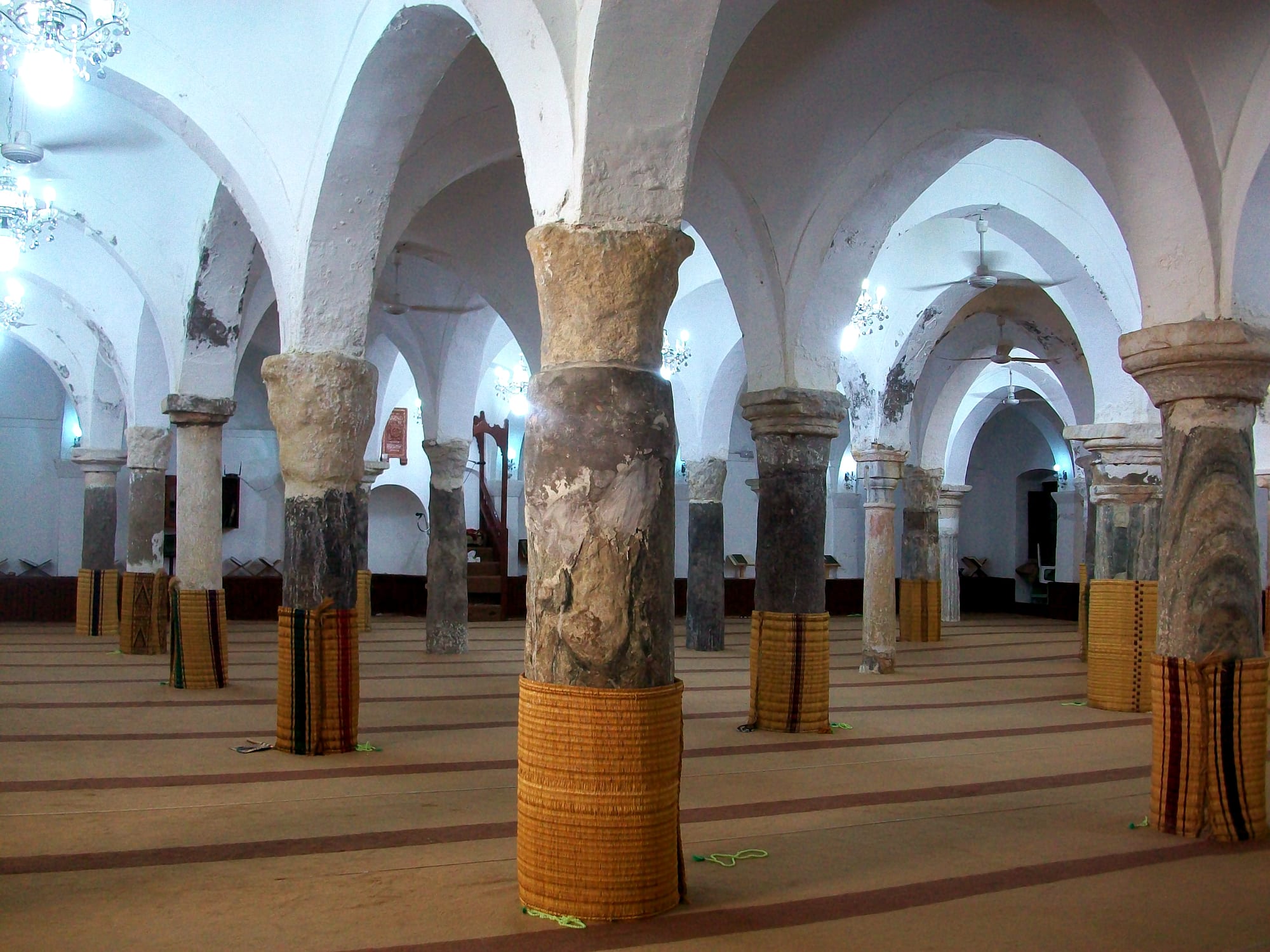
Family sits close behind faith as a marker of identity. In the traditional pattern, a bride went to live in the household of her husband's family, and a family's reputation was felt to belong to all of its members, so that the conduct of one reflected on everyone. Modesty, charity and responsibility towards relatives remain widely respected values. National life has been unsettled since 2011, and since 2014 rival administrations in the west and east of the country have competed for authority; this article leaves the politics aside and concentrates on the customs that most Libyans share.
Greetings and meeting people
Greetings matter, and they are not hurried. The standard Arabic greeting, "as-salamu alaykum" ("peace be upon you"), is answered with "wa alaykum as-salam" ("and upon you be peace"), and it is often followed by a friendly run of enquiries about health, family and general well-being. Men usually greet one another with a handshake, and eye contact is valued but kept natural rather than intense or prolonged.
Between men and women more care is needed. A man should wait for a woman to offer her hand before attempting to shake it; if she does not, a nod and a spoken greeting are entirely respectful. Objects, gifts and food are passed with the right hand, or with both hands, as a mark of respect.
Time tends to be treated more fluidly than in much of Europe, and meetings and appointments do not always begin at the stated hour. Discussions may start late or run on beyond their expected end, and the word bukra, "tomorrow", can describe a flexible intention rather than a literal deadline. Visitors are still expected to arrive on time. Friday is the main day of congregational prayer, and meetings are arranged around it; banks generally open from Sunday to Thursday, with Friday and Saturday as the weekend.
Hospitality and being a guest
Hospitality towards guests is treated as a genuine obligation rather than a pleasant extra, and a visitor to a home or office can expect to be offered tea or coffee soon after arriving, and accepting is itself seen as a sign of courtesy. The drink is less about refreshment than about making room for conversation, and the relationship that grows over it matters more than any business that follows.
Guests invited to a Libyan home usually bring a small gift. Sweets, pastries or fruit are the safest choice, and a modest item from the visitor's own country is also welcome. Alcohol and pork products should never be offered, as both are forbidden by Islamic dietary law, and alcohol is also illegal. Modest, conservative clothing is the norm in public, particularly for women, and it is equally appropriate when visiting a family home: shoulders, chest and legs are kept covered.
Ramadan asks more of everyone. Non-Muslim visitors are expected to respect the fast in public: the UK government advises against eating, drinking, smoking or even chewing gum in public during daylight hours, including inside a car, and against playing loud music or dancing. It also notes that clothing seen as inappropriate may cause particular offence during the month.
Festivals and life's big moments
The religious calendar sets the rhythm of the year. After Ramadan comes Eid al-Fitr, the feast that ends the fast, and some two months later Eid al-Adha, the Feast of the Sacrifice. For Eid al-Adha, families that can afford it buy a sheep, or sometimes a goat, cow or even a camel, and sacrifice it in remembrance of Abraham's willingness to obey God. The meat is divided into three parts: one for the poor, one for relatives and one for the household. Livestock markets on the edges of the cities fill in the days beforehand, and in recent years high prices and cash shortages have made the tradition a real strain on family budgets.
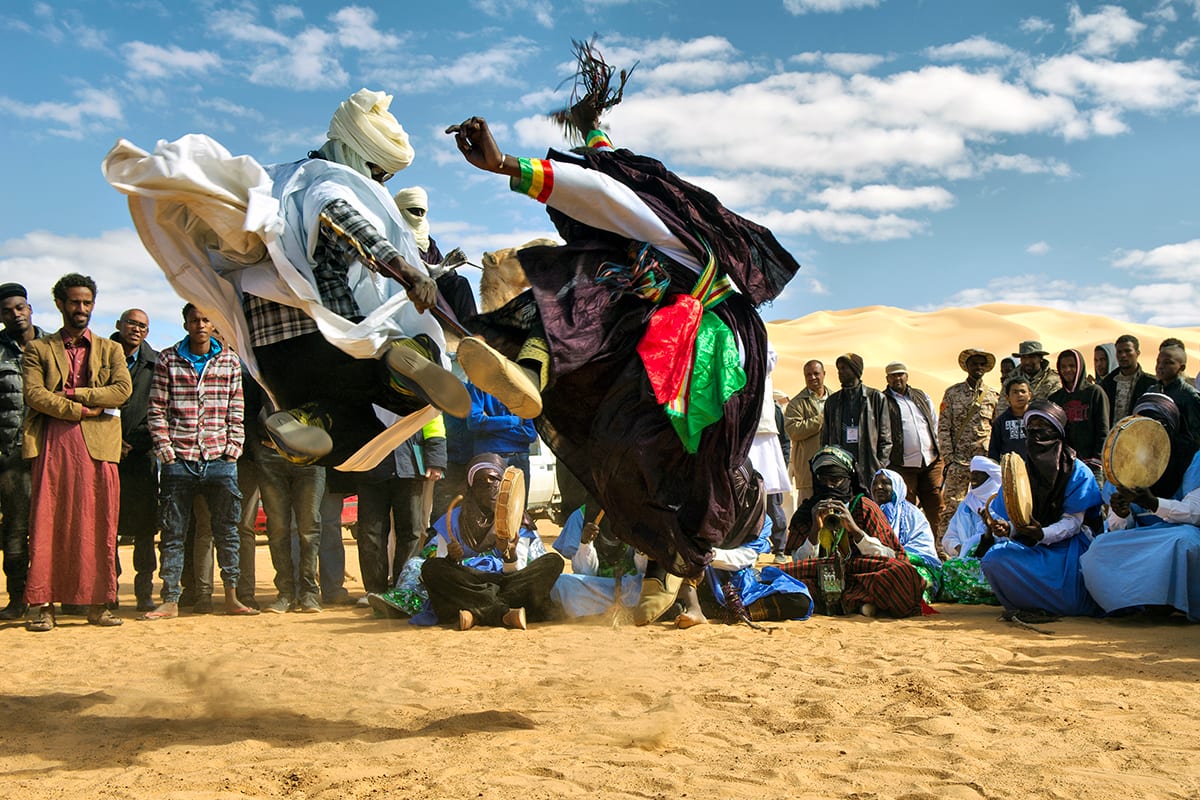
Mawlid, the birthday of the Prophet Muhammad, is a public holiday and one of the country's most distinctive celebrations. Sufi groups, dressed in traditional finery, process with drums and cymbals, singing hymns and chants, while young people mark the night with fireworks set off in the streets. It is also a celebration under pressure: in the capital the procession was suspended for several years over security fears before returning in 2018, and a government religious authority now discourages it. In the Saharan south, Tuareg communities hold festivals of traditional dance, song, handicrafts and camel racing.
Weddings are the great social occasions of Libyan life, and their customs vary from region to region. Common threads run through most of them, though. The bride's hands are decorated with henna, and for a pre-wedding party she wears traditional dress. Musical groups, including the women's singing bands known as zimzamat, provide the entertainment, and the celebrations bring together every age group. Traditional bridal costume is embroidered with silver and gold thread and worn with gold jewellery, and it is customary for the groom to give his bride the outfit and its gold. Many celebrations are now held in wedding halls, which often have one stage for the band and another for the bride and groom.
Funerals are marked with equal seriousness, and attending both kinds of occasion is seen as a social duty, so it is not unusual to go to a wedding and a funeral on the same day. Mourning gatherings traditionally last for three days, if not longer, as relatives, neighbours and friends call on the bereaved family to offer condolences. The atmosphere is subdued, and women attending generally dress plainly rather than in the finery of a wedding, and food is served to those who come to pay their respects.
Arts, crafts and music
The best-known strand of Libya's classical music is ma'luf, a repertoire of sung poetry arranged in suites, which its performers regard as old heritage descended from the Muslims and Jews expelled from Spain at the end of the Middle Ages. Scholars distinguish the ma'luf of the Sufi lodge, sung as devotion, from the ma'luf of the radio and concert hall. The turning point came in 1964, when the musician Hassan Araibi directed the first modern ma'luf ensemble, which gave its first public performance in Tripoli that November; he went on to lead a government-supported group until his death in 2009. Debates about whether the repertoire is now fixed, or whether new pieces can still legitimately be added to it, continue among its performers.
Textiles carry as much meaning as music. The jard, a single piece of fabric roughly four to six metres long and one and a half metres wide, is wrapped around the body from a small ring knotted in the cloth, no bigger than an apricot and called a tukumia: the cloth is wound around the left arm, leaving the right arm free, and the rest is drawn up over the head. In the past, not knowing how to wrap it properly was considered shameful. The garment was traditionally woven at home by women on a hand loom called a masda, a task that could take up to a year and was often shared with neighbours over tea, songs and poetry. Customs surrounded the work: weaving was not done at night, and it paused for a time after a death in the neighbourhood. Today the jard is worn mainly at festivals and on special occasions, and it is closely associated with the resistance leader Omar al-Mukhtar, who was captured and executed wearing one.
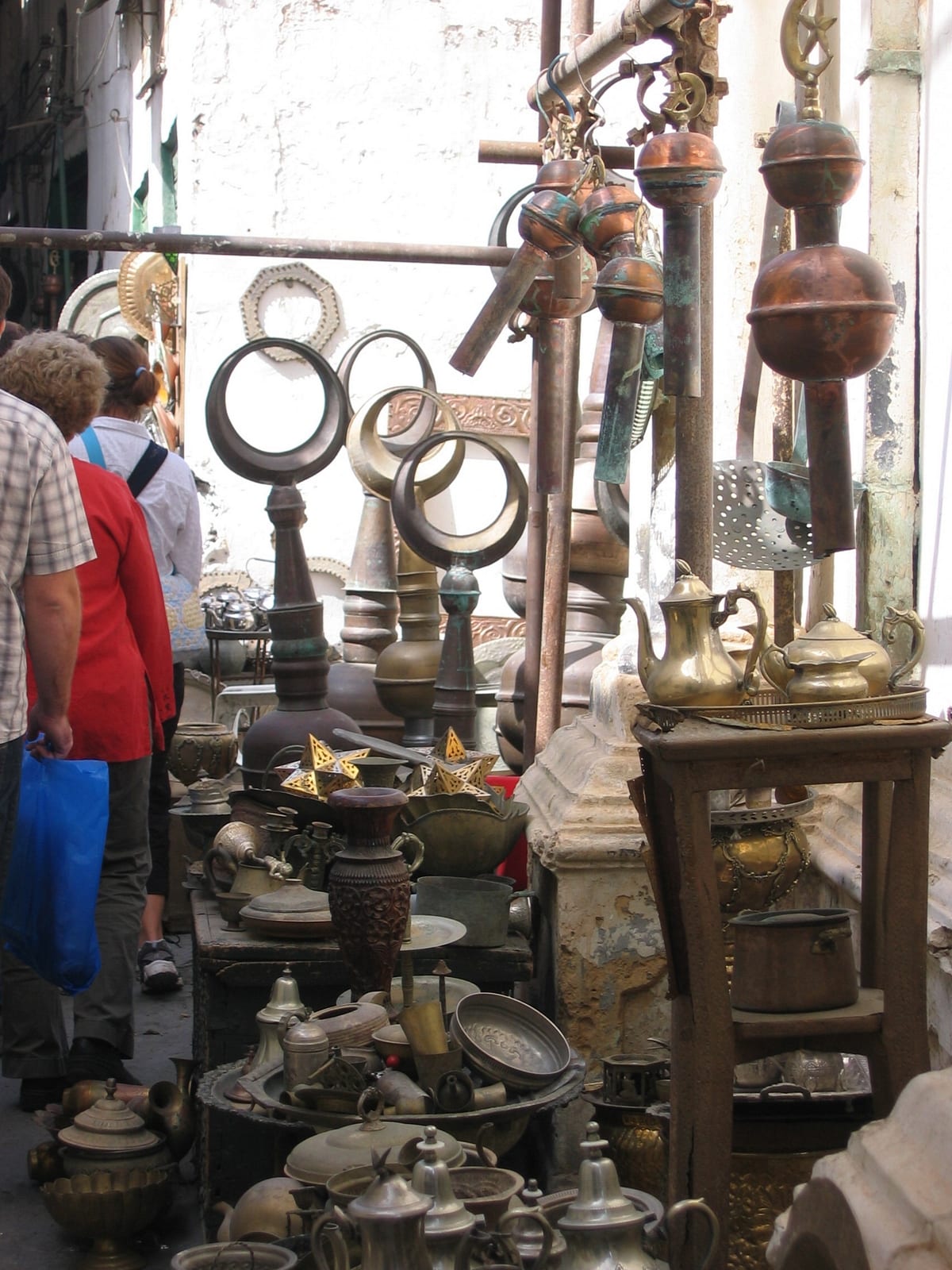
For formal occasions, the most common traditional costume for men is the farmla, a waistcoat heavily embroidered with silver or gold thread. Jewellery has its own symbolism. The large brooches that women once used to fasten their robes, traditionally made of silver and now more often of gold, are frequently decorated with the khamsa, a hand-shaped motif believed to ward off the evil eye.
Dos and don'ts for visitors
- Do check the latest government travel advice before any trip; most governments advise against all travel to Libya because of armed conflict, terrorism, kidnapping and crime.
- Do dress modestly and conservatively in public, particularly during Ramadan.
- Do wait for a woman to offer her hand before shaking it; a nod and a spoken greeting are a respectful alternative.
- Do accept tea or coffee when it is offered, and pass food, gifts and other objects with the right hand or both hands.
- Don't eat, drink, smoke or chew gum in public during daylight hours in Ramadan, including in a car.
- Don't bring alcohol or pork into a Libyan home, even as a gift; alcohol is illegal in Libya.
- Don't photograph people without asking first, and never photograph government buildings or military sites.
What to take away
Libyan customs rest on faith, family and an old sense of obligation to the guest, and visitors who meet them with modesty and patience will find that the welcome is sincere, even in difficult times.