Culture & Customs · Laos
Laos: Gentle Voices and White Threads
A Buddhist country that still honours its spirits, a greeting made with palms pressed together, and a way of life built on keeping the peace, saving face and never raising the voice
By Worldlore Editorial · 30 September 2026
A family gathers on the floor of a wooden house around a tall arrangement of flowers and banana leaves, hung with dozens of short white cotton strings. An elder murmurs a blessing. Then, one by one, relatives and friends take a string, lean in, and tie it around the wrist of the person being honoured, adding a quiet wish for health and good fortune as they knot it. Someone may be leaving on a journey, or coming home, or getting married, or simply being welcomed as a guest. Nobody hurries and nobody raises their voice. The baci, as the ceremony is known, gathers much of Lao culture into one scene: Buddhist calm, older beliefs about the spirit, a deep attachment to family and community, and a gentle, unhurried warmth towards anyone who arrives.
Faith, identity and values
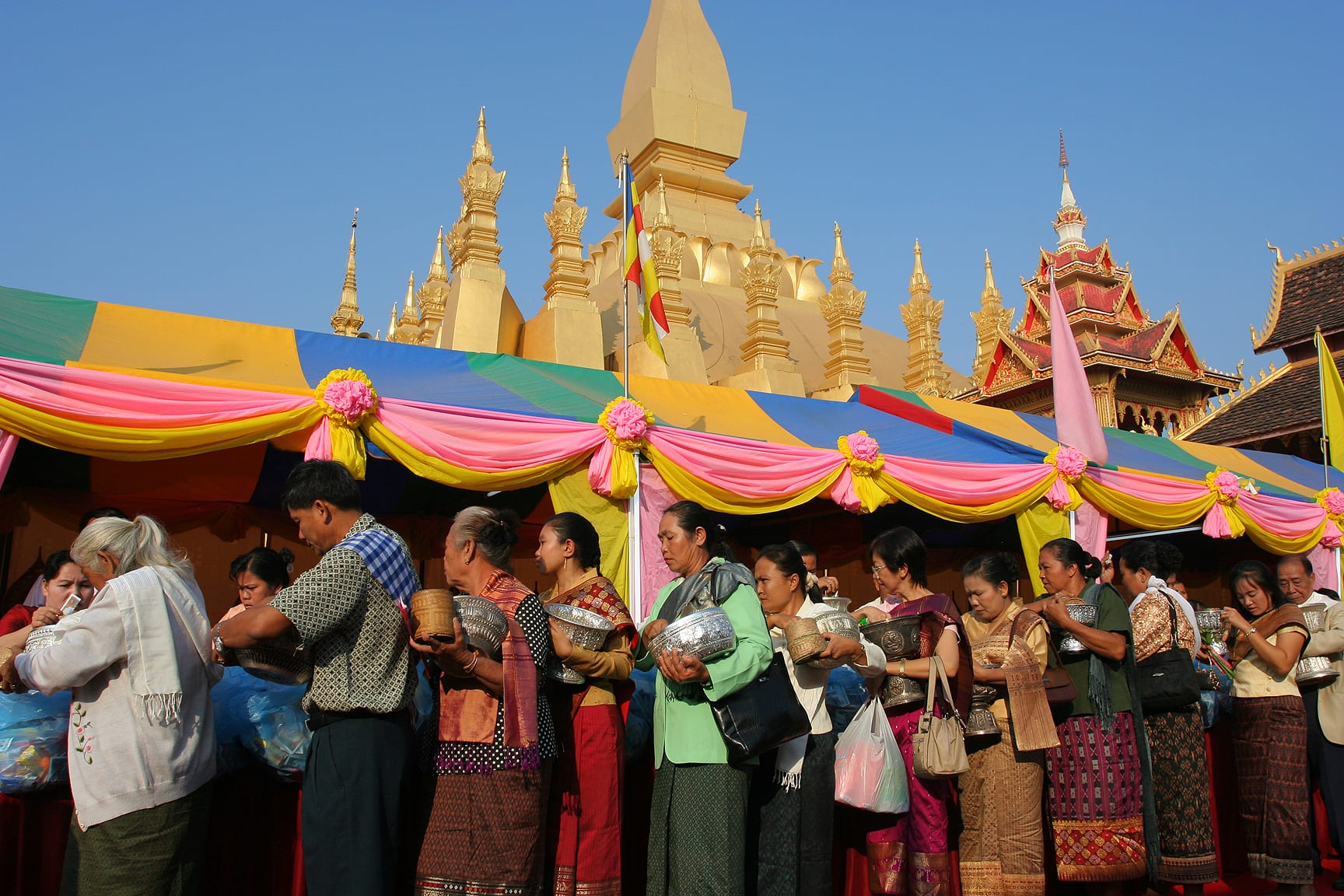
About two-thirds of Lao people are Theravada Buddhists, and the faith sets the rhythm of the year and of community life. Its centre is the Triple Gem: the Buddha, understood as a teacher rather than a god, his teaching, the dhamma, and the Sangha, the community of monks. The temple, or wat, is far more than a place of worship. It is where villages hold their festivities and rituals, where people seek blessings at the turning points of life, and where monks give counsel and lead ceremonies. Many young Lao men spend a period as novices or monks, which is believed to bring merit to themselves and their families. Merit-making runs through everyday religious life, most visibly in the morning alms round, when laypeople remove their shoes and kneel to offer food to monks as they pass.
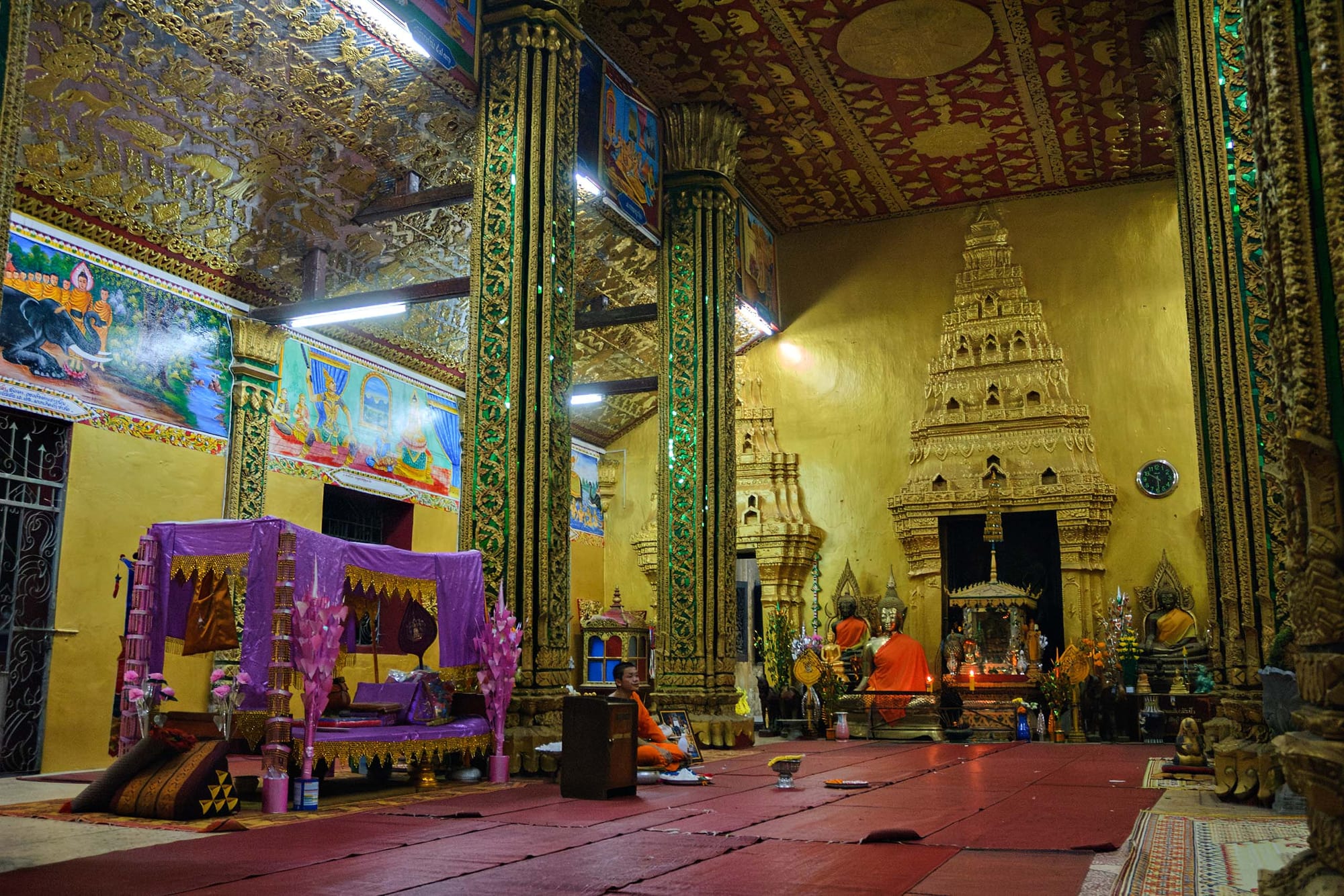
Buddhism in Laos lives comfortably beside a much older belief in spirits, known as phi. Spirits are thought to inhabit buildings, land, natural places and the ancestral line, and many homes and businesses keep a small spirit house that receives daily offerings of food and flowers. For most Lao it is not a question of Buddhism or spirit worship; the two simply coexist. Laos is also a country of many peoples, and alongside the Buddhist lowland majority, upland communities keep their own languages, dress and ancestral or animist traditions.
Beneath the religious life lie a handful of values that shape how people behave. Harmony comes first: conduct is reserved and considered, and open displays of anger or frustration are avoided because they disturb the peace of the family and the community. Closely tied to this is face, the sense of dignity and reputation that compliments and respect give, and that criticism, public correction or a raised voice can take away. The much-loved expression bo pen nyang, roughly "never mind" or "no problem", captures an attitude of acceptance and contentment, a refusal to let setbacks spoil the moment. Alongside it sits muan, a sense of fun that brings laughter and playfulness into ordinary tasks.
Greetings and meeting people
The everyday spoken greeting is sabaidee, and the question sabaidee bor, "are you well?". Among friends and neighbours, greetings can take the form of friendly questions: "have you eaten?" or "where are you coming from?", which work much like an enquiry about someone's day rather than a request for information.
The traditional gesture is the nop: the palms are pressed together in a prayer-like position at chest height, often with a slight bow. How high the hands are held signals the respect intended: the higher the hands, the greater the respect, with the highest positions kept for monks and elders. The younger or more junior person usually makes the nop first. Handshakes are used informally, most often between men, but touch between acquaintances is kept to a minimum, and public affection between men and women is rare.
Titles matter. People of high standing are addressed with the honorific thaan before their name, and teachers, doctors and police officers by their professional title; for others, terms based on age and gender are used, while friends of the same age use first names or nicknames. The most senior person present is usually greeted first. Communication is soft and indirect: a direct refusal may be avoided in favour of a noncommittal answer, a "yes" can mean anything from agreement to a polite no, and disagreements are often settled through an intermediary rather than face to face. To beckon someone, the hand is held palm down with the fingers curled towards the body, and anyone who has to pass between people asks permission and dips their head as they go.
Hospitality and being a guest
Lao people are hospitable, but they generally prefer to know when someone is coming, and in the countryside a family may send a child ahead to announce a visitor. The best times to call are after a meal or at the weekend. Shoes come off before entering a home or a temple, and at a house raised on stilts they are left at the foot of the stairs. Guests sit on cushions or low seats on the floor; men usually sit cross-legged, while women sit cross-legged or with their legs tucked to one side. Whatever the position, the soles of the feet should never point at anyone, and feet do not go on tables or pillows.
The body carries a clear hierarchy. The head is regarded as sacred, so touching someone's head, even a child's, is deeply disrespectful. The right hand is used to give and receive, and handing something over with the left hand alone is taboo. When serving, a host may squat so as to stay below the eye level of a seated guest, a small but telling sign of respect.
A drink and something to eat are offered as a welcome, and accepting at least a little honours the host. Meals are shared rather than served individually, with dishes placed in the middle for everyone.
Gifts are not expected on a casual visit, but they are welcome from a first-time visitor or on a special occasion. They are offered with the right hand while the left hand supports the right elbow, and are usually not opened in front of the giver. Monks have their own etiquette: women do not touch a monk or hand anything to him directly, and instead pass the item through a man or set it down for him to take.
Festivals and life's big moments
The Buddhist lunar calendar sets most of the festival year. The biggest celebration is Pi Mai Lao, the Lao New Year in mid-April, a festival of purification. Buddha images in homes and temples are washed with scented water, people build small stupas of sand in temple grounds, strings are tied around wrists, and the country turns out for good-natured water throwing. Over the full moons of the year come the great Buddhist days, including Visakha Bucha, marking the Buddha's birth, enlightenment and death, when people walk around the temple in the evening carrying candles, incense and flowers in the candlelit procession known as wien tien. Around May, Boun Bang Fai, the rocket festival, sends home-made rockets into the sky to call the rains before the rice is planted.
Usually in July, Boun Khao Phansa marks the start of Buddhist Lent, three months in which monks stay in their temples. In the months that follow, two festivals are devoted to the dead. At Boun Khao Padab Din, families rise before dawn to make small parcels of rice, fruit, flowers, candles and incense and set them out at temples, stupas and sacred trees for ancestral spirits and for souls with no family to feed them; at Boun Khao Salak, offerings are made to monks in the names of departed relatives. Lent ends with Boun Ok Phansa, when small floats of flowers, incense and candles are set adrift on the rivers at night, to honour the water spirits and carry away the bad luck of the year.
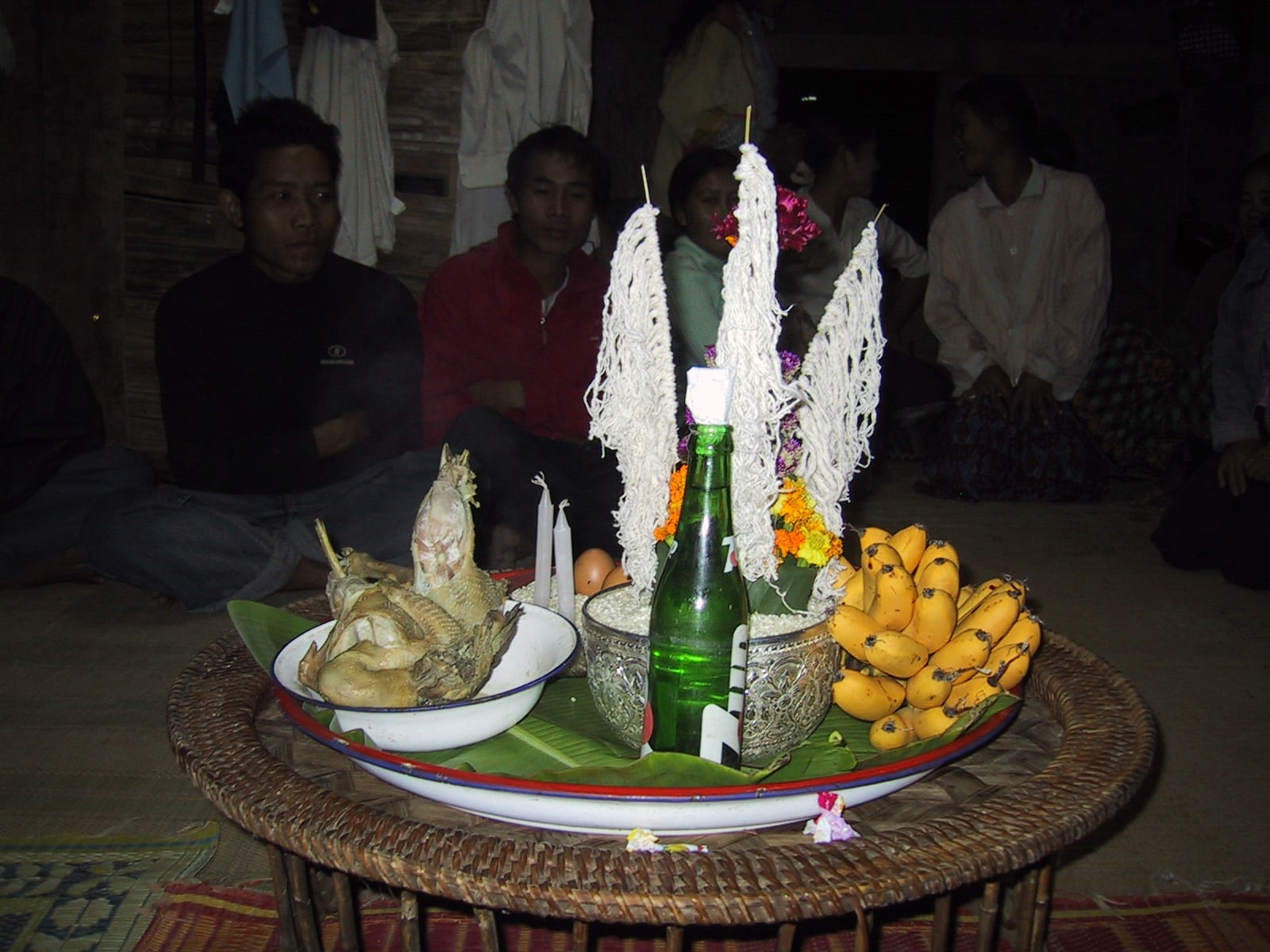
The baci ties many of life's big moments together. It is held at transitions, such as a birth, a marriage, a departure or a young man's entry into the monkhood, as well as to welcome guests, at the harvest and at New Year, and its white strings are tied on to keep good fortune close to the person and call their spirit home. At a wedding, the groom's family traditionally travel in procession to the bride's house, carrying bowls decorated with flowers and banana leaves that hold the bride price in cash or jewellery. The groom takes off his shoes before entering, and family elders then conduct the baci, tying strings around the couple's wrists to unite them and bless the marriage, before the celebrations move on to food, music and dancing.
Funerals are Buddhist occasions, with monks invited to chant and relatives making merit on behalf of the dead. The dead are remembered long afterwards: merit is dedicated to them by lighting a candle and incense and pouring water after giving alms, a practice that continues through the ancestral festivals of the year.
Arts, crafts and music
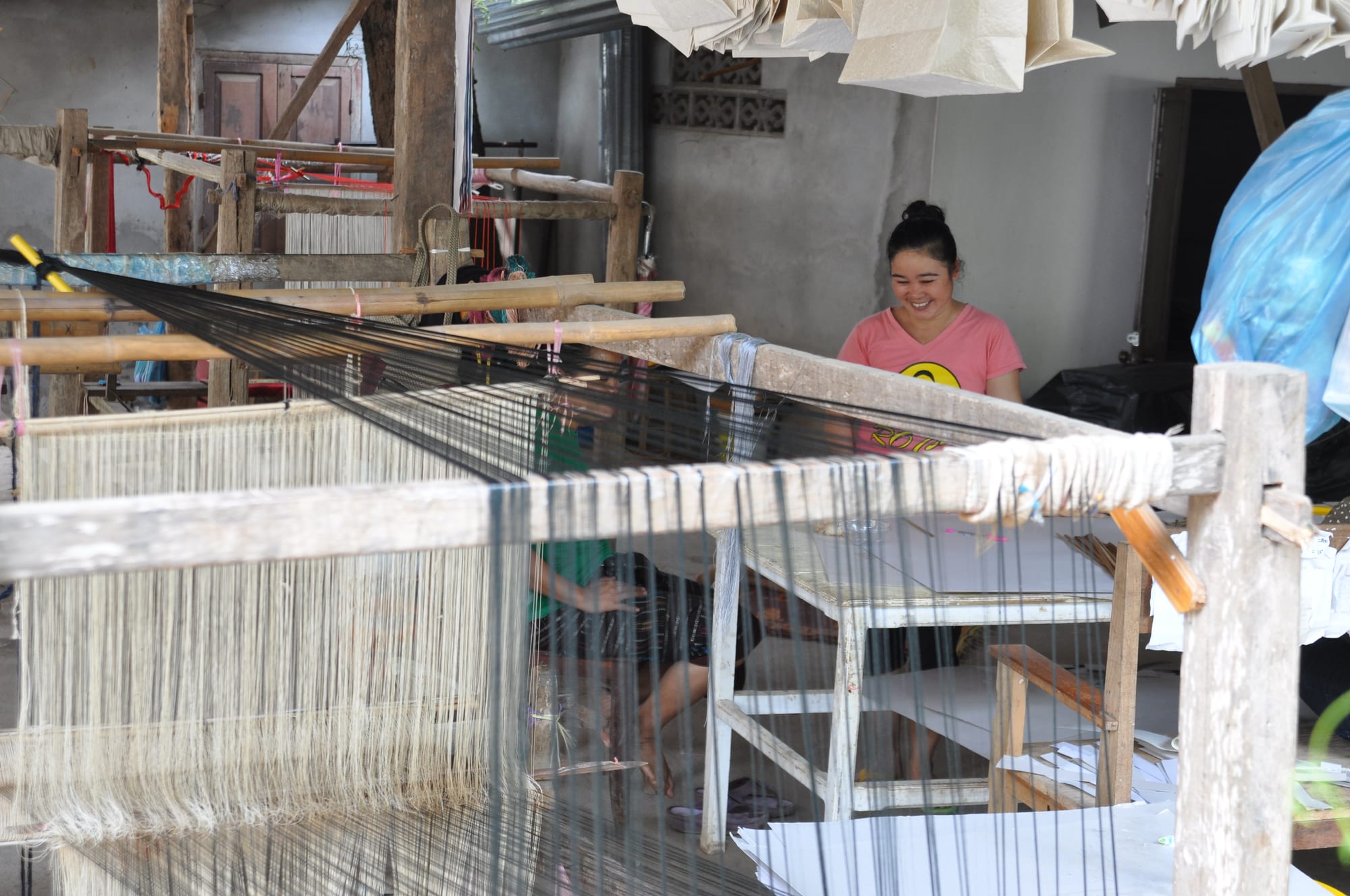
Weaving is the craft most closely bound up with Lao identity. Women have long woven silk and cotton on wooden looms, passing the skills down through families, and the finest pieces carry patterns built up in the weave itself rather than embroidered or printed afterwards. The most important motif is the naga, a mythical serpent of the rivers regarded as an ancestral guardian. Naga patterns follow people through life, appearing on cloths for babies, on everyday and ceremonial dress and on wedding clothes. The craft of naga motif weaving has been on UNESCO's list since 2023 of intangible cultural heritage, and woven textiles, above all the sinh, the tube skirt worn by Lao women, remain part of formal and festive dress.
The sound of Laos is the khaen, a mouth organ made of bamboo pipes of different lengths, each fitted with a metal reed and played by breathing into a central wind chamber. It is heard at village festivals across the country and accompanies singing and dancing, and its music is valued as much for bringing people together as for the playing itself: listeners join in the songs and dances rather than simply watching. Khaen music of the Lao people has been on UNESCO's list of intangible cultural heritage since 2017. Together with the lamvong, it is a reminder that in Laos the arts are rarely a performance to be watched from a seat; they are something a community does together.
Dos and don'ts for visitors
- Do greet people with a nop and a "sabaidee", and let the older or more senior person set the tone.
- Do take off shoes before entering homes and temples, and dress modestly there, with shoulders and knees covered.
- Do give and receive things with the right hand, supporting the right elbow with the left for anything important.
- Do keep calm and quiet when things go wrong; raising the voice or criticising someone in public causes a loss of face.
- Don't touch anyone's head, point the soles of the feet at people or Buddha images, or rest feet on tables.
- Don't touch monks or their robes, and women should not hand anything to a monk directly.
- Don't break Laos's strict laws: drug trafficking can carry the death penalty, and sexual relationships between foreigners and Lao nationals who are not married under Lao law are illegal, with heavy fines and possible imprisonment.
- Do stay on marked paths in the countryside and never pick up metal objects; unexploded bombs remain a hazard across much of Laos.
- Don't crowd the morning alms round: watch in silence from a distance, never use flash, and join in only if it is meaningful.
What to take away
Lao customs rest on gentleness and respect — a lowered voice, a lowered head, a string tied on with a good wish — and visitors who meet that quiet courtesy with their own will find it returned many times over.