Culture & Customs · Côte d'Ivoire
Côte d'Ivoire: Allies in Laughter
More than sixty peoples bound together by long greetings, old pacts of teasing friendship, masked dancers and funerals that gather whole communities — in a country where mosque, church and ancestor sit side by side
By Worldlore Editorial · 30 September 2026
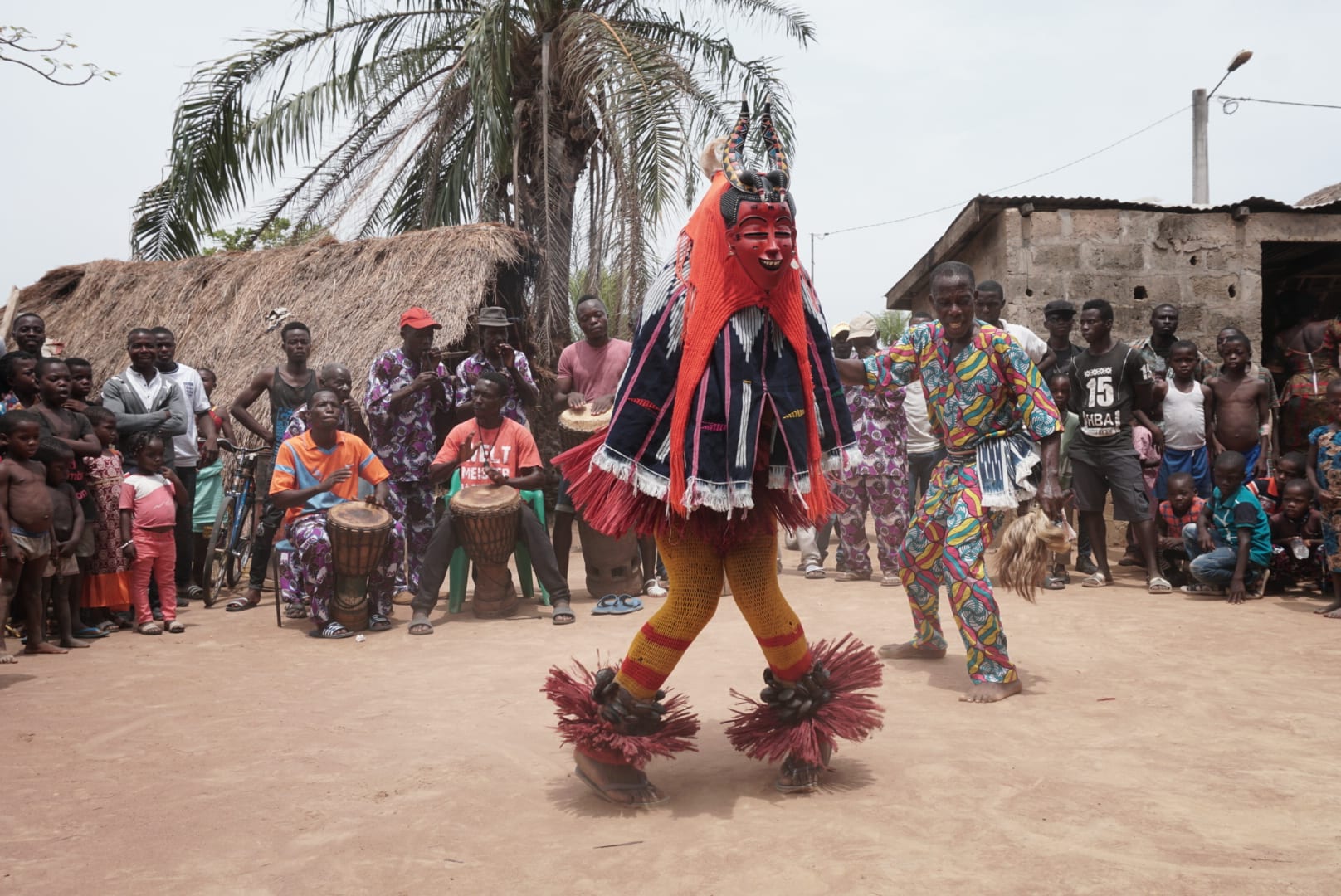
In a Guro village in the centre of the country, the drummers have been playing for some time before the dancer appears. When he does, the crowd surges forward. His face is hidden behind a carved and painted mask topped with horns and colour; his legs, bound in fringe and rattles, move so fast that they blur against the red earth. Zaouli is a homage to feminine beauty, and it brings together almost everything that matters in Ivorian culture in one performance: the sculptor who carved the mask, the weavers who made the costume, the musicians and singers, the elders who guard the tradition, and a whole village turned out to watch. Côte d'Ivoire is home to more than sixty ethnic groups, each with its own language and customs, and what holds them together is less a single tradition than a shared set of manners — greetings, respect, generosity and, surprisingly often, laughter.
Faith, identity and values
Côte d'Ivoire is religiously mixed, and proudly so. At the 2021 census, about 42 per cent of the population identified as Muslim and about 40 per cent as Christian, with around one in eight reporting no religion and about 2 per cent following traditional faiths. Muslims are mostly Sunni of the Maliki school, and Sufi brotherhoods are widespread; Christians include a large Catholic community, Methodists, a wide range of evangelical churches, and the Harrists, followers of a Liberian preacher who travelled through the country in the early twentieth century. Both faiths' great feasts — Tabaski and the end of Ramadan, Christmas and Easter — are national holidays. Beneath and alongside both, older beliefs remain strong: for many families, conversion to Islam or Christianity has not meant abandoning rituals that honour the spirits of the ancestors, and traditional priests, diviners and healers still play a part in community life.
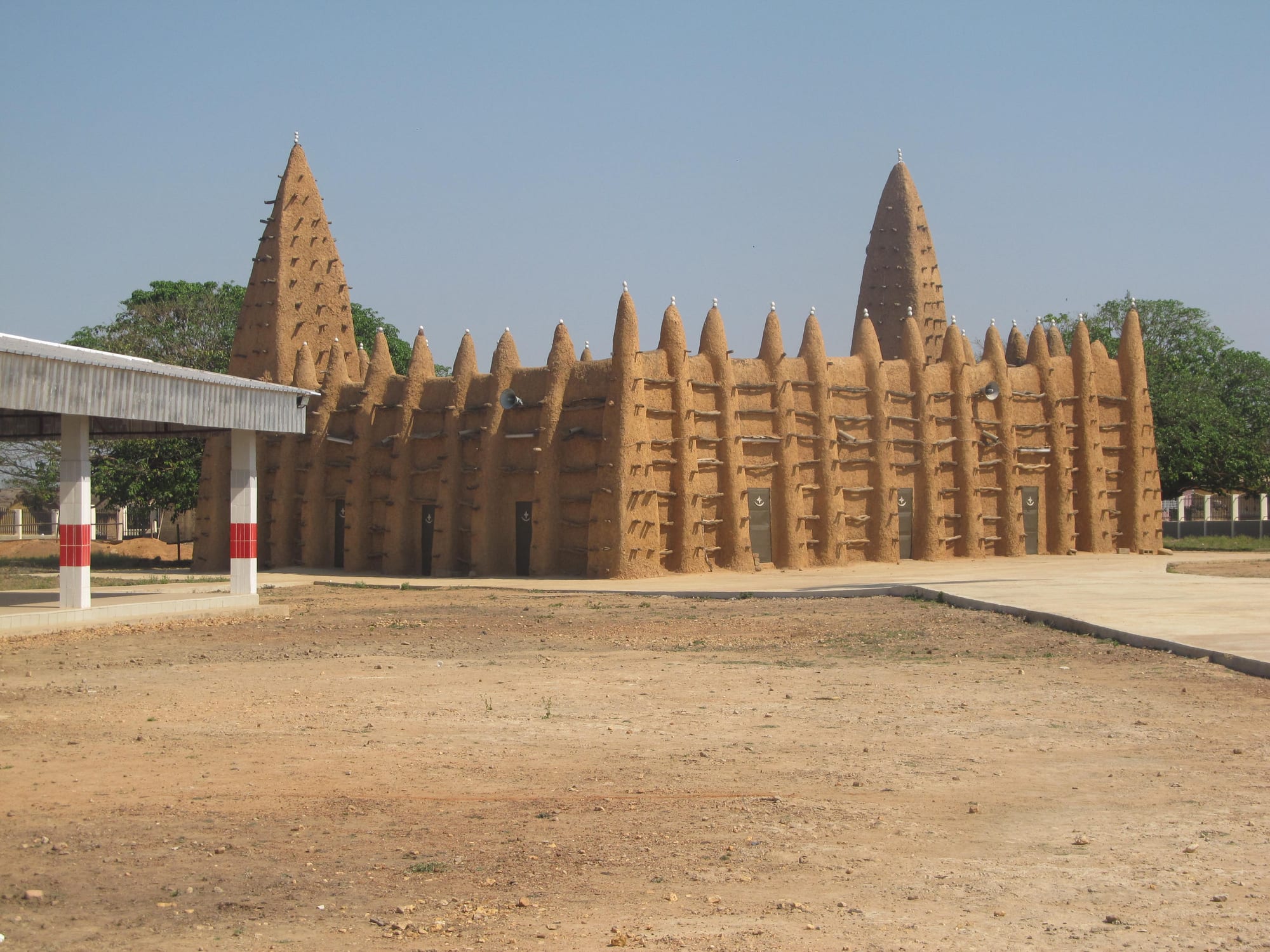
The architecture reflects the same range. In the north, earthen mosques in the Sudanese style, with vertical buttresses and timber framing projecting from their walls, stand in a tradition that spread south from Djenné over centuries; eight of them are inscribed together as a UNESCO World Heritage Site. In the centre stands the vast domed Basilica of Our Lady of Peace in Yamoussoukro.
Among the values that bind this diverse society, one of the most distinctive is the toukpê, the system of interethnic alliances. These are pacts of non-aggression said to have been sealed long ago between the ancestors of particular peoples — the Sénoufo with the Yacouba and the Gouro, for example, or the Baoulé with the Agni. The Baoulé word toukpê is used for what the Mandinka call sanankounya. Members of allied groups are entitled, and sometimes expected, to tease, mock and insult one another freely and without offence, turning potential grievances into jokes; in return, violence between allies is forbidden, and each owes the other help. Ivorian commentators, academics and officials have promoted these "joking alliances" as a tool for social cohesion and reconciliation. Respect for elders is the other constant. Age brings authority, and deference to older people shapes conversation, greetings and everyday behaviour.
Greetings and meeting people
Greetings come first, and they are not rushed. Ivorians greet one another and ask after each other's health, family and work before turning to anything else; launching straight into business or a request without these preliminaries is considered impolite. In business, it is usual to break the ice with talk of family, health or the weather before getting to the point.
French is the official language and the common tongue between peoples, so bonjour or bonsoir with a handshake is the natural opening for a visitor. A handshake is appropriate for both men and women on a first meeting; among acquaintances, women are often greeted with kisses on alternate cheeks. At social gatherings, it is polite to shake hands with everyone on arrival and again on leaving, rather than simply waving to the room.
Direct eye contact is used with care. Staring is considered disrespectful, and younger people often lower their gaze a little when speaking with parents and elders as a sign of respect. Some people mark respect for an older person with a slight bow or bend of the knee as they shake hands.
Hospitality and being a guest
Ivorians are known for hospitality, and meals are shared occasions. Food is traditionally eaten with the hands, often from a common dish, and in many homes family meals are prepared outdoors and eaten together.
Gifts matter, especially as a way of showing respect to older people and to figures of standing in a community. Bringing something when visiting a family is a courteous gesture, and gifts are part of the reciprocity that runs through Ivorian social life. That reciprocity is at its most visible at funerals, when relatives, neighbours and friends contribute money, cloth or drinks, in the knowledge that the favour will one day be returned.
Joking, too, is part of social life. Between members of allied peoples, mock insults are a friendly form of greeting and banter. Outsiders are not expected to join in, but it helps to recognise that what sounds like rudeness is often affection.
Festivals and life's big moments
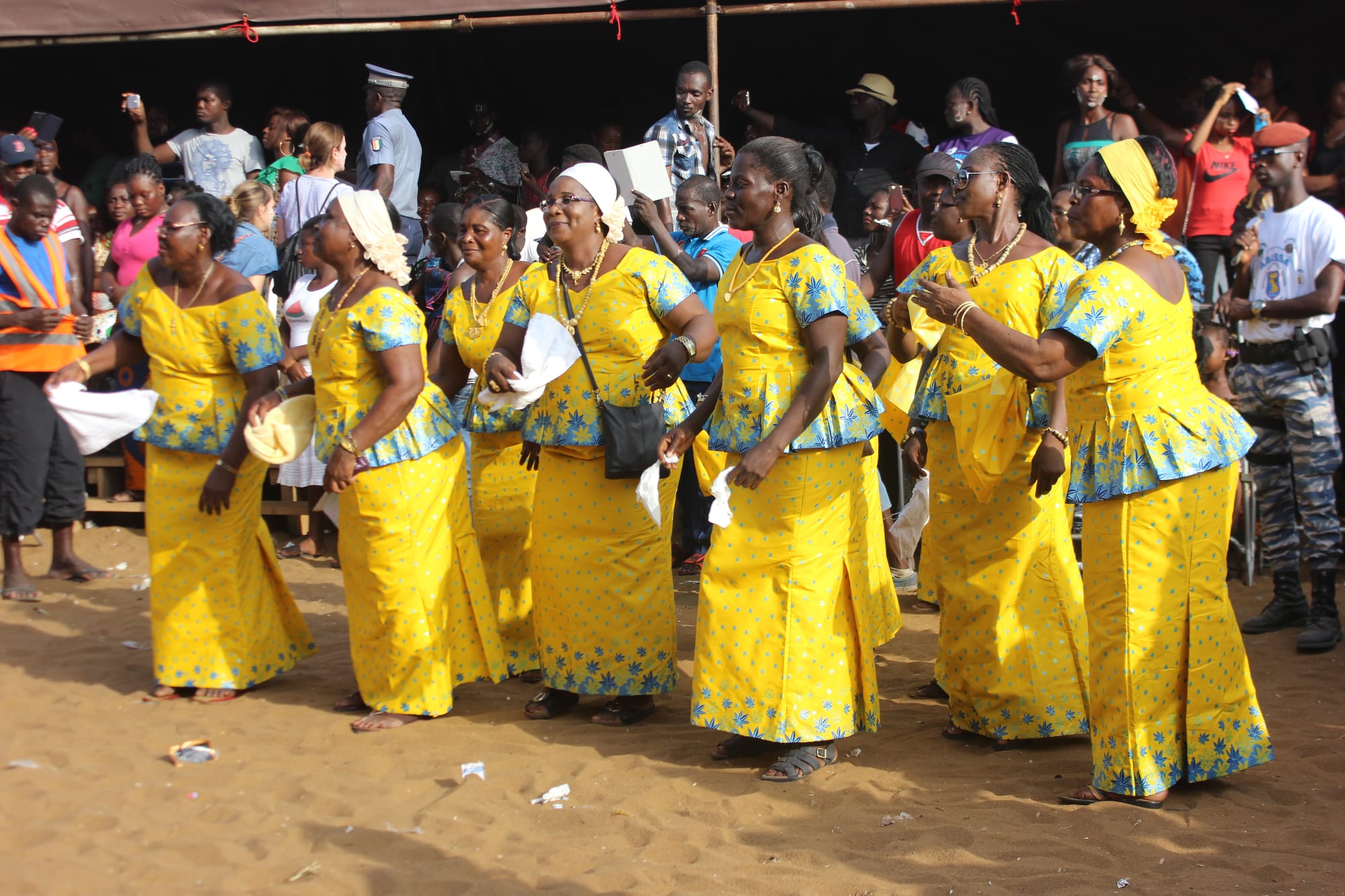
The religious year gives the country holidays from both faiths, and some festivals blend faith and ancestral custom. Among the Baoulé, Easter has become Paquinou — the Baoulé word for Easter — a great reunion in the home villages. Parents, cousins, aunts and nephews gather, masked dancers representing spirits and ancestors perform, mass is said, and the weekend is also a time to settle disputes and plan village development. Among the Akan peoples of the east, yam festivals at the end of the harvest mark a new year and honour the ancestors, and on the coast the N'Zima people celebrate their own new year with the Abissa festival.
Marriage is understood as a union of two families rather than only two people, and although civil and religious weddings are common, many couples also go through a customary ceremony. At its heart is the dot, the gifts presented by the groom's family to the bride's. What it contains varies from people to people — cloth, money, drinks and other goods — but its meaning is broadly shared: a public mark of respect for the bride's family, handed over before both families, after which elders bless the couple.
Funerals are the most important of all life's events. Death is understood as the passage of a person into the ranks of the ancestors, and funerals are celebrated accordingly — sometimes weeks or even months after the death, with the body kept in a mortuary until the family is ready. Ceremonies can include a religious vigil, a wake enlivened by music and dancing, the transfer of the body to the home village and the burial itself, and for an older or prominent person the whole sequence can last several days. Families often have matching cloth made so that relatives can dress alike. Contributions from mourners are announced during the wake and help cover the costs, which can be very high; the expense of funerals is a frequent subject of public debate.
Arts, crafts and music
Masks are the country's best-known art form, and they are far more than decoration: carved for religious and community purposes, many represent spirits and ancestors when they appear in dance. Zaouli, the masked dance of the Guro, is on UNESCO's list of intangible cultural heritage; it is inspired by two older masks, has seven types of mask each linked to its own legend, and combines carving, weaving, music and dance. It is performed regularly in the villages that keep it and at inter-village competitions and festivals. Also on UNESCO's list are the gbofe of Afounkaha, music played on transverse horns by the Tagbana, and the balafon traditions of the Sénoufo, which Côte d'Ivoire shares with Mali and Burkina Faso.
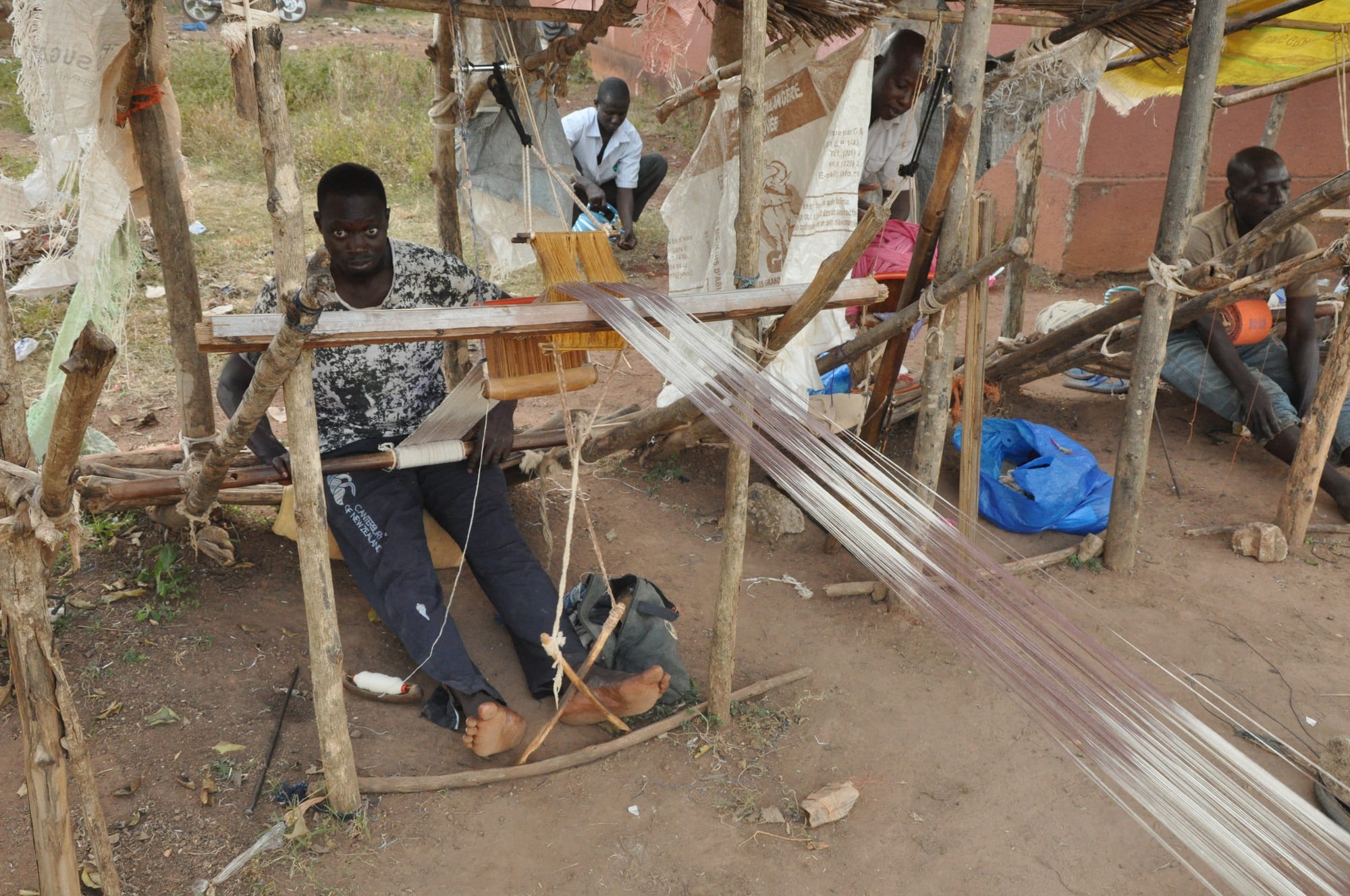
Weaving is another inherited art, and another on UNESCO's list, inscribed in 2023 as the traditional skills of loincloth weaving. Among the Gouro, Baoulé, Malinké, Sénoufo, Koulango, Nafana and Abron, cotton thread dyed in different colours is woven into narrow strips on a hand loom designed by the weaver; the strips are then joined together to make a larger cloth, with patterns and skills particular to each community; the cloths are worn at weddings, celebrations and funerals. Other peoples have their own methods: raffia cloth among the Dida, and among the Sénoufo, Korhogo cloth, cotton spun by women, then woven and painted by men with fermented mud and plant pigments.
Music and dance run through every ceremony, from initiation dances to funeral wakes, and traditional instruments accompany most group singing. In the cities, Côte d'Ivoire's popular dance music has travelled far beyond its borders and fills the maquis, the open-air eateries, late into the night.
Dos and don'ts for visitors
- Do greet people properly, asking after health and family, before any question or request.
- Do shake hands with everyone when arriving at and leaving a gathering.
- Do show deference to elders, and avoid staring; a slightly lowered gaze is a mark of respect.
- Do bring a small gift when visiting a family, especially an older relative or a respected figure.
- Do contribute if invited to a wake or funeral; contributions are part of the occasion.
- Don't rush straight into business; a few minutes on family and health comes first.
- Don't be alarmed by exchanges of mock insults between members of allied peoples; it is toukpê, and it is friendly.
What to take away
In a country of so many peoples and faiths, Ivorian manners are the common language — take time over the greeting, honour the old, share what there is, and learn to recognise a joke that is really a gesture of friendship.