Culture & Customs · Bhutan
Bhutan: The Discipline of Mind, Body and Speech
A kingdom that writes its Buddhist heritage into the constitution, teaches etiquette in every school, dresses for the occasion by law and custom, and gathers each year to watch the gods dance
By Worldlore Editorial · 30 September 2026
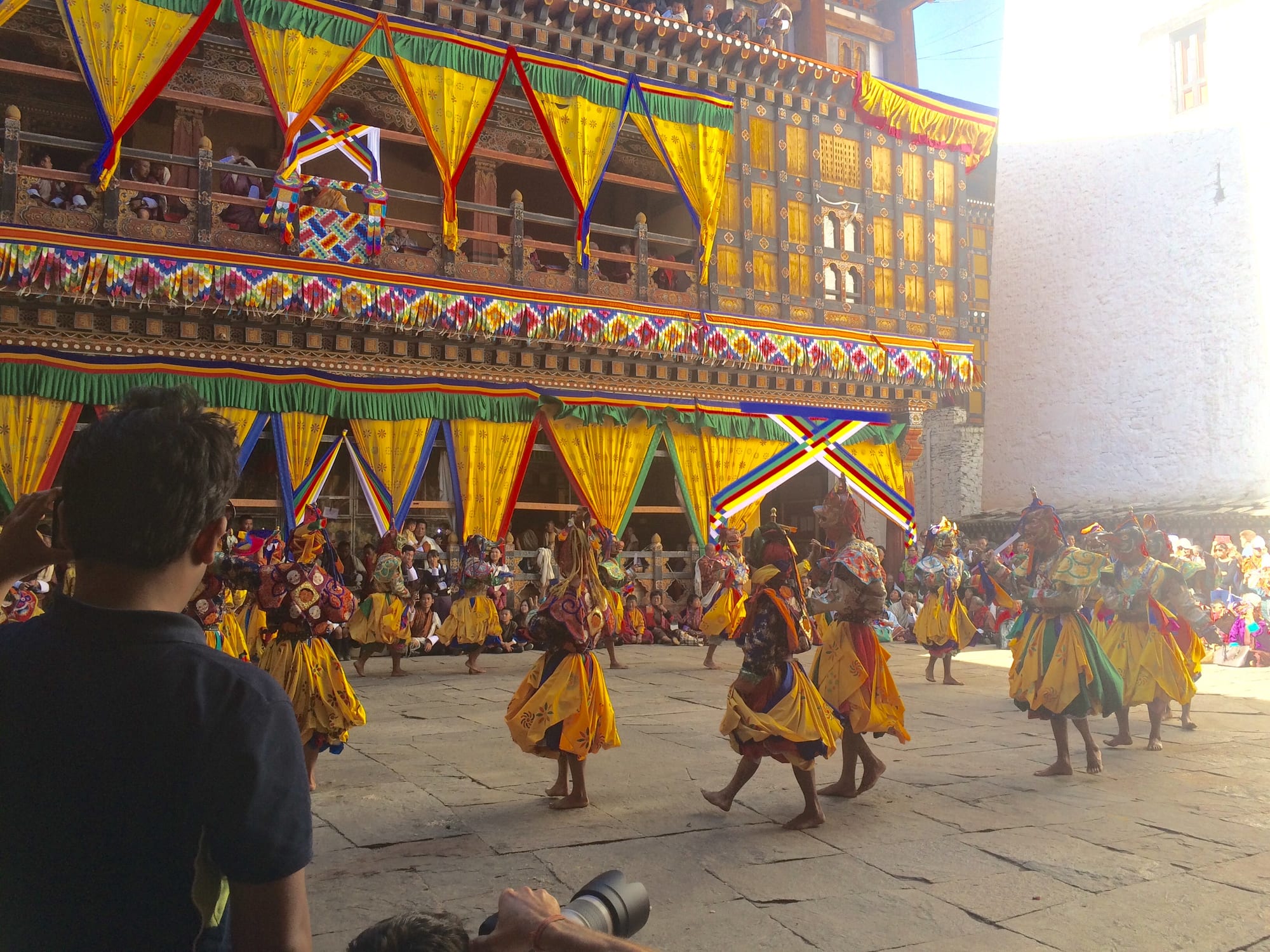
It is the last day of a tshechu, one of the religious festivals held each year in districts across Bhutan. For days the courtyard of the dzong or temple has been filled with masked dancers, the drums and cymbals of the monks, and families in their finest clothes. Now an enormous religious painting, a thongdrel, has been unrolled against the wall, and the crowd files past to receive its blessing. Around the edges, masked clowns known as atsara tease the crowd and keep the mood light. The scene brings together much of what defines Bhutanese culture: a Buddhist faith woven into public life, a strong sense of community, and a set of manners and traditions that the country has chosen, deliberately, to keep.
Faith, identity and values
Buddhism shapes the rhythm of Bhutanese life, and the state gives it a formal place. The constitution adopted in 2008 describes Buddhism as the spiritual heritage of Bhutan, one that promotes peace, non-violence, compassion and tolerance, and it charges religious institutions with promoting that heritage while keeping religion separate from politics. The same constitution commits the state to preserving the country's cultural heritage, from dzongs and temples to language, music and the visual arts, and to treating culture as a living force rather than a museum piece.
Bhutan is also home to several distinct communities, among them the Lhotshampa of the south, whose festivals and customs sit alongside those of the Buddhist majority. Figures cited by the US State Department put Buddhists at about 83 per cent of the population, Hindus, who live mostly in the south near the Indian border, at about 11 per cent, and Christians at a little over 2 per cent. Across these communities, respect for elders, for religious figures and for authority runs deep, and it is expressed as much through behaviour as through words.
That behaviour has a name. Driglam Namzhag, Bhutan's code of etiquette, sets out how people should dress, speak, sit, eat and conduct themselves, especially in formal settings and in the presence of officials and monks. Officials describe its purpose as the taming of mind, body and speech, not simply the following of protocol. In recent years officials have voiced concern that younger people use the honorific forms of speech less than before, and etiquette is taught in schools.
Greetings and meeting people
The everyday greeting is "kuzuzangpo la". The word "la", added at the end of a sentence, is a mark of politeness and respect, and Bhutanese speech contains a whole register of honorific words used when addressing elders, monks and people of standing.
Dress is a central part of good manners. Men wear the gho, a knee-length robe, and women the kira, an ankle-length dress, and national dress is expected at official occasions and at religious festivals such as the tshechu. When visiting government offices, and at formal events, men wear a ceremonial scarf called a kabney over the shoulder, and women a narrower cloth called a rachu. The colour of a kabney signals rank, and the higher colours are conferred by the King: orange, for instance, for senior officials such as ministers and the Speaker. A red scarf is one of the kingdom's highest honours, awarded by the King for exceptional service, and receiving a scarf is understood as a pledge of loyalty and service to the nation. The rachu is a narrow embroidered cloth draped over the left shoulder, and the government has pressed for its traditional designs to be kept rather than replaced by invented ones.
Ceremonial white scarves, khadar, are also presented to mark important moments, such as appointments to office or blessings from senior religious figures.
Hospitality and being a guest
Much of Bhutan's hospitality is shared at communal occasions. Festivals and new-year celebrations are times for feasting together, for families to gather and for offerings of thanksgiving, and at larger community celebrations teams of volunteers cook for hundreds or thousands of guests. Being included in such an occasion is a welcome, and visitors who join in are expected to observe the same courtesies as everyone else.
In the home, the first courtesy is a drink. Bhutan's Department of Tourism notes that a good host will not let a guest leave without some kind of beverage, that it is considered rude not to offer one, and that it is equally rude for the visitor to refuse. The cup may hold suja, the salted butter tea, sweet milk tea, or ara, the home-made spirit. The guest is settled in the best seat, and there is a gentle ritual to the offer: it is polite to decline at first, and the host will keep insisting until the guest accepts. A small gift for the household is welcome, and it is polite to wait for the eldest members of the family, or any officials present, to begin eating first.
Formal etiquette is most visible at religious sites. Bhutan's Department of Tourism asks visitors to wear respectful, smart-casual clothing that covers them from shoulders to knees when visiting places of religious significance, and a licensed guide must accompany visitors into dzongs and monuments. Inside, visitors follow their guide's lead on where they may go, and on when to be quiet.
Smoking is one area where visitors should take particular care. Bhutan banned the sale of tobacco outright in 2010, and although sales were allowed again under an amendment passed in 2021, smoking in public places, offices, institutions, public transport and entertainment venues remains prohibited and is fined, and tobacco may not be sold near monasteries, dzongs, schools or heritage sites.
Festivals and life's big moments
Tshechus are the heart of the religious year. Held in districts across the country, many last several days and centre on cham, sacred masked dances, many of them honouring Guru Rinpoche, the revered Buddhist teacher also known as Padmasambhava. Some are danced by monks, others by laymen drawn from the surrounding villages, and dancing in a tshechu is regarded as a responsibility to the community as well as an honour. People travel from far and wide to watch, to meet relatives and to receive blessings, and on the final day many festivals display a thongdrel, a vast religious painting before which people gather to receive blessings.
Bhutan's one element on UNESCO's list of intangible cultural heritage is a masked dance of this kind: the Drametse Ngacham, the mask dance of the drums, performed twice a year at a monastery in the east of the country. Sixteen male dancers in wooden masks depicting real and mythical animals are accompanied by ten musicians playing cymbals, trumpets and several kinds of drum. The dance moves from a slow, contemplative section representing peaceful deities to a fast, athletic one representing wrathful ones, and audiences attend in search of spiritual empowerment.
The new year, Losar, is celebrated at different times by different communities. Many observe Dawa Dangpa Losar, on the first day of the first month of the lunar calendar, usually in February or March; Chunipa Losar, the Traditional Day of Offering, falls on the first day of the twelfth month and is a national holiday. Losar is marked by feasting, family gatherings and offerings of thanksgiving, and often by matches of khuru, a traditional game of darts.
Weddings are religious occasions as much as social ones. An auspicious date is chosen according to the Bhutanese calendar, and monks or a lama perform rituals and blessings for the couple. Ceremonial scarves are presented to the couple along with good wishes, and in some rural communities relatives and neighbours pledge practical help to the newlyweds.
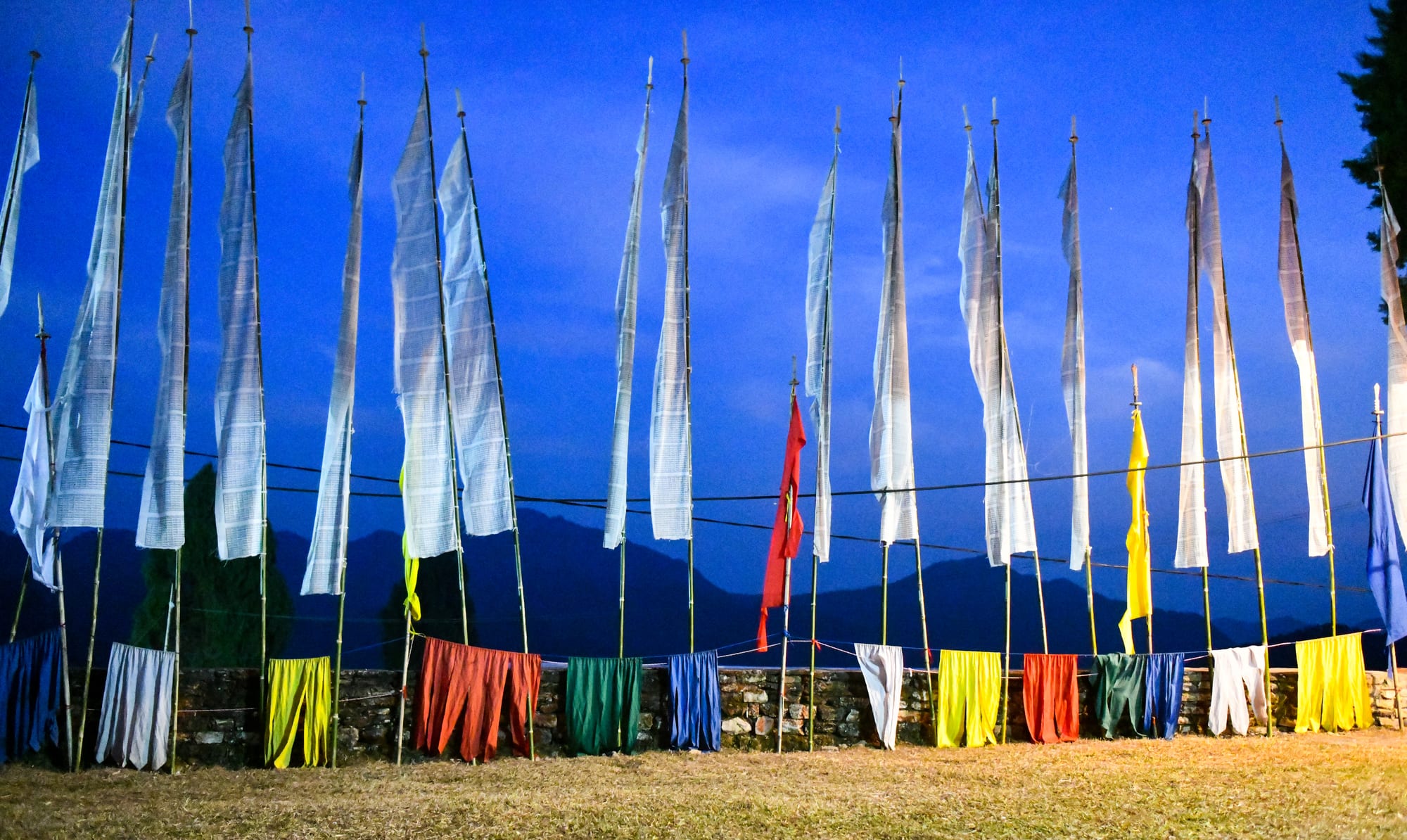
Death carries particular religious weight. Most Bhutanese believe in rebirth, and when someone dies, the family takes great care to perform the proper funeral rites so that the deceased passes swiftly to the next life. An astrologer is consulted for the right date for the cremation, and some days of the month are considered unsuitable, so a body may be kept for some time before the funeral. The deceased is believed to spend 49 days in the bardo, the intermediate state between death and rebirth, and the community generally mourns over the same period, with monks leading a series of rituals; texts may be read aloud to guide the dead through the bardo. Families have traditionally raised 108 prayer flags in the dead person's name, believed to help free the soul from that state. The rites draw large gatherings of relatives and neighbours, and their cost can be a heavy burden for a family.
Arts, crafts and music
Bhutan's traditional arts and crafts are known collectively as zorig chusum, the thirteen arts. They range from painting and sculpture to smithery, leatherwork, woodturning and ornament-making, and they are taught formally at institutes for zorig chusum, where students can also learn traditional methods such as extracting plant pigments for painting. Some of the more demanding disciplines have struggled to attract young apprentices, and efforts are under way to revive them.
Masked dance is itself one of the country's great art forms, and the costumes, masks and music of the tshechu are made and maintained by craftspeople and monks. Traditional music and dance are also taught and performed through the Royal Academy of Performing Arts.
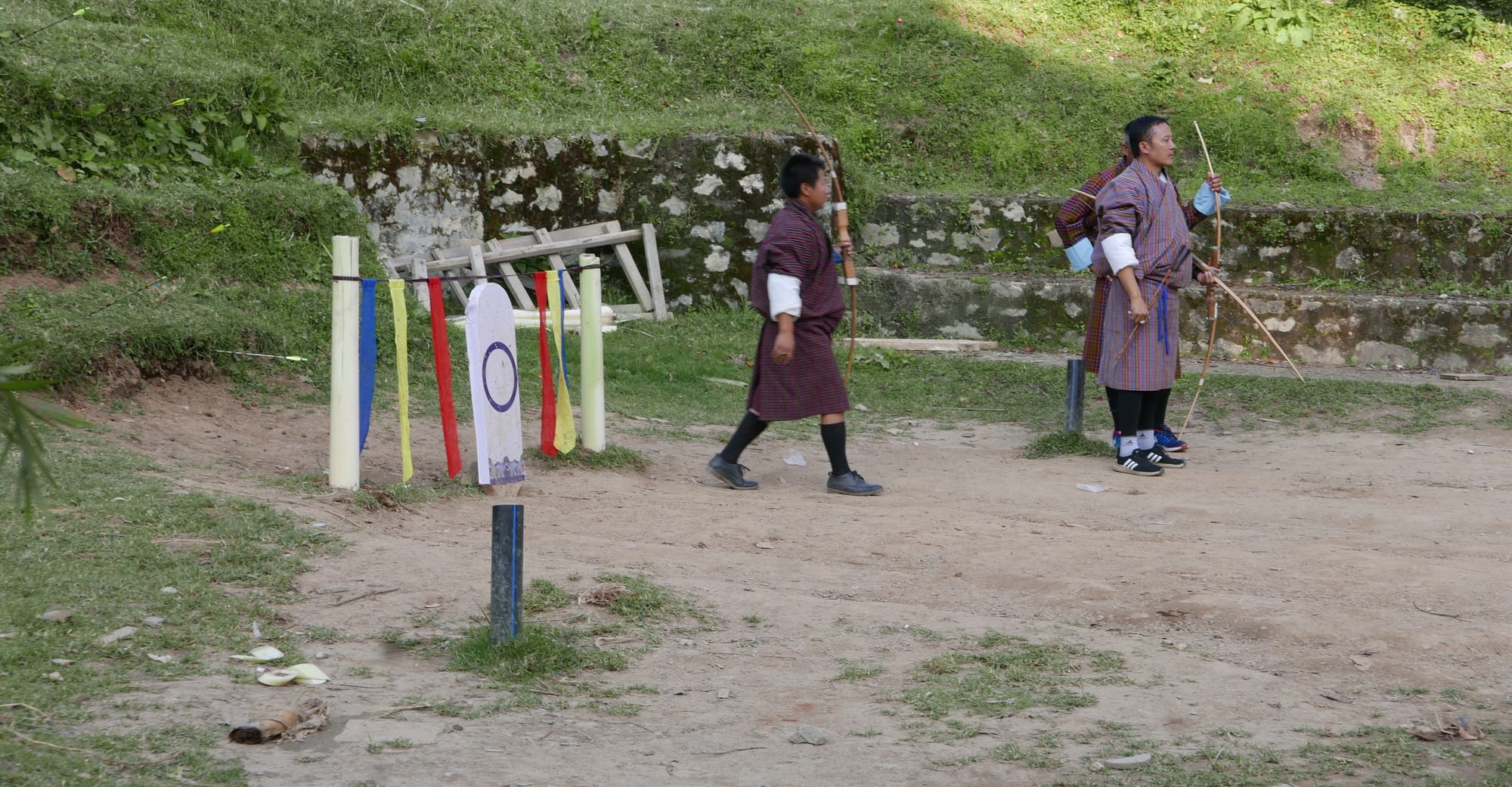
Archery is the national sport, and a matter of great local pride. Matches between villages and districts are fiercely contested social occasions, with teams shooting at small targets placed far down a long range. The traditional bow is made of bamboo, and although many archers now use imported compound bows, communities organise matches specifically to keep the bamboo bow alive, and craftsmen still make traditional bows and arrows by hand.
Dos and don'ts for visitors
- Do greet people with "kuzuzangpo la", and add "la" to show politeness.
- Do dress from shoulders to knees when visiting temples, dzongs and other religious sites.
- Do enter dzongs and monuments with a licensed guide, and follow their lead once inside.
- Do show particular respect to monks, elders and officials.
- Do accept the tea or drink offered in a home; declining once is polite, but refusing outright is rude.
- Do watch tshechu dances quietly, and take the atsara's teasing in good humour.
- Don't smoke in public places, offices or on public transport; it is prohibited and fined.
- Don't wear casual or revealing clothing to formal events, where national dress is the norm.
What to take away
Bhutan's customs rest on the idea that good conduct is a discipline of mind, body and speech, and visitors who dress with care, speak with courtesy and show respect at its sacred sites will find themselves welcomed into a culture that has chosen, very consciously, to remain itself.