History · Albania
Albania: The Seam of Europe
Three thousand years on the line where empires and faiths met — from the Illyrians to the Adriatic republic of today
By Worldlore Editorial · 19 September 2026
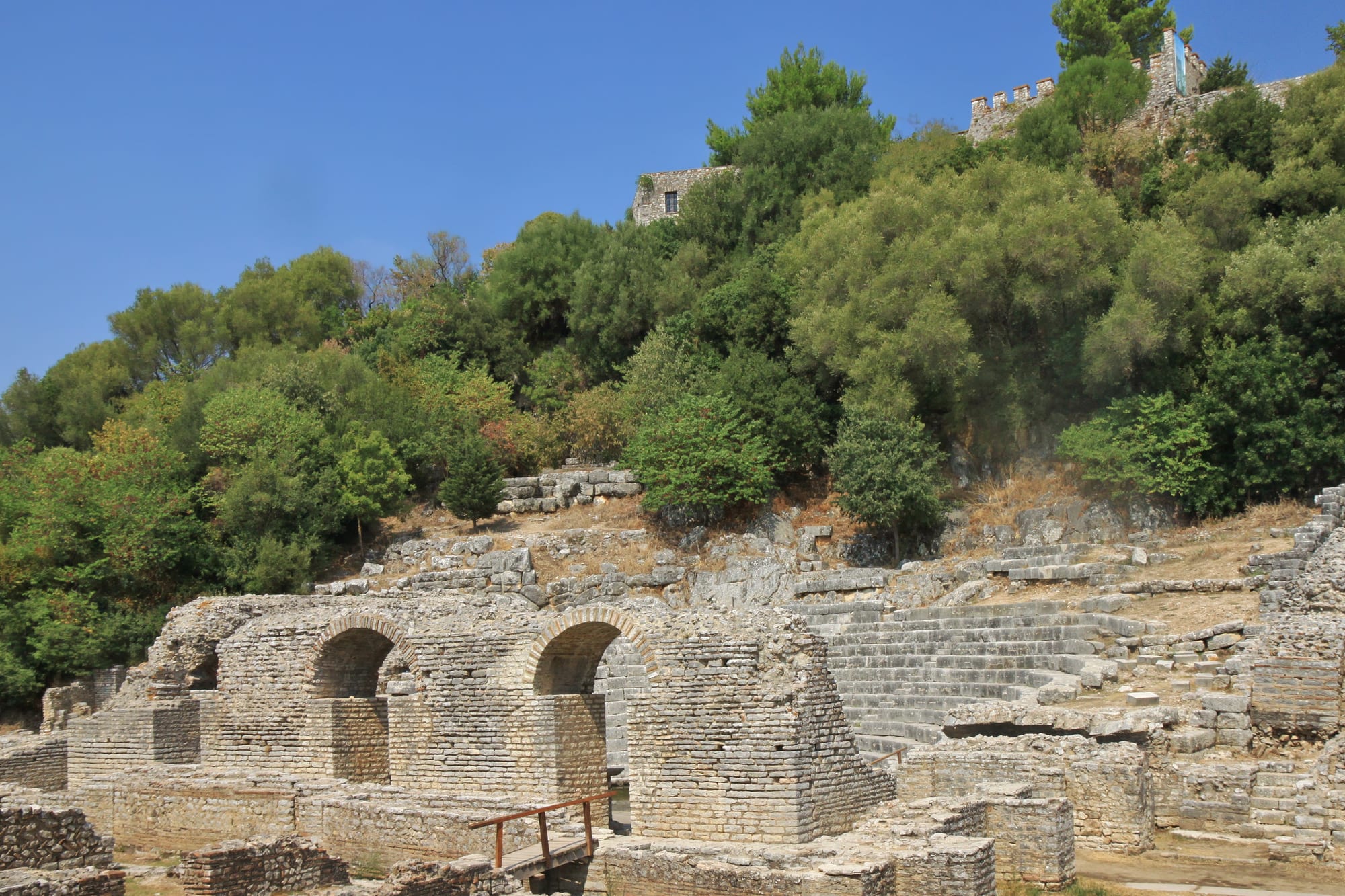
The seam of Europe
Albania is a small country in a decisive spot. Its coast looks across a narrow strait at the heel of Italy — at the closest point the Adriatic is barely 70 kilometres wide — while its back is pressed against a wall of mountains that rises almost from the beach and does not really stop until the plains of Kosovo and North Macedonia. For most of recorded history that geography made the country a threshold. The main road between Rome and Constantinople ran across it. The line between the Latin and Greek halves of Christianity ran through it. And when Islam moved up through the Balkans with the Ottomans, Albania was where it met, and mixed with, Catholic and Orthodox Europe.
What is striking is how much survived the traffic. Albanians speak a language that forms its own isolated branch of the Indo-European family, with no close living relatives, and they held on to a firm sense of themselves as a distinct people through nearly five centuries with no state of their own. The history below is partly about the outsiders who passed through, and partly about how a nation kept its shape in the gaps between them.
Three thousand years, in brief
The dates below compress a great deal; the sections that follow fill them in.
- from c. 1000 BCE
The Illyrians
Tribal kingdoms of the western Balkans; Greek colonies are founded on the coast at Epidamnos (Durrës) and Apollonia from the 7th century BCE.
- 168 BCE
Rome takes over
The defeat of the Illyrian king Gentius brings the region under Roman rule; the Via Egnatia soon links the Adriatic to the Aegean.
- 395 CE
The empire divides
Albania ends up on the frontier between the Latin West and the Greek East, and later between their two churches.
- c. 1190
The Principality of Arbanon
The first Albanian polity, centred on Krujë, emerges as Byzantine power fades.
- 1443–1468
Skanderbeg
Gjergj Kastrioti unites the Albanian lords and holds off the Ottomans for a quarter of a century.
- 1479
Ottoman conquest
With the fall of Shkodër, Albania becomes Ottoman for more than four hundred years.
- 1878
The League of Prizren
The start of an organised Albanian national movement.
- 28 November 1912
Independence
Ismail Qemali declares an independent Albania at Vlorë as the Balkan Wars rage.
- 1928
A kingdom
President Ahmet Zogu makes himself King Zog I.
- 1939–1944
Occupation
Fascist Italy invades, then Nazi Germany; a communist-led resistance wins control.
- 1944–1985
Enver Hoxha
A Stalinist dictatorship breaks in turn with Yugoslavia, the USSR, and China, and seals the country off.
- 1990–1992
The end of communism
Protests, mass emigration, and the first multi-party elections in half a century.
- 1997
Collapse
The failure of nationwide pyramid schemes triggers an armed uprising and the near-collapse of the state.
- 2009
NATO
Albania joins the alliance; European Union membership talks follow.
Illyrians, Greeks, and Romans
The people the ancient world called the Illyrians occupied the western Balkans from at least 1000 BCE — a patchwork of tribes and small kingdoms rather than a single nation, herding and farming in the valleys and trading amber and metals. From the 7th century BCE Greek colonists planted trading cities along the coast: Epidamnos, later Dyrrhachium and today Durrës; Apollonia, a little to the south; and Bouthroton, now Butrint, on a lagoon facing Corfu. These were Greek islands in an Illyrian sea, and the mix of the two — Greek planning and letters, Illyrian hinterland — is the oldest layer of the country's identity.
An Illyrian kingdom centred on the Lake Shkodër region grew powerful enough in the 3rd century BCE to alarm Rome. Its ships raided Adriatic commerce, and a regent-queen, Teuta, became notorious in Roman accounts for it. Two short Illyrian Wars followed, and in 168 BCE the defeat and capture of the last king, Gentius, ended Illyrian independence for good. Under Rome the region became a thoroughfare: the Via Egnatia, built in the 2nd century BCE, ran from Dyrrhachium and Apollonia across the mountains to Thessalonica and on toward Byzantium, so that anyone travelling between Italy and the East came ashore here. The province was prosperous and thoroughly Romanised, and it produced soldiers and even emperors for the late empire.
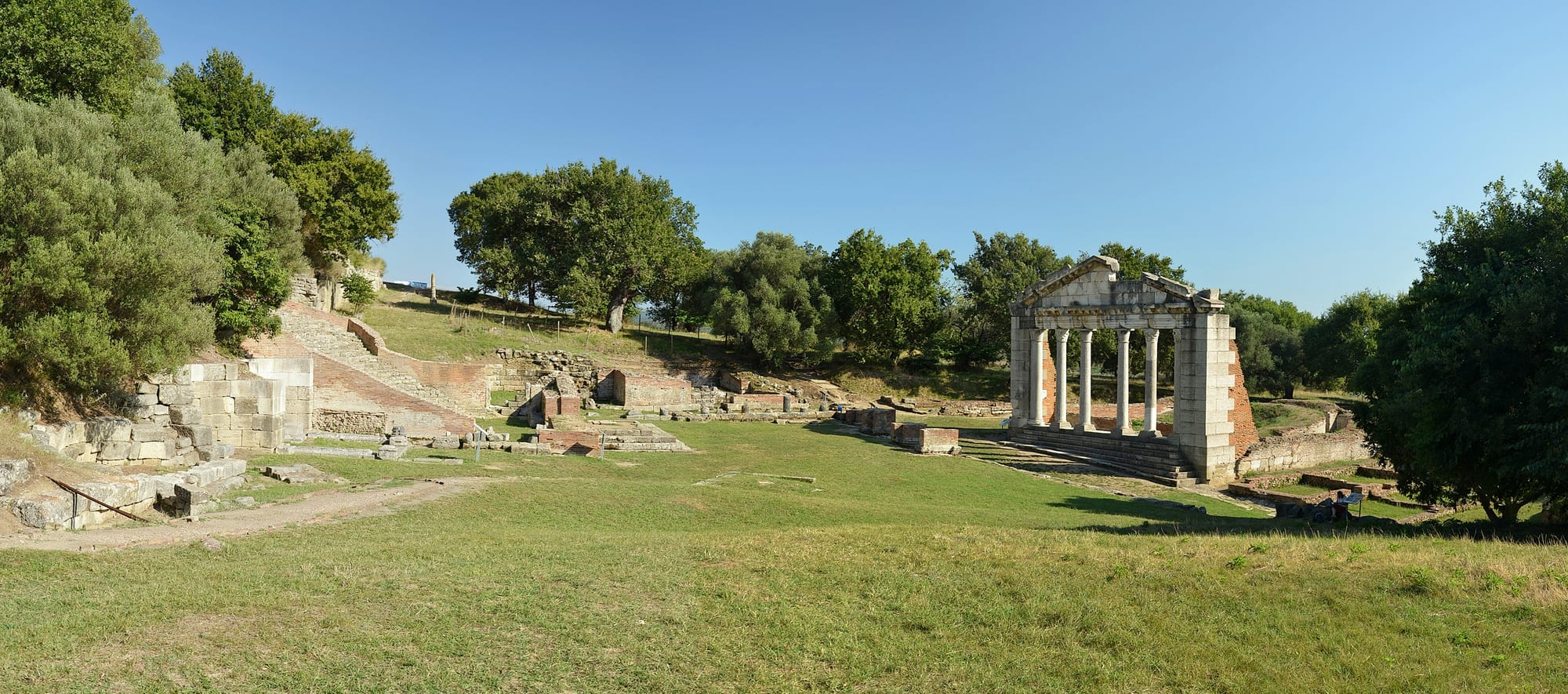
When the Roman Empire was formally divided in 395 CE, the line between its western and eastern halves ran close to here, and the region was assigned to the East. That accident of administration set a pattern: for the next thousand years Albania would sit on the edge of Byzantium, close enough to Italy to be pulled west, close enough to Constantinople to be governed from the east.
Byzantium, the Slavs, and the name "Albania"
The early medieval centuries were hard on the coast. Gothic and Hun raids gave way, from the late 6th century, to the arrival of Slavic peoples who settled much of the Balkan interior. Byzantine authority shrank to the ports and re-expanded in cycles; the First Bulgarian Empire held the inland districts in the 9th and 10th centuries, with a centre of power at Ohrid just over today's eastern border. Through all of this an Albanian-speaking population persisted in the highlands, and it is here that the modern nation's name first surfaces: Byzantine writers of the 11th century mention the Albanoi and a district called Arbanon in the mountains behind Durrës. Albanians still call their country Shqipëria, but outsiders have used a version of "Arbën / Alban" ever since.
Around 1190, as Byzantium weakened after the sack of Constantinople loomed, a local ruler named Progon established the Principality of Arbanon around Krujë — the first thing that can be called an Albanian state. It did not last long. Over the following two centuries the region was fought over by the Angevin kings of Naples, who proclaimed a "Kingdom of Albania" at Durazzo in 1272; by the Serbian empire of Stefan Dušan, which absorbed it in the 1340s; and, after Dušan's death, by a rising set of Albanian noble houses — the Balsha, Thopia, Muzaka, Arianiti, Dukagjini and Kastrioti families — who ran their own principalities in the vacuum. It was into that fractured world that the Ottomans arrived.
Skanderbeg and the long resistance
The Ottoman advance into Albania began in earnest after a victory at the Battle of Savra in 1385. Several Albanian lords became Ottoman vassals, sending sons to the sultan's court as hostages and soldiers. One of those sons was Gjergj Kastrioti, born around 1405, who was raised at the Ottoman court, converted to Islam, served with distinction in the sultan's armies, and was known by the Turkish name İskender Bey — Skanderbeg.
In 1443, during a campaign against a Hungarian-led crusade, Skanderbeg abandoned the Ottoman army, rode to Krujë, took the fortress by a ruse, renounced Islam, and raised a red banner with a black double-headed eagle. The next year he gathered the Albanian princes into a military alliance, the League of Lezhë, and for the next 25 years he held the mountains against everything the Ottomans sent. Sultan Murad II besieged Krujë in person in 1450 and failed; Mehmed II, the conqueror of Constantinople, besieged it in 1466 and 1467 and also failed. Skanderbeg drew subsidies from Naples and the papacy, which cast him as a shield of Christendom, and he became a celebrity across Renaissance Europe.
Skanderbeg, then and now
Two versions of the national hero: a 16th-century Florentine portrait, and the fortress of Krujë that he held against three sultans.
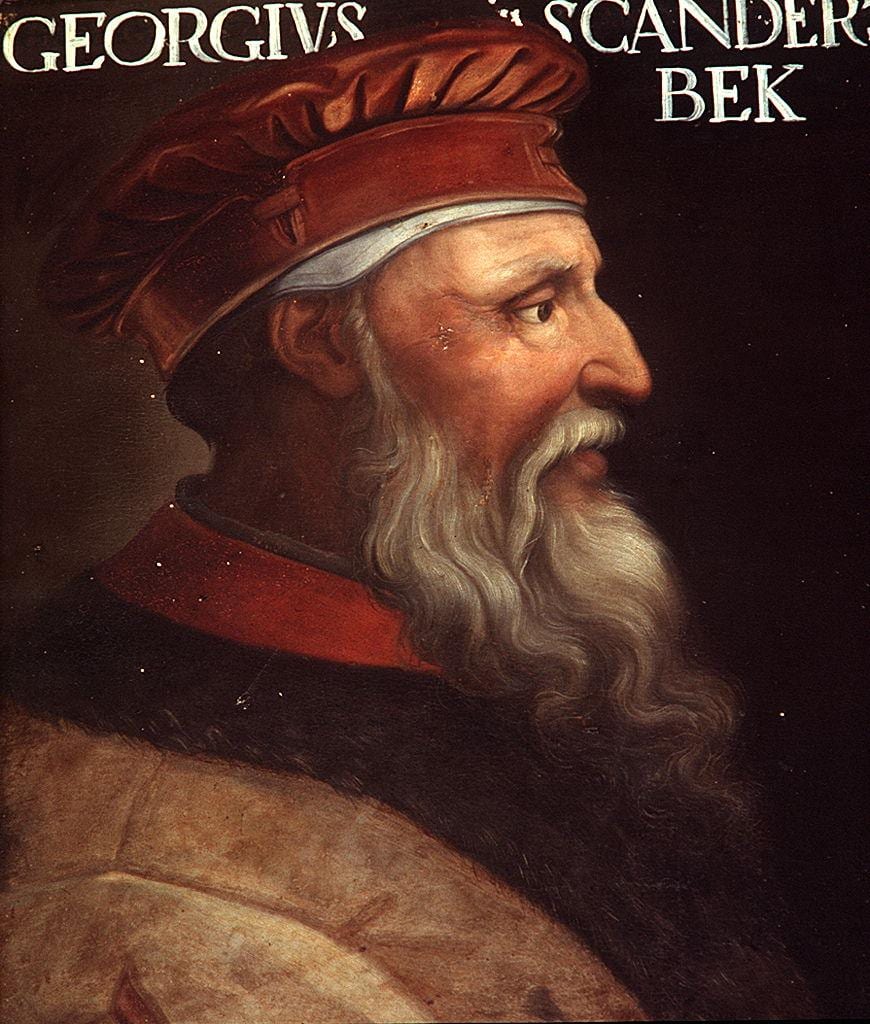
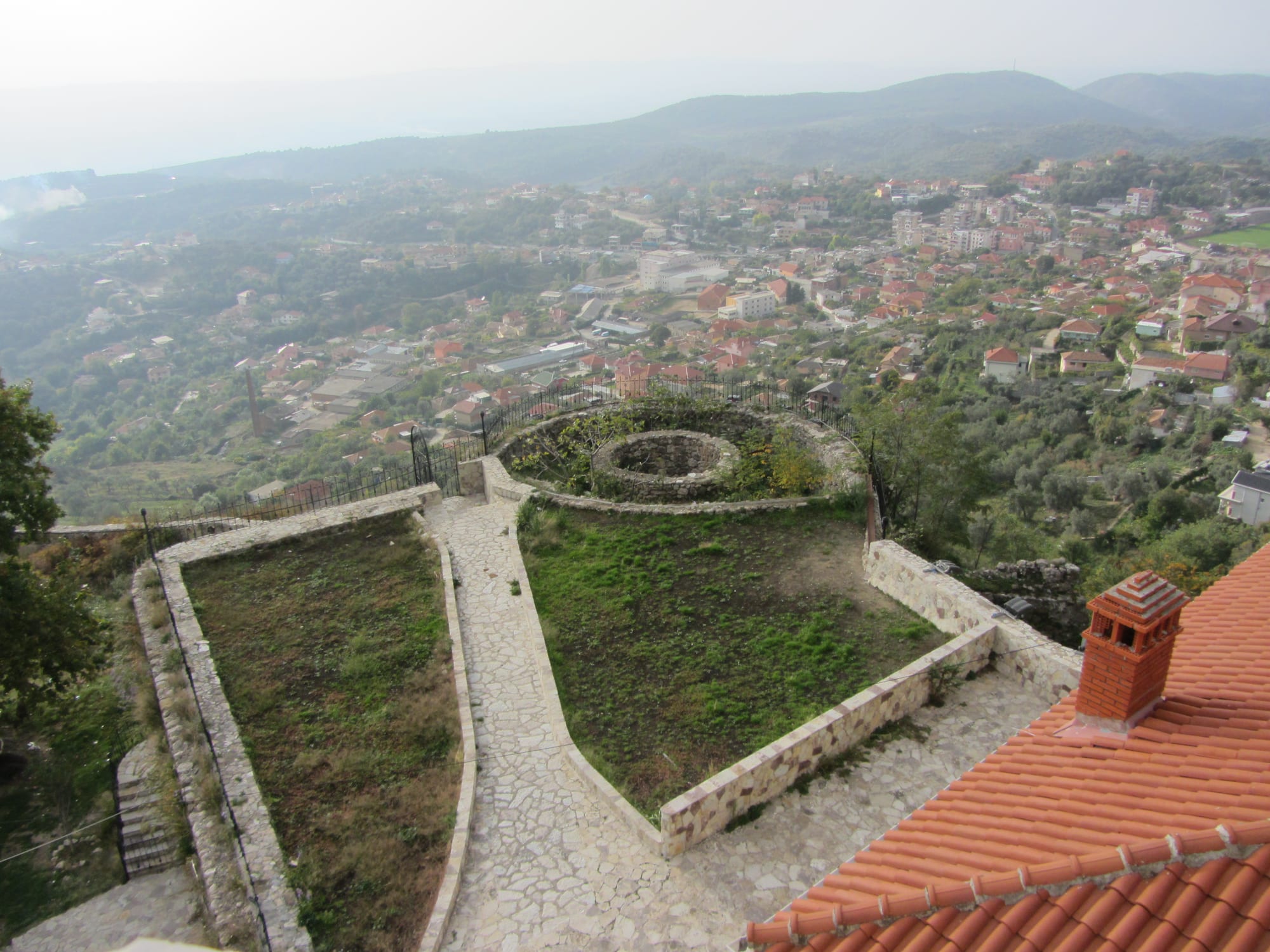
Skanderbeg died of a fever at Lezhë in January 1468. Resistance carried on without him for another decade, but Krujë fell in 1478 and the great Venetian-held fortress of Shkodër surrendered in 1479. Many thousands of Albanians crossed the Adriatic to southern Italy and Sicily, where their descendants, the Arbëreshë, still speak a form of Albanian today.
Four centuries under the Ottomans
Ottoman rule lasted, in most of the country, from 1479 to 1912. For the first century or two the Albanian lands were a military frontier facing Venice and the Habsburgs, governed through the standard Ottoman system of provinces and land-grants. The deepest change was religious. Conversion to Islam, slow at first, accelerated in the 17th and 18th centuries, encouraged by lower taxes, access to office, and the pull of the Bektashi Sufi order, which put down especially strong roots in the south. By 1900 roughly seven Albanians in ten were Muslim, with Orthodox Christian communities in the south and a Catholic heartland in the northern highlands around Shkodër. Unusually, this produced no single religious identity for the nation — a fact 19th-century nationalists would turn into a slogan: "the faith of the Albanian is Albanianism."
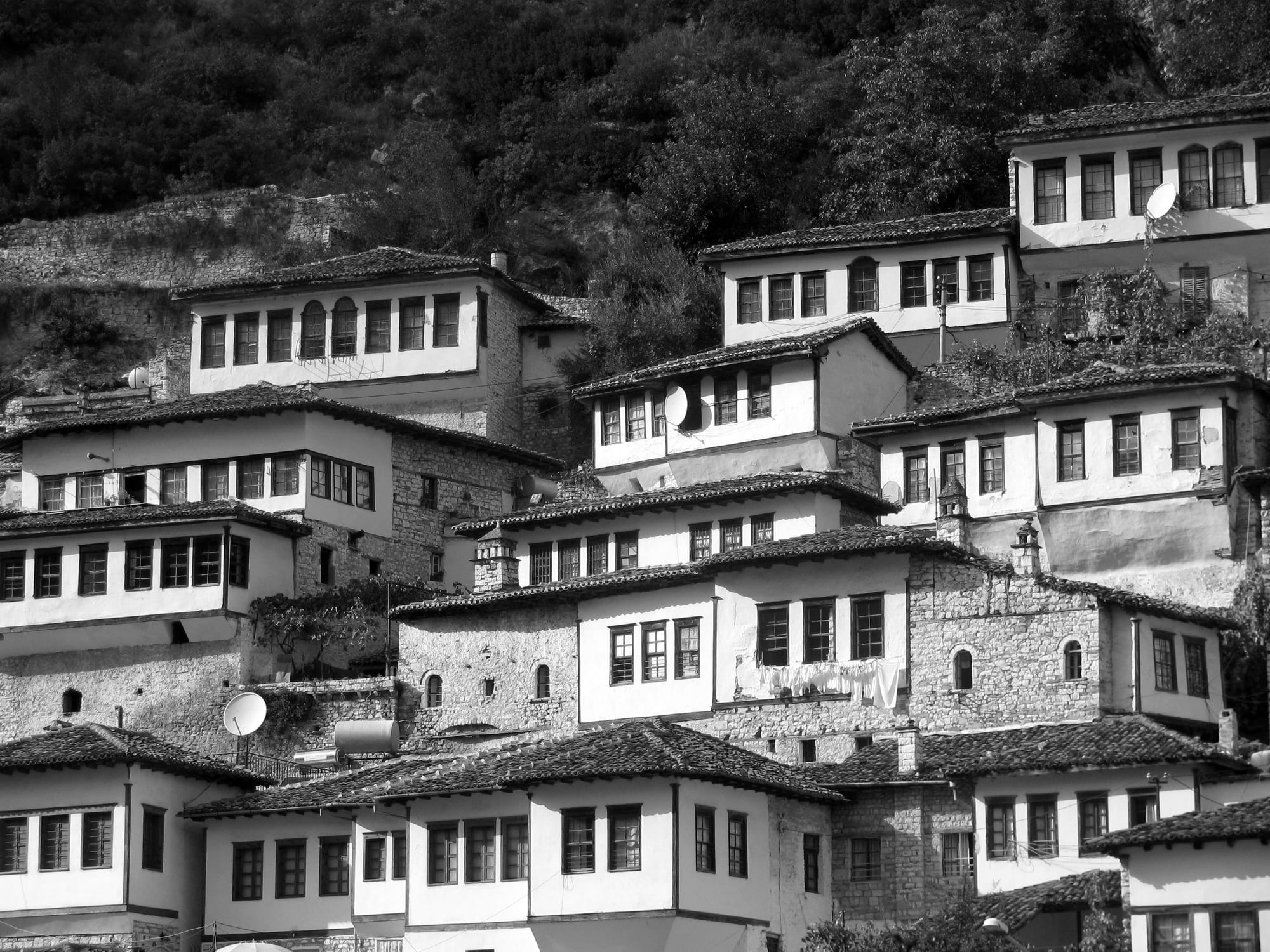
Albanians did well inside the empire even as their homeland stayed poor and peripheral. Dozens of Ottoman grand viziers were of Albanian origin, including the long line of the Köprülü family; Muhammad Ali, the founder of modern Egypt, came from an Albanian family in Kavala. Closer to home, powerful governors carved out near-independent fiefs in the late 18th century — the Bushati dynasty at Shkodër, and above all Ali Pasha of Tepelena, who ruled a swathe of Albania and Greece from Ioannina until the sultan had him killed in 1822.
The Rilindja and independence
An Albanian national movement — the Rilindja, or "rebirth" — took shape in the mid-19th century, driven at first by writers and teachers: the Frashëri brothers, the poet-priest Pashko Vasa, and the Arbëresh scholar Jeronim de Rada in Italy. Its first political moment came in 1878, when the Congress of Berlin handed Albanian-inhabited districts to Serbia, Montenegro and Greece. Albanian delegates met at Prizren and formed a League to resist the transfers and to press for a single autonomous Albanian province. The Ottomans crushed the League in 1881, but the idea outlived it.
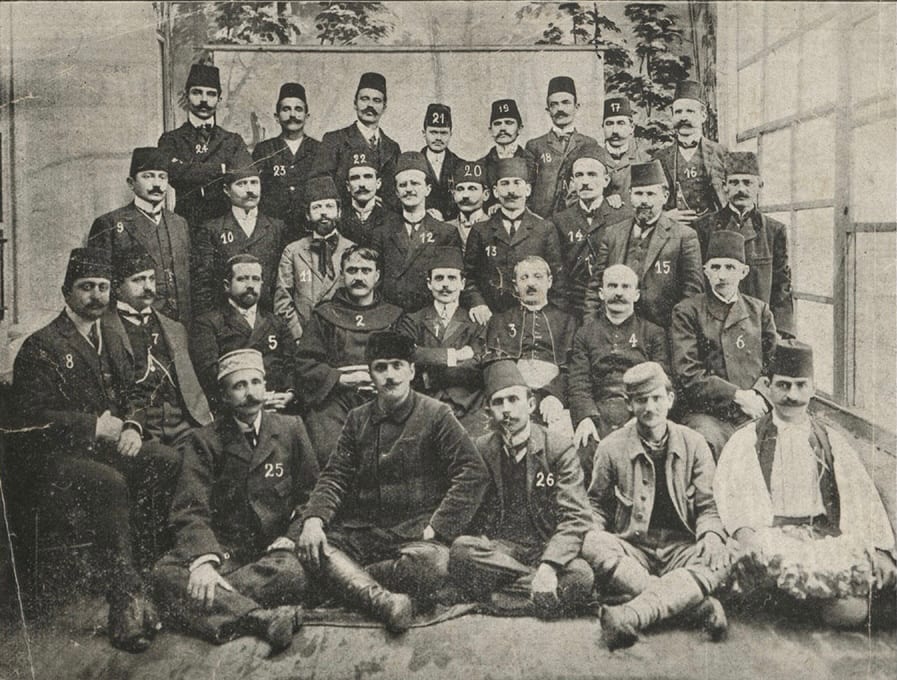
The movement gathered pace in the 1900s. In 1908 a congress at Manastir (Bitola) settled the long-running dispute over how to write Albanian, adopting the Latin-based alphabet still in use. A series of armed revolts against the new Young Turk government followed, and the rising of 1912 won a promise of autonomy for the Albanian vilayets. Then the First Balkan War broke out in October 1912, and Serbian, Montenegrin and Greek armies poured into Albanian territory. To keep the country from being carved up entirely, a assembly of notables met at Vlorë on 28 November 1912 and, under Ismail Qemali, declared Albania independent.
The Great Powers accepted the principle at a conference in London and drew the borders themselves in 1913. The new state was small and its frontiers brutal: roughly half of the region's Albanians — those of Kosovo, of western Macedonia, and of the Çamëria district in Greece — were left outside it. Those boundaries, barely altered since, are still the root of most of the Balkans' Albanian questions.
A kingdom that barely held: Wied to Zog
Independent Albania began in chaos. A German prince, Wilhelm of Wied, was installed as sovereign in March 1914 and left after six months, driven out by a peasant revolt and a Greek-backed secession in the south. During the First World War the country had no government at all and was occupied in pieces by Italy, Austria-Hungary, France, Serbia, Greece and Montenegro. Only in 1920 did a national congress at Lushnjë re-establish a state, move the capital to the small town of Tirana, and win admission to the League of Nations.
The 1920s were a contest between two men: Fan Noli, a reforming Orthodox bishop educated in the United States, and Ahmet Zogu, a young chieftain from the northern Mati highlands. Noli held power briefly in 1924; Zogu returned that December with Yugoslav help, drove Noli into exile, made himself president in 1925, and in September 1928 proclaimed himself King Zog I. His rule brought a measure of order and the country's first modern legal codes, but it leaned ever more heavily on Fascist Italy, which financed the state and treated Albania as a client.
Invasion and war, 1939–1944
On 7 April 1939 Mussolini cashed in the debt. Italian troops landed at Durrës, Zog fled with his wife and infant son, and the Albanian parliament was made to offer the crown to the king of Italy. Albania became a launch-pad for the Italian invasion of Greece in October 1940 — an assault that failed so badly the Greek army ended up occupying southern Albania for the winter.
Resistance grew after the Communist Party of Albania was founded in November 1941 with Yugoslav guidance and Enver Hoxha at its head. Its partisans competed with the nationalist Balli Kombëtar and with royalists, and when Italy surrendered in September 1943 the Germans moved in and the fighting took on the character of a civil war. By late 1944 the communist-led forces had the upper hand; the Germans withdrew, and on 29 November 1944 the resistance took full control of the country.
Hoxha's fortress
Enver Hoxha ruled Albania for 40 years, until his death in 1985, and made it the most closed country in Europe. The regime collectivised the land, built heavy industry from nothing, banned private cars, and ran a pervasive secret police, the Sigurimi, with a network of labour camps and prisons for political offenders. In 1967 it declared Albania the world's first officially atheist state and closed or demolished every mosque, church and monastery in the country.
Its foreign policy was a sequence of ruptures. Hoxha was close to Yugoslavia until the Tito–Stalin split of 1948, then aligned with the Soviet Union; he broke with Moscow in 1961 over de-Stalinisation and took China's side in the Sino-Soviet quarrel; and after China opened to the United States in the 1970s he broke with Beijing too, in 1978, and committed the country to standing entirely alone.
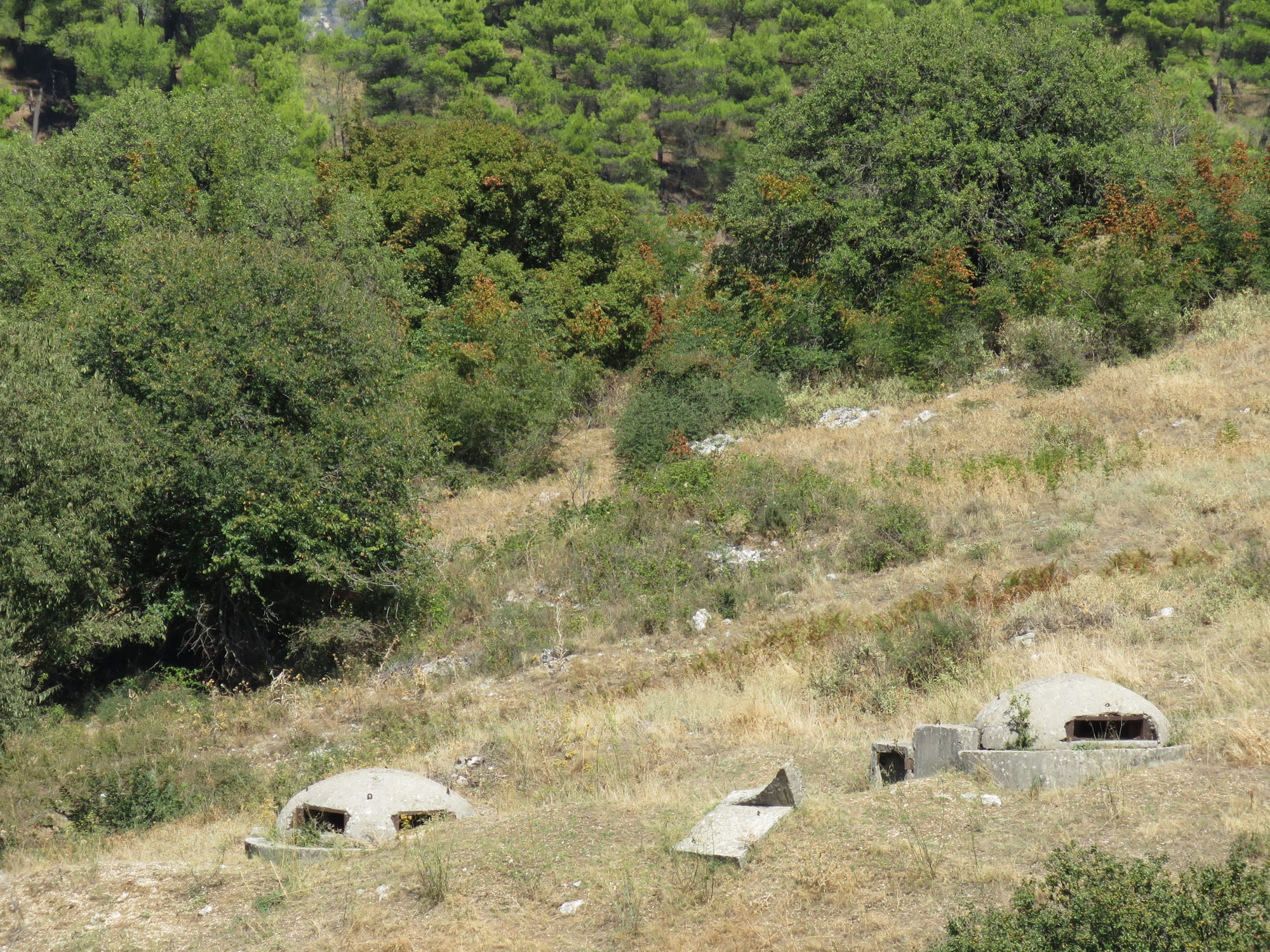
The most visible legacy of that siege mentality is concrete. From the late 1960s the state poured its resources into a programme of small domed pillboxes built across every beach, ridge, field and road junction, against an invasion — from east or west — that never came. Tens of thousands still stud the landscape, too solid and too numerous to remove, and have become an unofficial national emblem.
Collapse and recovery
Hoxha's successor, Ramiz Alia, inherited a bankrupt economy and a population that had begun to hear what it was missing. In July 1990 thousands forced their way into foreign embassies in Tirana and were allowed to leave the country; student protests that December forced the legalisation of opposition parties. The old party won a first multi-party election in 1991, but a second vote in 1992 brought the Democratic Party and Sali Berisha to power. Tens of thousands emigrated by any means available, including the freighter Vlora, which reached the Italian port of Bari in August 1991 with some 20,000 people aboard.
The worst was still to come. In 1996–97 a set of nationwide pyramid investment schemes, in which a large share of Albanian households had placed their savings, collapsed, wiping out sums equivalent to more than half of annual national output. The government's failure to compensate or explain triggered an armed uprising, especially in the south; army depots were looted of hundreds of thousands of weapons, perhaps 2,000 people were killed, and the state effectively ceased to function until an Italian-led multinational force restored order and new elections were held.
Recovery from that low point has been slow but real. Albania absorbed close to half a million refugees from Kosovo during the war of 1999, joined NATO in 2009, was granted European Union candidate status in 2014, and opened formal accession talks in 2022. Emigration has continued on a scale few countries have seen in peacetime — the resident population has fallen from around 3.2 million in 1990 to under 2.8 million — and the money those emigrants send home, together with a fast- growing tourist trade along the Ionian coast, now does much to keep the country running.
What Albania keeps
The through-line of Albanian history is endurance without a state. For most of the last thousand years the land was run from somewhere else — Constantinople, Rome, Istanbul, briefly Belgrade and Rome again — and yet the language held, the clans held, and a sense of nationhood strong enough to survive four Ottoman centuries and four decades of self-imposed isolation held too. The empty niches of that history are everywhere in plain sight: a Greek theatre reused by Rome at Butrint, Ottoman windows climbing the hill at Berat, a communist pillbox in a farmer's field. Albania is the seam where all of those worlds were stitched together, and the stitching still shows.