A spit of pale desert sand reaching into a wide, calm turquoise lagoon, low dunes and open sky beyond

Western Sahara

The lagoon at Dakhla, on a peninsula on the Atlantic coast of the Moroccan-controlled part of Western Sahara, now a kitesurfing destination. (Tbo47 / Wikimedia Commons · CC0 (public domain dedication))

A sparsely populated stretch of Atlantic desert south of Morocco, and the last major unresolved decolonisation case in Africa — a former Spanish colony claimed and largely controlled by Morocco, with a smaller zone held by the Polisario Front's self-declared Sahrawi republic and a large refugee population in Algeria.

Explore Western Sahara

History

The desert was home to nomadic Sahrawi tribes of Arab-Berber descent, herding camels and controlling caravan routes, with the caravan town of Smara as a religious centre. Spain claimed the coast in 1884 and consolidated the colony of Spanish Sahara in the twentieth century, developing phosphate mining at Bou Craa from the 1960s.

As Spain prepared to withdraw in 1975, the International Court of Justice found no tie of sovereignty that would override the Sahrawis' right to self-determination. Morocco responded with the "Green March", sending some 350,000 civilians across the border to press its claim, and Spain handed administration to Morocco and Mauritania. The Polisario Front, backed by Algeria, declared the Sahrawi Arab Democratic Republic (SADR) and fought both. Mauritania gave up its share in 1979; Morocco took it and built a 2,700-kilometre defensive sand wall, the berm, sealing off roughly the western four-fifths of the territory — the useful part, with the coast, the towns, and the phosphates.

A United Nations-brokered ceasefire in 1991 was meant to lead to a referendum on independence or integration; it has never been held, snagged on who is eligible to vote. The SADR is a member of the African Union and is recognised by dozens of states, while Morocco's claim has drawn growing recognition, including from the United States in 2020 and France in 2024. Around 170,000 Sahrawi refugees have lived for decades in camps near Tindouf in southwestern Algeria. In November 2020 the Polisario declared the ceasefire over, and a low-intensity conflict along the berm has continued since.

  • Western Sahara: The Last Colony A stretch of Atlantic desert the size of Britain — a Spanish colony until 1975, then claimed by Morocco and Mauritania, fought over with the Polisario Front, and still, half a century later, the only territory in Africa whose decolonisation the UN has not completed

Culture & Customs

Sahrawi culture is closely related to that of Mauritania: Hassaniya-speaking, Muslim, and rooted in camel-herding nomadism, with the same customs of desert hospitality and the ritual of three rounds of sweet, foamy green tea poured from a height. Sung and recited Hassaniya poetry is a prized art, and the melhfa, the brightly coloured cloth women wrap around themselves, is the distinctive dress.

Decades of displacement have shaped a strong national identity among Sahrawis, in the camps and the diaspora, expressed in protest art, poetry, and the flag. In the Moroccan-controlled towns, daily life increasingly resembles that of southern Morocco, with a large settler population drawn by tax breaks and public jobs, and the two societies — long-standing Sahrawi families and Moroccan settlers — living side by side under a heavy security presence.

Daily Life

Fewer than 600,000 people live in the whole territory. The Moroccan-controlled area is centred on Laâyoune, a purpose-grown administrative city, and the fishing and tourism port of Dakhla; the economy runs on Moroccan public spending, the Bou Craa phosphate mine and its conveyor belt to the coast, one of the world's richest fishing grounds, and, more recently, tomatoes and melons grown under plastic and a push into wind and solar power.

Life in the Polisario-run zone east of the berm is thin and pastoral, and life in the Tindouf camps depends almost entirely on international food aid, with a generation born and raised in exile. Water, in a place with almost no rainfall, is the constant constraint everywhere.

Food

The food is Sahrawi and southern Moroccan: whole roast camel or goat (méchoui) for celebrations, camel meat and milk among herders, couscous with meat and vegetables, and plentiful grilled and fried Atlantic fish on the coast at Dakhla and Laâyoune. Bread, dates, and the long green-tea ceremony accompany almost every gathering, and a guest is not let go without being fed.

Attractions & Natural Wonders

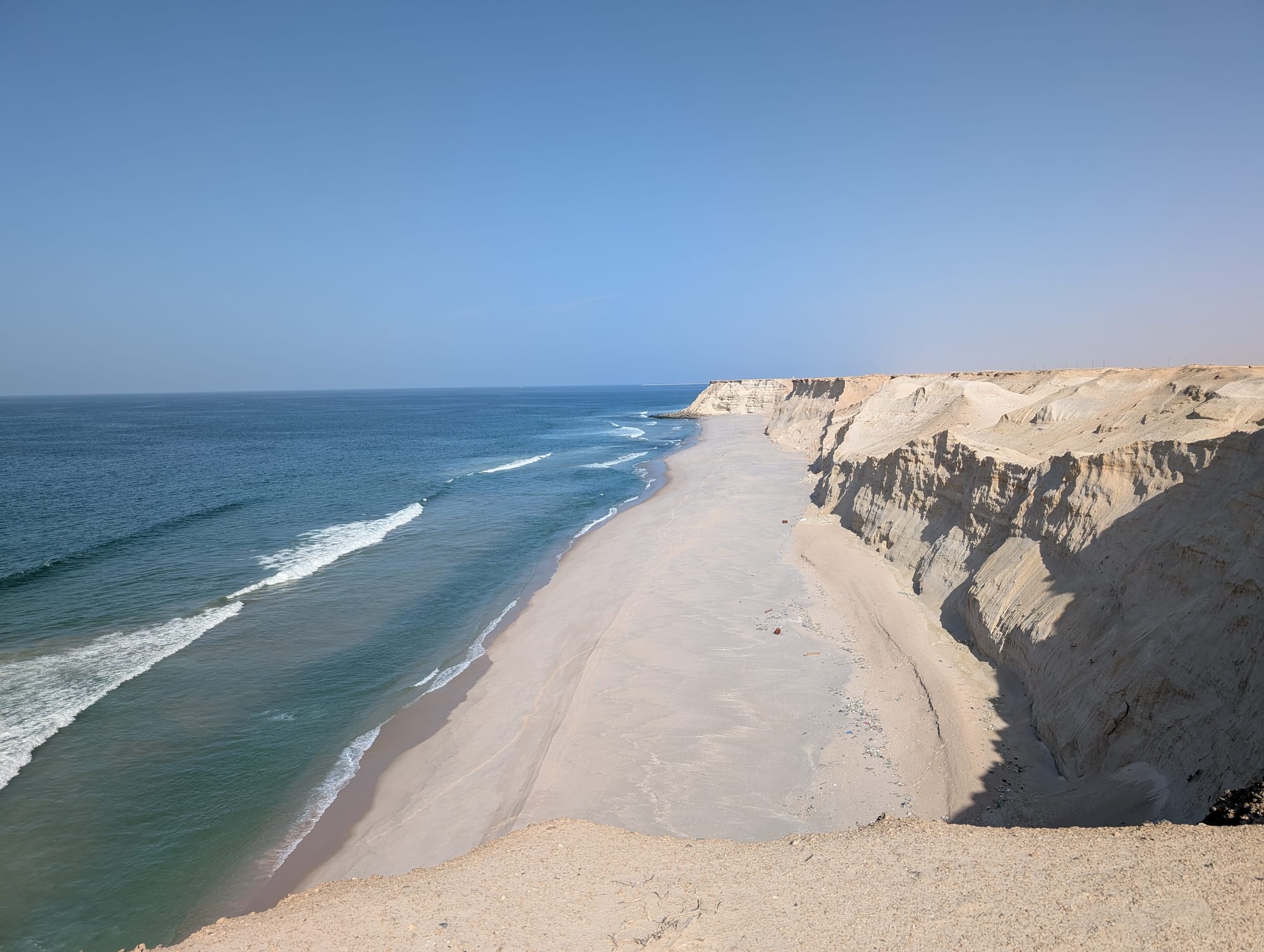
Realistic visiting means the Moroccan-controlled Atlantic coast. Dakhla, on a thin peninsula enclosing a large shallow lagoon, has become a kitesurfing and windsurfing centre, with desert camps, flamingos, oyster farms, the white dune of its lagoon, and 4x4 trips to features such as the "Imlili" pools and the Porto Rico beach. Laâyoune has Spanish colonial architecture, the cathedral, and the market, and is the gateway to the Bou Craa conveyor — at around 100 kilometres, the longest in the world — visible from the road.

The wider desert holds the caravan town of Smara with its ruined nineteenth-century fortress-mosque, long empty beaches and rich birdlife along the coast, and, at Lagouira in the far south near the Mauritanian border, the meeting of desert and ocean. Areas near the berm, the buffer strip, and the Polisario-held east are mined and off-limits, and the ruins of the war are not a tourist landscape.

  • Western Sahara: Four Attractions and Natural Wonders A vast, sparsely populated stretch of the Sahara along the Atlantic coast, and a lagoon town that has become one of the world's premier kitesurfing destinations, in a territory whose political status remains unresolved

Planning basics

Budget

There is very little dedicated tourism infrastructure. The Moroccan-run towns of Laâyoune and Dakhla have hotels across the range, and Dakhla has grown a kitesurf-camp economy on its lagoon. The Polisario-controlled zone and the Sahrawi refugee camps near Tindouf in Algeria are reached only by arrangement and are not tourist destinations.

Daily Budget Midrange
MAD 700–1,600 / USD 70–160 (mid-range hotel, a kitesurf package or 4x4 excursion, meals)
Daily Budget Shoestring
MAD 250–500 / USD 25–50 (basic hotel in Laâyoune or Dakhla, café food, shared transport)

Base in Dakhla for the lagoon and desert; travel on the coastal highway rather than heading inland toward the berm.

Visa Requirements

For the roughly 80 per cent of the territory that Morocco controls, entry is via Morocco under Moroccan rules — most Western nationals enter visa-free for up to 90 days — and there is no separate checkpoint on the main road south, though there are police controls. Visiting the Polisario-administered "Free Zone" or the Tindouf refugee camps requires prior arrangement with the Sahrawi authorities and is done from Algeria.

Typical Stay
Up to 90 days visa-free (Moroccan rules) for most Western passports on the controlled side

Carry your passport and be ready for repeated police checks and questions on the coastal road; independent travel toward the berm or the buffer strip is not permitted.

Safety

The Moroccan-controlled coastal strip and its towns are calm and policed, and Dakhla in particular sees steady tourism. However, most governments advise against travel to areas near the 2,700-kilometre sand berm that divides the territory, where uncleared landmines from the war remain a serious hazard, and against travel to the Polisario-controlled zone and the wider buffer strip. A low-level armed confrontation between Morocco and the Polisario Front resumed in November 2020 after nearly three decades of ceasefire. Photographing security forces and installations is not allowed.

Landmines
Uncleared mines and unexploded ordnance remain along and east of the berm — one of the most mine-affected areas in the world

Keep to the coastal highway and the towns, never leave the road near the berm or the buffer strip, don't photograph the military or checkpoints, and read your government's travel advice in full.

Climate

Hot desert, moderated on the coast by the cool Canary Current, which brings frequent fog and keeps Dakhla and Laâyoune milder than the interior. Inland is very hot by day and cold at night, extremely dry, and subject to dust storms and the hot sirocco wind. There is almost no rain.

Coast
Mild and often foggy, roughly 18–28°C
Interior
Very hot days, cold nights, dust storms

Transportation

Laâyoune and Dakhla have airports with flights from Casablanca and other Moroccan cities; long-distance Moroccan coaches (CTM, Supratours) run down the coastal highway from Agadir and Marrakesh. Beyond the paved coast road, travel needs a 4x4 and, near the militarised berm, is prohibited. The Polisario zone is reached overland from Tindouf in Algeria.

Fly or take a coach to Dakhla or Laâyoune and stay on the coastal highway; do not attempt to drive toward or across the berm.

Best Time to Visit

October to April is the most comfortable, with warm days and cooler nights; the Dakhla kitesurfing season runs roughly March to October on the steady trade wind. Deep summer inland is punishing.

Events
Little in the way of public festivals for visitors; the Moroccan calendar applies in the controlled towns, and the Sahrawi national day (27 February) is marked in the camps

Currency

In the Moroccan-controlled area the currency is the Moroccan dirham (MAD), the same restricted currency as in Morocco proper — obtain and spend it inside the country. Cards work in Laâyoune and Dakhla hotels; carry cash elsewhere. The Sahrawi refugee camps operate on Algerian dinars and aid.

Symbol
DH
Currency Code
MAD — Moroccan dirham (controlled area)

Language

The Sahrawis speak Hassaniya Arabic, the same Bedouin Arabic as much of Mauritania. In the Moroccan-administered area, Modern Standard Arabic and French are used in administration, alongside Moroccan Arabic among settlers; Spanish survives from the colonial period and is still taught in the Sahrawi camps. English is limited.

Also Used
French and Modern Standard Arabic (administration); Spanish (colonial legacy, camps)
Everyday Language
Hassaniya Arabic