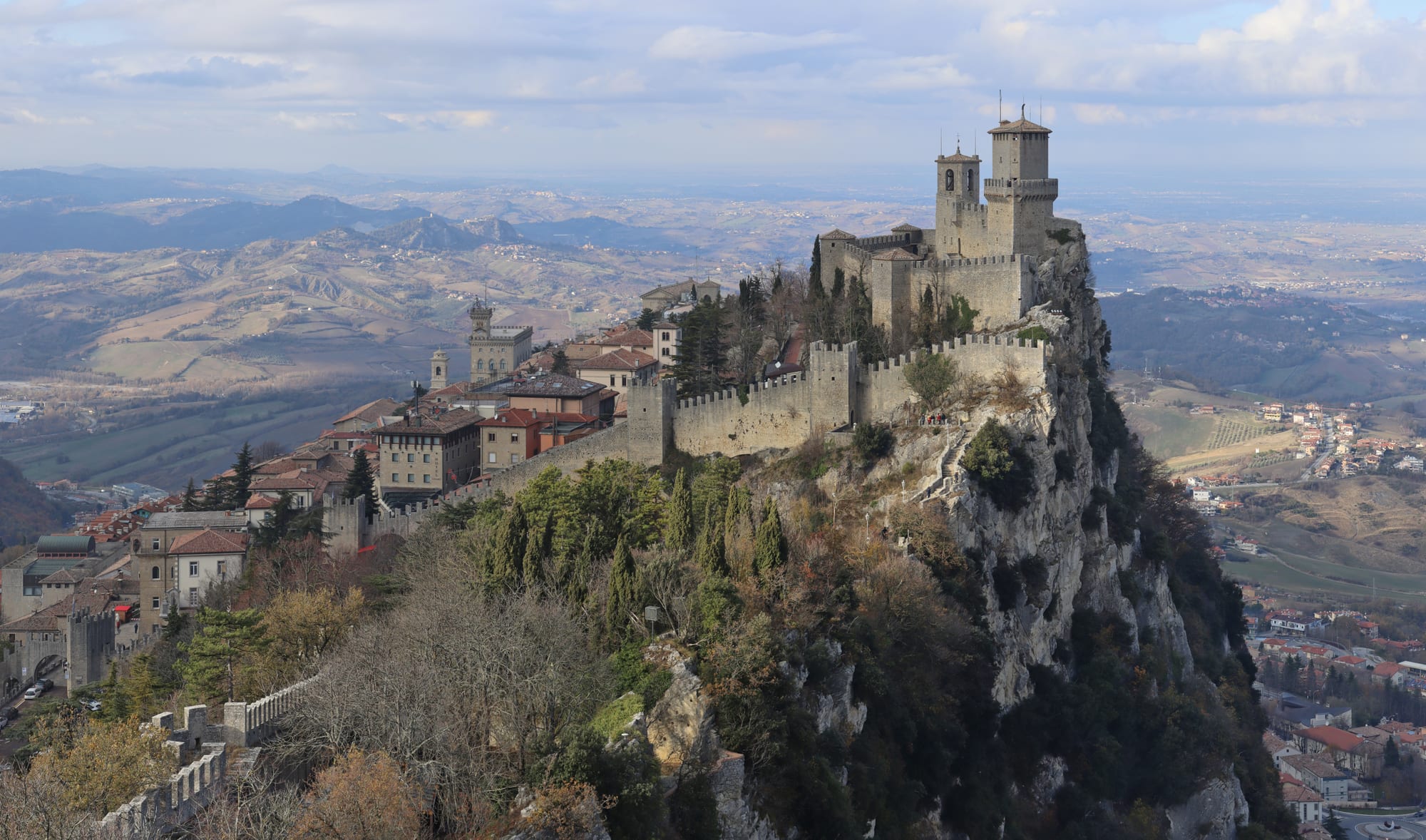
A medieval stone watchtower with a pointed spire on the crest of a cliff, with the tiled roofs of a small city below and a hazy plain stretching to the horizon

San Marino

The Guaita tower on the ridge of Monte Titano above the city of San Marino, one of three fortresses that crown the mountain. (Terragio67 / Wikimedia Commons · CC BY-SA 4.0)

A microstate of 61 square kilometres on and around Monte Titano, entirely surrounded by Italy near the Adriatic — by its own account the world's oldest surviving republic, founded by tradition in 301 AD and independent, more or less continuously, ever since.

Explore San Marino

History

By tradition, San Marino was founded in 301 AD by Marinus, a Christian stonemason from the Adriatic island of Rab who fled persecution and formed a monastic community on Monte Titano. That community grew into a commune in the Middle Ages, had its independence recognised by the Papacy in 1631, and survived a brief occupation by a cardinal in 1739.

In 1849 San Marino sheltered Giuseppe Garibaldi as he fled Austrian troops, and Garibaldi in turn made sure that a unified Italy would respect the little republic's independence; a treaty of friendship with Italy dates from 1862 and has been renewed ever since. San Marino stayed neutral in both world wars, was accidentally bombed and briefly occupied in 1944, and sheltered around 100,000 refugees — three times its population — during the Italian campaign.

In 1945 San Marino elected the world's first democratically chosen communist-led government, which held power until 1957. A later reputation as a tax haven and banking-secrecy centre brought friction with Italy and international scrutiny, resolved through transparency agreements that shrank the financial sector. The country now lives largely on tourism, collectible coins and stamps, light industry, and finance, and is negotiating an association agreement with the EU.

  • San Marino: The Oldest Republic A mountain-top city-state that has kept its independence since, by tradition, the year 301 — surviving the popes, Napoleon, Italian unification and two world wars by being too small, too steep and too clever to bother conquering

Culture & Customs

San Marino's culture is essentially that of the surrounding Romagna and Marche, Italian in language, food, and Catholic faith, with a strong civic identity built on the pride of unbroken independence. Its distinctive institution is the pair of Captains Regent, heads of state elected for six-month terms — a system running continuously since the thirteenth century — installed twice a year in a ceremony of medieval pageantry.

Crossbow companies, flag-throwers, and costumed processions feature at the national festivals, and the country fields its own Olympic and football teams, issues its own passports and vehicle plates, and gives its name to a MotoGP round raced just over the border in Italy. Same-sex civil unions were recognised in 2018, and abortion was legalised by referendum only in 2021.

Daily Life

Most Sammarinese live not in the hilltop historic city, which is given over to tourism, but in the larger settlements below — Serravalle, Borgo Maggiore, Dogana — which run into the Italian conurbation around Rimini with no visible border. Incomes are high and unemployment low, and daily life, work, shopping, and schooling are closely interwoven with Italy's.

The economy leans heavily on the two million or so visitors a year, most of them day-trippers from the Adriatic beaches, along with ceramics, electronics, and clothing manufacturing, wine, and the sale of coins and stamps to collectors. The banking contraction and San Marino's dependence on the Italian economy are the standing vulnerabilities.

Food

The food is Romagnol. Fresh egg pasta is the heart of it — strozzapreti, tagliatelle, cappelletti in broth, and passatelli — dressed with ragù or seasonal sauces, and piadina, the thin griddle flatbread of the region, is folded around cured ham, soft squacquerone cheese, and greens.

Grilled and roast meats, coniglio (rabbit), and porcini in season fill the mains, and the local dessert is the torta tre monti, a wafer-and-chocolate cake shaped and named for the three peaks of Monte Titano. San Marino makes its own wines — Sangiovese and the white Biancale — and a herbal liqueur, tilus.

Attractions & Natural Wonders

The historic centre of San Marino and Monte Titano are together a UNESCO World Heritage Site. Three medieval fortresses run along the ridge, linked by a cliff- edge path with huge views over Romagna to the Adriatic: the Guaita, the oldest; the Cesta, on the highest point, with a museum of historic arms; and the smaller Montale.

Below them, the walled city is a warren of stepped lanes with the Basilica del Santo, the neoclassical Palazzo Pubblico where the Captains Regent govern and the changing of the guard takes place in summer, the Piazza della Libertà with its Statue of Liberty, and a string of small, quirky museums — of torture instruments, of curiosities, of wax figures, and the state museum of art and archaeology. The cable car down to Borgo Maggiore, itself a pleasant town with a Sunday market, completes a compact visit.

Planning basics

Budget

San Marino can be seen in a day, which many visitors do as a trip from Rimini. Staying overnight in the historic centre is more expensive than the coast; eating a little way from the main tourist lanes brings prices down.

Daily Budget Midrange
EUR 130–240 to stay overnight (hotel in or near the old town, restaurants, the cable car and sights)
Daily Budget Shoestring
EUR 45–80 as a day trip (bus from Rimini, a trattoria lunch, the towers and museums)

Come as a day trip by bus from Rimini, or stay overnight to have the historic centre to yourself after the tour groups leave.

Visa Requirements

San Marino has open borders with Italy and no entry checks, so Schengen rules apply. Citizens of the EU, the UK, the US, Canada, Australia, New Zealand, and many other countries may enter visa-free for up to 90 days in any 180-day period; others need a Schengen visa.

Typical Stay
90 days in any 180-day period, visa-free, for most Western passports

Safety

San Marino is one of the safest places in the world, with negligible violent crime. The only real concerns for visitors are pickpocketing in the crowded high-season lanes, the steep and often slippery cobbles and stairs of the historic centre, and exposed drops with low railings at the towers and along the cliff paths.

Wear sturdy shoes and take care on the steps in rain or ice, keep bags secure among the tour crowds, and stay back from the unguarded edges on Monte Titano.

Climate

Mediterranean, moderated by the altitude of Monte Titano, which is cooler and often mistier than the coast just below. Summers are warm to hot, winters are mild with some snow and fog on the mountain, and spring and autumn are pleasant. Rain is spread through the year, heavier in autumn.

Summer
June–September, 25–32°C
Winter
December–February, 3–10°C, fog and occasional snow on the mountain

Transportation

There is no airport or railway. Access is by road from Rimini — a regular Bonelli bus (about 50 minutes), taxi, or car — and a cable car runs from Borgo Maggiore up to the historic centre. Within the tiny hilltop city everything is on foot, up steep, stepped, cobbled lanes; a small tourist road-train loops the sights.

Park below the walls and walk or take the cable car up; the old town is car-free and very steep.

Best Time to Visit

April–June and September–October are mild, clear, and less crowded than the July–August peak, when day-trippers pour up from the Rimini Riviera. The Medieval Days festival in late July recreates the town in period costume.

Events
Investiture of the Captains Regent (1 April and 1 October); Medieval Days (late July); the national day of Saint Marinus (3 September)

Currency

San Marino uses the euro under a monetary agreement with the EU and mints its own euro coins, sought after by collectors. Cards and contactless payment are accepted widely.

Symbol
Currency Code
EUR — euro

Language

Italian is the official language, identical to standard Italian and used in government, education, and daily life. A form of Romagnol, often called Sammarinese, is spoken mainly by older people. English is widely understood in the tourism trade.

Also Spoken
Romagnol (Sammarinese); English in tourism
Official Language
Italian