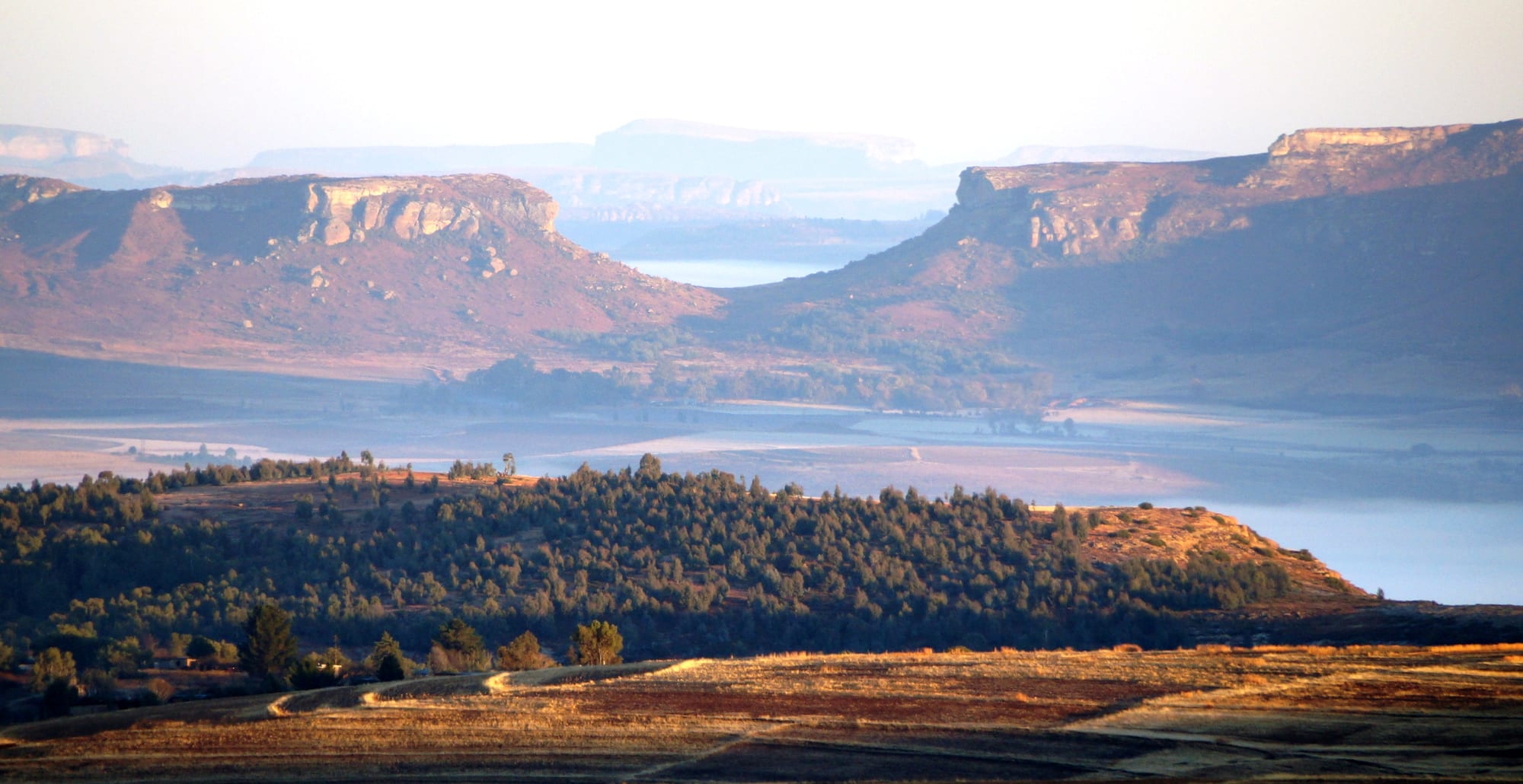
Flat-topped sandstone mesas glowing pink in low sun above a valley filled with white fog, with a pine-covered ridge and golden fields in the foreground

Lesotho

Fog fills the Mohokare (Caledon) River valley beneath flat-topped sandstone plateaus in Lesotho. (Paramente Phamotse / Wikimedia Commons · CC BY-SA 3.0)

A mountain kingdom entirely surrounded by South Africa — "the kingdom in the sky," the only country whose land lies wholly above 1,000 metres — built by a nineteenth-century king who chose British protection over absorption.

Explore Lesotho

History

The Basotho nation was forged in the early nineteenth century by King Moshoeshoe I, who gathered refugees fleeing the wars of the Zulu expansion onto the flat-topped mountain stronghold of Thaba Bosiu and welded them into a people. Facing pressure from Boer settlers moving into the fertile lowlands, he asked for British protection, and in 1868 the territory became the protectorate of Basutoland — which is why it never became part of South Africa.

Basutoland was administered separately through the apartheid decades and became independent as the Kingdom of Lesotho in 1966, a constitutional monarchy. Its politics have been chronically unstable, with coups, a 1998 South African and regional military intervention to restore order after disputed elections, army mutinies, and fragile, frequently collapsing coalition governments.

The king, currently Letsie III, is a ceremonial "living symbol of national unity." The modern economy rests on selling water and hydroelectricity to South Africa through the Lesotho Highlands Water Project's giant dams; on diamonds from the world's highest mines; on garment factories exporting to the United States; on wool and mohair; and on remittances from Basotho who work, in dwindling numbers, in South Africa's mines.

  • Lesotho: The Kingdom in the Sky A mountain nation forged by Moshoeshoe I during the wars of the 1820s, surrounded entirely by South Africa — saved from annexation by British protection, and living now on migrant wages and exported water

Culture & Customs

Basotho culture is strongly identified with the mountains and with a few vivid symbols: the Basotho blanket, a heavy patterned wool blanket worn as a garment, with specific designs for a chief, a newlywed, or a new mother; the mokorotlo, the conical woven straw hat that also appears on the national flag; and the hardy Basotho pony, on which much of highland life still moves.

Society is largely Christian, layered over traditional belief, with a strong system of chieftaincy and communal land held in trust by the king through local chiefs. Initiation schools, the lesiba mouth-blown string instrument, choral singing, and famo accordion music are living traditions.

Hospitality in the villages is warm, and pony-trekking visitors are often hosted overnight in Basotho households. Cattle are wealth, status, and ritual sacrifice, and the seasonal movement of animals to high pastures shapes the herding year.

Daily Life

Most Basotho live in the lowland strip along the western border, in and around Maseru — a small, low-rise capital on the Caledon River facing South Africa — and in scattered highland villages of stone-and-thatch rondavels reached by dirt track or on horseback. The eastern two-thirds of the country is high, cold, and thinly peopled.

Lesotho is one of the poorer countries in the region, and its economy is tightly bound to South Africa's through the customs union, the currency peg, and the labour migration that has sustained families for generations but is now shrinking. The garment sector is the largest formal employer, mostly of women. Lesotho also has one of the world's highest HIV prevalence rates, though treatment has expanded widely.

Daily life follows the farming and herding seasons — eroding maize and sorghum plots in the lowlands, sheep and goats and the move to summer cattle posts in the highlands — the church, and, for many households, a wage or a pension sent home from across the border.

Food

Basotho cooking is Southern African and maize-based. Papa (also pap), a stiff maize porridge, is the staple, eaten with moroho (cooked wild or cultivated greens), beans, or a stew of beef, mutton, or chicken. Likhobe (samp and beans) and motoho, a soured sorghum porridge often taken for breakfast, are traditional.

Mutton and beef feature at ceremonies, often slaughtered on site, and sesotho bread baked in a pot over coals, pumpkin, and wild vegetables round out rural meals. Roadside grills and shebeens serve braai meat, pap, and relish, the shared regional fare.

Home-brewed sorghum beer (joala) is drunk at gatherings and rituals; commercial lager and, in winter, strong sweet tea are the everyday drinks.

Attractions & Natural Wonders

Lesotho's appeal is high, wild scenery and a way of life still lived on horseback. The Sani Pass, a steep, rough 4x4 track climbing from South Africa's KwaZulu-Natal to nearly 2,900 metres, delivers you to the "highest pub in Africa" just over the border and is one of the great mountain drives.

Pony trekking is the classic way in: multi-day guided rides from Malealea or Semonkong lodges through villages, over passes, and to viewpoints and rock-art sites, staying in Basotho homes along the way. Maletsunyane Falls near Semonkong drops nearly 200 metres in a single plunge and has the world's longest commercially run single-drop abseil.

Sehlabathebe National Park, in the remote southeast, protects highland moorland, rock pools, San paintings, and strange sandstone formations, and forms part of the Maloti-Drakensberg Park, a UNESCO World Heritage Site straddling the border. Thaba Bosiu, the mountain where the nation was founded, the Katse and Mohale dams with their visitor centres, and the mission town and dinosaur footprints of Morija fill out a short but memorable circuit.

  • Lesotho: Eight Attractions and Natural Wonders The 'Kingdom in the Sky' — one of Africa's highest waterfalls, a hair-raising mountain pass, a highland dam feeding two countries, and villages best reached on a sure-footed pony

Planning basics

Budget

Lesotho is inexpensive, and prices track South Africa's since the currencies are linked. Backpacker lodges, guesthouses, and pony-trekking packages are the norm; there are few luxury options. Cards work in Maseru and at the lodges; carry cash (rand or maloti) in the mountains.

Pony Trek
Guided multi-day pony treks from Malealea or Semonkong include meals and village stays
Daily Budget Midrange
USD 70–140 (guesthouse or lodge, a hired 4x4, a pony trek, park fees)
Daily Budget Shoestring
USD 30–50 (backpacker lodge, self-catering, minibus taxis)

Visa Requirements

Citizens of the EU, the UK, the US, Canada, Australia, and most Commonwealth countries enter visa-free for stays of up to 14 to 90 days depending on nationality; an e-visa is available for others. Nearly everyone arrives overland from South Africa.

Typical Stay
14 to 90 days visa-free for most Western passports

Check the opening hours of the border post you plan to use; several close in the early evening.

Safety

Rural Lesotho and the pony-trekking and lodge circuit are fairly safe, but Maseru has significant crime — muggings, carjacking, and home invasion — so take normal urban precautions and avoid walking after dark. Political instability occasionally brings unrest to the capital, and stock theft can make some remote border areas tense.

Source
US Department of State and UK FCDO travel advisories — check for the latest wording.

Take mountain weather, altitude, fog, ice, and sheer drops seriously; watch for lightning on the exposed highlands; and cross rivers only when they are low.

Source: US Department of State and UK FCDO travel advisories — check for the latest wording.

Climate

Temperate highland, with sharp seasons. Winters (May–August) are cold and dry, with hard frosts and snow on the high ground — enough for a small ski resort. Summers (November–April) are warm to hot in the lowlands with dramatic afternoon thunderstorms and the year's rain; snow can fall at altitude even in summer.

Lowlands
warm summers, cold clear winters
Highlands
cold much of the year; snow and ice on the passes in winter

Transportation

Moshoeshoe I International Airport near Maseru has limited links, so most visitors drive in from South Africa (Johannesburg is about four hours to Maseru). There is no useful passenger rail. Minibus taxis cover the country slowly and cheaply; a 4x4 is essential for the interior, and the mountain passes demand caution.

Driving
On the left; the 'Roof of Africa' route and the Sani Pass are spectacular but slow, steep, and weather-dependent

Best Time to Visit

March to May and September to November for mild, mostly dry weather and good hiking and pony-trekking conditions. June to August is bitterly cold but clear, with snow and the Afriski season. The summer rains can make river crossings and dirt roads difficult.

Currency

The currency is the Lesotho loti (plural maloti, LSL), pegged one-to-one to the South African rand, which circulates freely and is accepted everywhere. Maloti are generally not accepted in South Africa, so spend them before you leave.

Cards
Accepted in Maseru and at lodges; cash elsewhere
Symbol
L / M
Currency Code
LSL — loti (1:1 with the South African rand)

Language

Sesotho and English are both official. Sesotho, a Bantu language, is spoken by almost everyone; English is used in government, secondary education, and business and is widely understood in Maseru and the tourist lodges.

English
Widely spoken in tourism and government
Official Languages
Sesotho, English