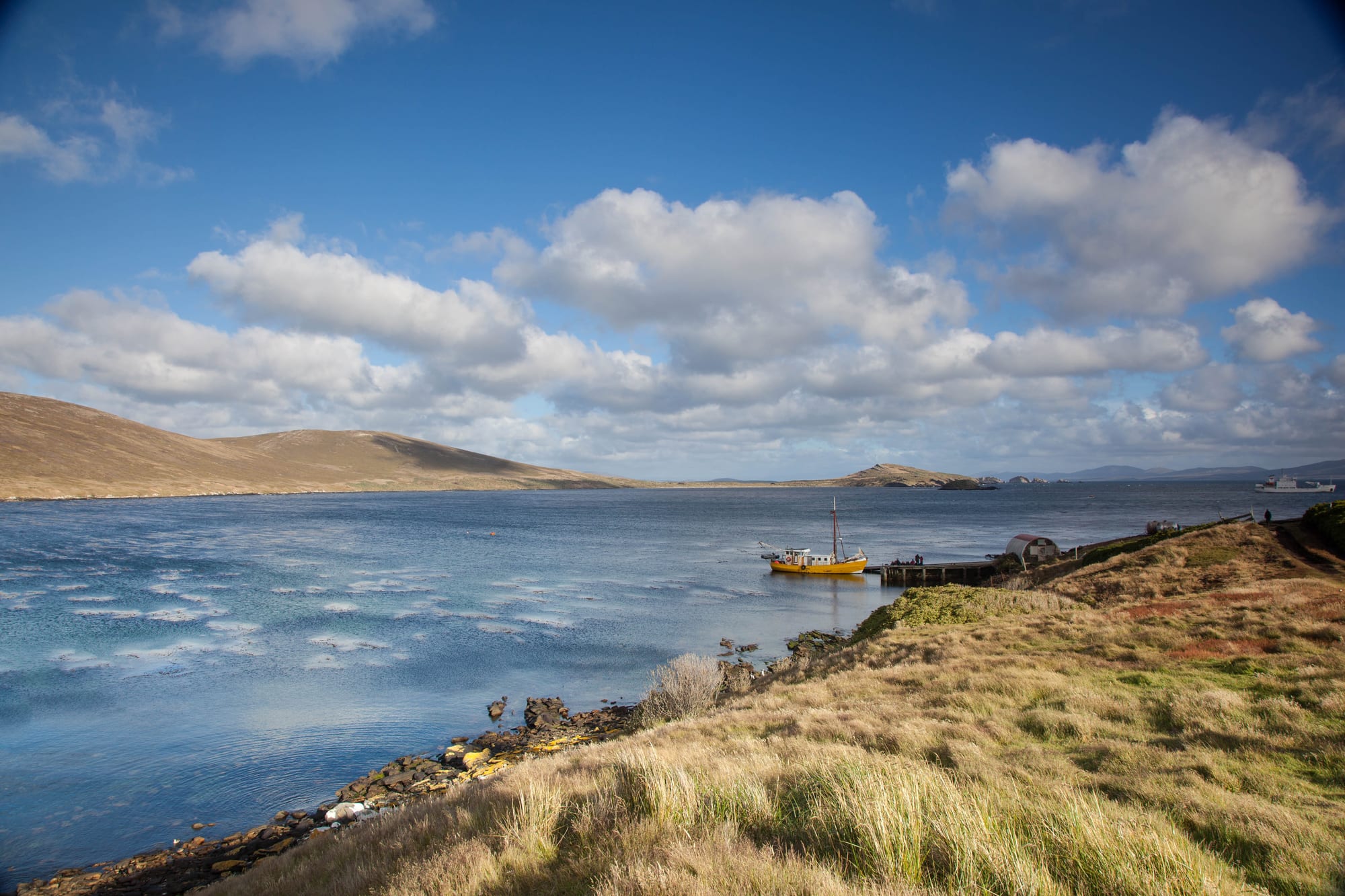
A small yellow boat moored at a wooden jetty in a wind-ruffled blue bay, with golden tussock grass in the foreground, bare brown hills beyond and white clouds in a deep blue sky

Falkland Islands

A boat at the jetty on Carcass Island, with tussock grass running down to the shore and treeless hills across the water. (nomis-simon / Wikimedia Commons · CC BY 2.0)

A windswept South Atlantic archipelago of two large islands and hundreds of small ones, about 500 km off Argentina — a British Overseas Territory of around 3,700 people, invaded by Argentina in 1982 and retaken in a 74-day war, now living self-sufficiently on fishing, wool, and wildlife tourism.

Explore Falkland Islands

History

The islands were uninhabited when Europeans arrived. France, Britain, and Spain all made claims and planted small settlements in the eighteenth century; Spain, and then the newly independent Argentine state, asserted control in the early nineteenth. Britain reasserted its own claim and established a continuous administration in 1833 — a step Argentina has never accepted.

A sheep-farming colony grew up, dominated by the Falkland Islands Company, with a settled population mostly of British descent who became known as "Kelpers". On 2 April 1982 Argentina's military junta invaded. A British naval task force sailed 13,000 kilometres south, and after air, sea, and land fighting — the loss of HMS Sheffield, the battle of Goose Green, the assaults on the hills around Stanley — retook the islands by 14 June. In all, 255 British and 649 Argentine service personnel and three islanders died.

Since the war the United Kingdom has kept a garrison at Mount Pleasant, and the islands have prospered on revenue from selling fishing licences in their waters. A 2013 referendum returned a 99.8 per cent vote to remain a British Overseas Territory on a 92 per cent turnout. Argentina maintains its claim, and the "Malvinas" are written into its constitution.

Culture & Customs

The Falklands are a small, close-knit, English-speaking, mostly Christian community — rural, practical, and self-reliant, with a strong tradition of volunteering and mutual help. Life divides between Stanley and "camp" (from the Spanish campo), the term for everywhere else — the scattered farms and settlements reached by rough track and small plane.

Land Rovers, the pub, darts, and Boxing Day horse racing are fixtures, and the identity is firmly and deliberately British, bound up with the right of the islanders to determine their own future. The 1982 war is present in daily life: the memorials, the battlefield sites, and Liberation Day on 14 June.

Daily Life

About 3,700 people live in the Falklands, roughly three-quarters of them in Stanley and the rest on isolated farms across the two main islands and the smaller ones. The economy runs on fishing-licence fees — largely for squid — plus wool from around half a million sheep, wildlife and expedition-cruise tourism, and services to the military base.

There is little poverty of the usual kind and the government runs a surplus, but everything is remote, imported, and weather-dependent, and many young people leave for education in the United Kingdom. Offshore oil has been discovered but not developed.

Food

Falklands cooking is British home food adapted to what grazes and grows: mutton and lamb in every form (locals joke about "365"), beef, and vegetables raised in polytunnels against the wind. "Smoko" is the mid-morning tea break. Local touches include diddle-dee jam, made from the berries of the heath shrub that covers the moorland, upland goose, and sea trout. Stanley has fish and chips and a couple of pubs, and a lot of the larder is imported and tinned; small-batch local ale and gin have appeared in recent years.

Attractions & Natural Wonders

Wildlife is why most people come. Five penguin species breed here — the king penguins of Volunteer Point, plus gentoo, Magellanic, southern rockhopper, and macaroni — along with black-browed albatross colonies, southern elephant seals, sea lions, and Commerson's dolphins. Much of it is seen on offshore islands run as wildlife lodges, among them Sea Lion Island, Carcass, Saunders, Pebble, and Bleaker.

Stanley itself is a tidy, colourful little capital with Christ Church Cathedral and its arch made from the jawbones of two blue whales, the Historic Dockyard Museum, and the 1982 memorials; Gypsy Cove just outside town has Magellanic penguins, and the Cape Pembroke lighthouse marks the eastern point. For those with an interest in the war, the battlefields and the Argentine cemetery near Darwin can be visited with a guide.

The harbours hold the hulks of nineteenth-century sailing ships driven in for shelter and never repaired, and the open camp — tussock islands, white-sand beaches, and windswept moorland — is the real character of the place.

Planning basics

Budget

Expensive and logistically demanding. Internal flights, the handful of island wildlife lodges, and the few Stanley hotels are all costly, and a visit usually has to be built around the weekly international flight or a cruise-ship call. Budget travel is barely a concept here.

Daily Budget Note
Roughly GBP 150–350+ per day once inter-island flights and lodge stays are counted

Decide early whether you are coming by cruise for a day or flying in for a week, and book lodges and FIGAS flights well ahead — capacity is tiny.

Visa Requirements

Citizens of the UK, EU, US, Canada, Australia, New Zealand, and many other countries do not need a visa for short stays (commonly up to four weeks, extendable). A passport valid for the stay, proof of onward travel, pre-booked accommodation, sufficient funds, and comprehensive insurance are required.

Typical Stay
Around 4 weeks visa-free for most Western passports, extendable

Arrange accommodation and any inter-island flights before you arrive; immigration expects to see a full itinerary.

Safety

Very safe, with almost no crime. The real hazards are environmental — the wind, cold, and fast-changing weather, boggy ground and river crossings in camp, and the sea. Wartime minefields have all been cleared, with the work completed in 2020 and the beaches reopened, but obey any remaining signage.

Health
Medical care in Stanley is basic; serious cases are flown to Chile or the UK, so comprehensive insurance is essential

Carry windproof and waterproof layers even in summer, tell someone your route in camp, keep well back from cliff edges and wildlife, and never enter a fenced or signed area.

Climate

Cool oceanic and persistently windy. Summer (December–February) days are about 9–13°C with very long daylight; winter (June–August) is about 2–5°C with short days and snow flurries. The weather changes constantly and can bring sun, rain, and hail within an hour; the wind is the defining feature year-round.

Summer
December–February, 9–13°C, long days
Winter
June–August, 2–5°C, short days

Transportation

The only scheduled air links are the weekly LATAM flight from Santiago via Punta Arenas in Chile, which stops monthly at Río Gallegos in Argentina, and the twice-weekly UK military "airbridge" from RAF Brize Norton via Ascension. Many visitors instead arrive on Antarctic or South Atlantic expedition cruises. Within the islands, the Government Air Service (FIGAS) flies small aircraft to grass strips on next-day request; roads outside Stanley are few, and camp travel is by 4x4 on tracks. Driving is on the left.

Build your itinerary around the FIGAS schedule, which is set the evening before based on demand, and allow slack for weather.

Best Time to Visit

October to March is the visitor season, when penguins and seabirds are breeding and the cruise ships call. December to February is the mildest and the peak for wildlife. Outside that window many lodges close and flights are sparse.

Events
Liberation Day (14 June); the Stanley Sports and camp sports meetings with horse racing over Christmas and New Year; the West Falkland Sports

Currency

The Falkland Islands pound is pegged one-to-one to sterling and interchangeable with it within the islands, though Falklands notes are not accepted in the UK. Cards work in Stanley; carry cash for camp and the lodges. There is a single bank and very limited ATM access.

Symbol
£
Currency Code
FKP — Falkland Islands pound (at par with sterling)

Language

English is the sole official and everyday language, spoken with an accent of its own that mixes West Country, Scottish, and other British influences.

Official Language
English