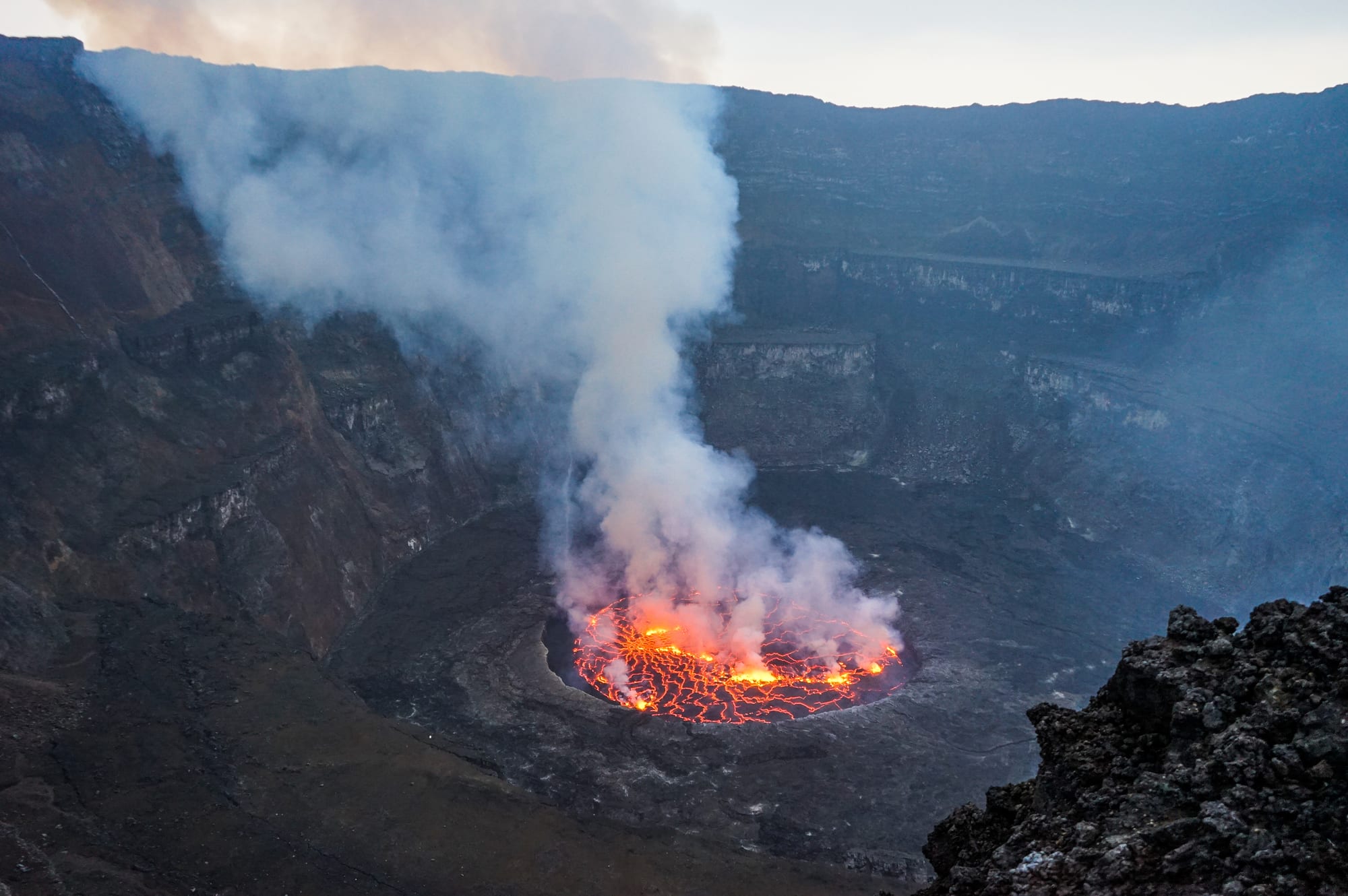
A glowing orange lava lake churning in a dark volcanic crater, steam rising into a night sky

Democratic Republic of the Congo

The lava lake of Nyiragongo, one of the world's few permanent lava lakes, in Virunga National Park near Goma. (Nina R / Wikimedia Commons · CC BY 2.0)

The largest country in sub-Saharan Africa — vast, mineral-rich, and covered by the second-biggest rainforest on Earth — shaped by the Congo Free State's atrocities, Mobutu's kleptocracy, and a long war in its east that has never fully ended.

Explore Democratic Republic of the Congo

History

The Congo basin was home to the Kingdom of Kongo in the west, the Luba and Lunda states in the south, and many other polities, all touched by the Atlantic and, in the east, the Indian Ocean slave trades. In the 1880s King Leopold II of Belgium acquired the entire basin as his personal property, the Congo Free State, and ran it as a rubber-extraction regime of forced labour, mutilation, and killing that is estimated to have caused millions of deaths. International outrage forced Belgium to take it over as a formal colony in 1908.

Independence came abruptly in 1960 and collapsed almost immediately into secessions, a UN intervention, and the murder of the first prime minister, Patrice Lumumba. Colonel Joseph-Désiré Mobutu seized power in 1965, renamed the country Zaïre, and ruled for 32 years, enriching himself and his circle while the state decayed.

Mobutu was overthrown in 1997 by a rebellion backed by Rwanda and Uganda. The Second Congo War that followed, from 1998, drew in nine African countries and dozens of armed groups and, mostly through disease and starvation, is estimated to have killed several million people — the deadliest conflict since the Second World War. A formal peace came in 2003, but eastern Congo has never been fully pacified: the M23 rebellion, backed by Rwanda, captured the cities of Goma and Bukavu in early 2025.

Culture & Customs

With more than 200 ethnic groups, the DR Congo is one of the most diverse countries on Earth. Broad regional identities — Kongo in the west, Luba in the centre-south, Mongo in the forest, and the Swahili-speaking peoples of the east — sit alongside hundreds of smaller communities and the Mbuti and other forest hunter-gatherers of the Ituri.

The country's greatest cultural export is music. Congolese rumba, born in Kinshasa and Brazzaville in the mid-twentieth century and evolving into soukous and ndombolo, dominated African popular music for decades and is inscribed on UNESCO's heritage list. Kinshasa's art scene, its sapeurs in their dandy suits, and its painters and sculptors have an international following.

Most Congolese are Christian — Catholic, Protestant, and the home-grown Kimbanguist church — with Islam in the east and traditional beliefs throughout. Family, church, and neighbourhood solidarity are what hold daily life together in the near-absence of a functioning state in many areas.

Daily Life

Kinshasa, on the Congo River facing Brazzaville, is one of the largest French-speaking cities in the world, with well over ten million people and very little formal employment; most residents survive through trade, hustle, and family networks (Article 15 — "fend for yourself" — is the wry national motto).

The DR Congo holds an enormous share of the world's cobalt and coltan, along with copper, gold, diamonds, and tin, much of it dug by hand in artisanal mines, including by children, in conditions that have drawn global scrutiny. This mineral wealth has funded armed groups and foreign interference far more than it has funded schools or roads.

Outside the cities and mining towns, life is rural and hard: farming cassava, maize, and plantain, fishing the rivers, and gathering forest products, often cut off from markets by the collapse of the road network. The eastern conflict has displaced more than six million people inside the country.

Food

Congolese cooking centres on cassava — as fufu, as the leaf stew pondu (also called saka-saka), and as chikwangue loaves — and on plantain, rice, and maize. Moambe chicken, cooked in a sauce of palm-fruit pulp with chilli, is the dish most often called national, served with rice or fufu and greens.

Freshwater fish from the Congo and its tributaries, and makayabu (salted cod), are important proteins, grilled or steamed in leaf parcels (maboké or liboké). Grubs, caterpillars (mbinzo), and bushmeat feature in forest areas. Groundnut sauces, okra, and fiery pili-pili season most dishes.

Palm wine and locally brewed maize or sorghum beer are traditional; bottled lager is popular in the cities, and strong sweet tea and coffee are common in the east.

Attractions & Natural Wonders

In peaceful times, the DR Congo's draws are extraordinary. Virunga National Park, the oldest in Africa, protects mountain gorillas on the forested slopes of the Mikeno volcano, and Nyiragongo, whose summit crater holds one of the world's few permanent lava lakes — an overnight climb to the rim is a bucket-list trip when the park is open and secure. The park's rangers have paid a heavy price defending it.

Kahuzi-Biéga National Park near Bukavu is the main refuge of the eastern lowland (Grauer's) gorilla; Garamba in the northeast holds savanna wildlife; and Salonga, deep in the central forest, is the largest rainforest reserve in Africa and a stronghold of the bonobo, the great ape found nowhere else. The Lola ya Bonobo sanctuary near Kinshasa cares for orphaned bonobos.

The Congo River itself — the second by volume in the world — is the country's spine, navigable for long stretches and travelled by barge, with the Livingstone Falls thundering below Kinshasa. Access to nearly all of this is currently constrained by insecurity, and any visit needs current, on-the-ground advice.

Planning basics

Budget

The DR Congo is expensive and logistically hard. Kinshasa has some of the priciest hotels in Africa; the few visitor experiences — chiefly Virunga's gorilla trekking and Nyiragongo, when open — are sold as costly permits and packages. The economy is heavily dollarised.

Source
Limited data — verify everything against current advice.
Virunga Permits
Gorilla and Nyiragongo permits, when the park is open, run to several hundred USD each
Daily Budget Midrange
USD 200–500+ per day in Kinshasa or on an organised Virunga visit, before flights and permits
Daily Budget Shoestring
Not realistically applicable outside a narrow set of arrangements

Any visit is arranged through a specialist operator or directly with Virunga National Park; independent travel is impractical.

Source: Limited data — verify everything against current advice.

Visa Requirements

A visa is required for all visitors and is normally arranged in advance, through a Congolese embassy or, for Virunga, via the park's own permit and visa process for entry at the Rwandan border near Goma. A yellow fever vaccination certificate is mandatory.

Typical Validity
7 to 90 days depending on the visa; the Virunga tourist visa is short and single-purpose

Most governments advise against all or all-but-essential travel to much of the country; consular help is very limited.

Safety

This is the decisive fact about the DR Congo. The eastern provinces — North and South Kivu and Ituri — are an active conflict zone, with dozens of armed groups, the M23 rebellion that seized Goma and Bukavu in early 2025, mass displacement, and widespread sexual violence. Other regions see banditry, militia activity, and periodic unrest, and Kinshasa has serious street crime. Most governments advise against all travel to the east and all-but-essential travel to much of the rest.

Source
US Department of State, UK FCDO, and UN reporting — check for the latest wording.

Worldlore covers the DR Congo so it can be understood, not to encourage travel there now. Virunga National Park sets its own opening status and security conditions and closes to visitors when the situation demands; check directly with the park and read your government's advisory in full.

Source: US Department of State, UK FCDO, and UN reporting — check for the latest wording.

Climate

Equatorial across the centre — hot, humid, and wet much of the year — with more defined wet and dry seasons north and south of the Equator. The eastern highlands around the Virungas and the Kivu lakes are cooler and greener. The far south (Katanga) has a clear dry season from about May to September.

Centre
hot and humid, rain most of the year
Katanga
dry season May–September, wet October–April
East Highlands
temperate, cooler, long and short rains

Transportation

The country is the size of Western Europe with very few paved long-distance roads. Domestic flights (of variable safety record) and river barges on the Congo are the main ways to cover distance; the railways are limited and decrepit. Kinshasa has chaotic road traffic. The east is usually accessed from Rwanda via the Goma border.

Do not plan overland travel across the country; internal movement is by air or river and is slow and unpredictable.

Best Time to Visit

For the east — Virunga's gorillas and Nyiragongo, when security allows — the drier months of June to September and December to February give the best trail and road conditions. Security, not season, is the real determinant of whether a visit is possible.

Currency

The currency is the Congolese franc (CDF), but the US dollar is used for most significant transactions, and prices are often quoted in dollars. Bring clean, undamaged dollar bills; worn or older notes are refused.

Symbol
FC / $
Cash To Bring
US dollars, new and unmarked
Currency Code
CDF — Congolese franc; USD in wide use

Language

French is the official language, used in government, schooling, and the media. Four national languages serve as regional lingua francas: Lingala (Kinshasa and the river), Swahili (the east), Kikongo (the west), and Tshiluba (the centre-south). English is spoken by some in the east, near the Ugandan and Rwandan borders.

English
Limited, mainly in the east
Official Language
French
National Languages
Lingala, Swahili, Kikongo, Tshiluba