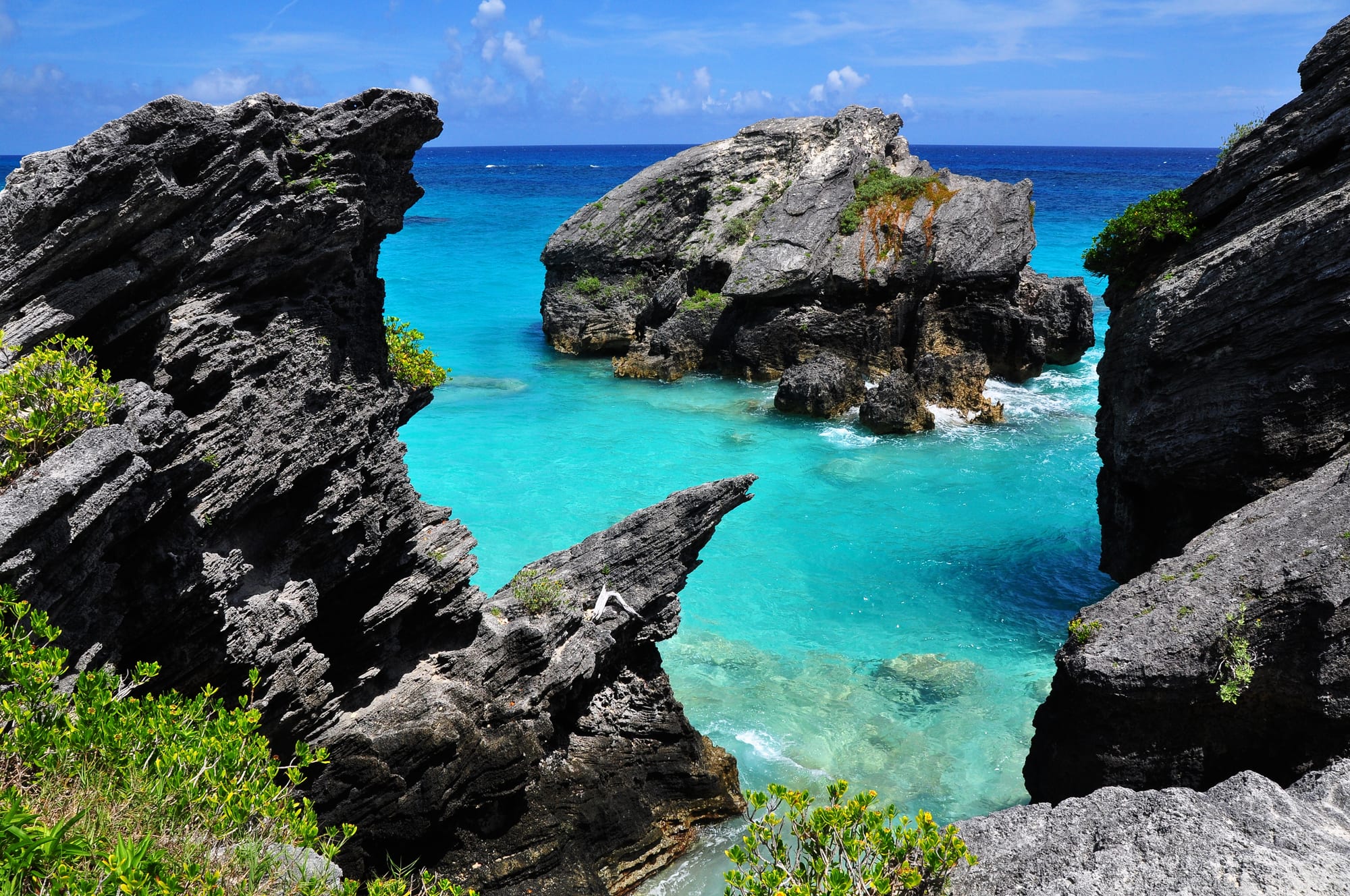
Jagged dark rocks framing a sheltered cove of vivid turquoise water, a rocky islet at its mouth and the deep blue ocean beyond

Bermuda

Jobson's Cove in Warwick Parish, a small turquoise inlet almost enclosed by jagged weathered rock. (kansasphoto / Wikimedia Commons · CC BY 2.0)

A British Overseas Territory of small islands in the North Atlantic, about 1,000 km off the coast of North Carolina and nowhere near the Caribbean — settled from 1609, one of the world's wealthiest places on the strength of international insurance, and known for its pink-sand beaches and pastel cottages.

Explore Bermuda

History

Bermuda was uninhabited when the English claimed it. In 1609 the Sea Venture, flagship of a fleet bound for Jamestown, was wrecked on the reefs during a hurricane; the survivors built new ships and most sailed on, but the islands were formally settled from 1612 by the Virginia Company and then the Somers Isles Company. The wreck and the "still-vexed Bermoothes" are usually taken as an inspiration for Shakespeare's The Tempest. St George, founded in 1612, is the oldest continuously inhabited English town in the New World.

The early economy rested on shipbuilding from Bermuda cedar, salt raked in the Turks Islands, maritime trade, and privateering, worked increasingly by enslaved Africans and some enslaved Native Americans. Slavery was abolished across the British Empire in 1834. After the loss of the American colonies, Britain built the Royal Naval Dockyard at the western end as its principal Atlantic base, and the garrison and dockyard shaped the islands for a century and a half.

Tourism from the United States grew from the late nineteenth century and boomed after the Second World War. Racial segregation persisted until a 1959 boycott desegregated the cinemas and hotels, and universal suffrage came in 1963. Bermuda gained internal self-government in 1968; a 1995 referendum rejected independence. From the 1980s the economy pivoted decisively to international business, especially insurance and reinsurance, making Bermuda one of the highest-income jurisdictions in the world while tourism declined in relative importance.

  • Bermuda: The Shipwreck Colony A remote Atlantic island settled by accident in 1609 — England's oldest overseas territory, a naval fortress, and a modern centre of global finance

Culture & Customs

Bermudian culture blends British institutions with a majority Black population of West Indian and African descent and a long-established Portuguese-speaking community from the Azores. The Anglican and African Methodist Episcopal churches are both strong, and society is generally conservative and church-going.

The Gombey dancers — masked, caped troupes with drums, whistles, and a tradition rooted in enslaved communities — perform on holidays and at Christmas. Cricket is the national passion, above all the two-day Cup Match between the east and west ends, played over a public holiday that also marks Emancipation. Sailing, fitted-dinghy racing, and golf are woven into island life.

Formality lingers in unexpected ways: Bermuda shorts, worn with knee socks, a jacket, and a tie, are acceptable business dress in Hamilton. Pastel-painted cottages with white stepped roofs are the signature architecture — the roofs are designed to catch rainwater, the islands' only fresh-water supply.

Daily Life

About 64,000 people live on roughly 54 square kilometres, making Bermuda one of the most densely populated territories in the world. Most residents live between Hamilton, the small capital and business centre, and the parishes along the main island chain, linked by causeway and bridge.

Incomes are high but so is the cost of living, and housing is expensive and tight. The economy runs on international insurance and financial services, with tourism and construction behind it; there is no income tax, and government revenue comes from payroll tax, customs duties, and company fees. Work permits tie most foreign professionals' residence to their employer, and the balance between international business and Bermudian opportunity is a constant political theme, along with the cost of living and the perennial, unresolved question of independence.

With no rivers or lakes, every building collects rain from its roof into a tank, and water conservation is a normal household habit.

Food

Bermudian cooking is Anglo-Caribbean with a strong Portuguese thread. The national dish is fish chowder, dark with tomato and stock and finished at the table with black rum and sherry-pepper sauce. Sunday breakfast is traditionally salt cod with potatoes, egg, onion, and banana or avocado.

Other staples include Bermuda fish sandwiches on raisin bread, mussel pie, cassava pie at Christmas, Portuguese red-bean soup and malasadas, and hoppin' John and peas and rice as sides. Local wahoo, rockfish, and spiny lobster (in season, September to March) appear on menus, and the Bermuda onion was once a famous export.

The islands' drinks are their best-known export of all: the Dark 'n' Stormy, Gosling's Black Seal rum topped with ginger beer, and the rum swizzle, both closely associated with Bermuda.

  • Bermuda: Food and the National Dish A rich tomato fish chowder finished with rum and a local hot sauce, a Christmas cassava pie, and a rum brand that trademarked its own cocktail name

Attractions & Natural Wonders

The south-shore beaches are the main draw — Horseshoe Bay with its pink sand and rock coves, and the quieter linked coves of Warwick Long Bay, Jobson's Cove, and Church Bay, good for snorkelling. The reefs offshore, the northernmost coral reefs in the Atlantic, are ringed with shipwrecks that make Bermuda a noted dive destination.

St George, a UNESCO World Heritage Site, preserves narrow lanes, the unfinished church, and St Peter's, the oldest continuously used Anglican church outside the British Isles, along with the surrounding forts. At the other end of the island, the Royal Naval Dockyard has been redeveloped with the National Museum of Bermuda, shops, and the cruise-ship pier.

Inland sights include the Crystal and Fantasy Caves near Hamilton Parish, with their clear pools and stalactites; the Bermuda Aquarium, Museum and Zoo; the Botanical Gardens; and Nonsuch Island, where the cahow, or Bermuda petrel — long thought extinct — has been brought back through decades of conservation. The Railway Trail, on the bed of the old island railway, runs much of Bermuda's length for walking and cycling.

Planning basics

Budget

Bermuda is one of the most expensive destinations in the world. Almost everything is imported, there is little budget accommodation, and dinner for two in a mid-range restaurant runs high. Guesthouses and vacation rentals are cheaper than the resorts, and the buses, ferries, and beaches keep daytime costs down.

Daily Budget Midrange
USD 400–800 (hotel or small resort, restaurant meals, drinks, scooter or minicar hire)
Daily Budget Shoestring
USD 180–260 (guesthouse, self-catering and takeaways, buses and ferries)

Travel in the low season (roughly November–March) for far lower room rates, use the transport pass for buses and ferries, and buy groceries for some meals.

Visa Requirements

Bermuda controls its own immigration. Citizens of the UK, US, Canada, the EU, Australia, and many other countries visit without a visa for up to 90 days (extendable to six months). A passport valid for the stay, an onward or return ticket, and proof of accommodation are required.

Typical Stay
Up to 90 days without a visa for most Western passports; extendable

Carry proof of onward travel and your first night's accommodation; there is no visa on arrival for those who need one, so check before flying.

Safety

Bermuda is generally very safe for visitors, with low levels of crime affecting tourists. Occasional gang-related gun violence occurs but is confined to specific residential areas away from the visitor circuit. The real hazards are road accidents on scooters and mopeds, strong currents and undertow on the unprotected south-shore beaches, sunburn, and hurricanes in late summer.

Health
Tap water — collected rainwater from roof catchments — is safe; medical care is good but expensive, so insurance matters

Ride scooters cautiously and always with the helmet, swim at guarded beaches and heed current warnings, and watch the forecast during hurricane season.

Climate

Subtropical and humid, moderated by the Gulf Stream, with no true dry season. Summers (June–September) are hot at around 29°C with high humidity; winters (December–March) are mild at 16–20°C, never freezing, but often windy and too cool for comfortable swimming. Atlantic hurricanes are a risk from August to October.

Summer
June–September, hot and humid, sea warmest
Winter
December–March, mild but breezy; swimming uncomfortable

Transportation

There are no rental cars for visitors — households are limited to one car, and tourists get around instead by the pink public buses, the ferries across the Great Sound, taxis, hired scooters, pedal and electric bikes, or tiny two-seat electric minicars. Driving is on the left. L. F. Wade International Airport is on St David's Island at the east end.

Buy a multi-day transport pass for the buses and ferries; if you hire a scooter, go slowly — visitor scooter crashes are common.

Best Time to Visit

May to October is the swimming season, with sea temperatures peaking from July to September. April and November are pleasant shoulder months with lower prices. Winter is quiet and mild but many hotels and restaurants cut back their hours, and it is not a beach season.

Events
Bermuda Day (late May) and its parade; Cup Match cricket and Emancipation holiday (late July/early August); the Gombey troupes at Christmas and on public holidays; Harbour Nights in Hamilton in summer

Currency

The Bermudian dollar is pegged one-to-one to the US dollar, and US dollars circulate freely and interchangeably. Cards are accepted almost everywhere; ATMs dispense Bermudian dollars.

Symbol
$
Currency Code
BMD — Bermudian dollar (US dollars accepted at par)

Language

English is the official and everyday language, spoken with a distinctive Bermudian accent. Portuguese is spoken within the community descended from Azorean immigrants who came from the 1840s onward.

Other
Portuguese (Azorean-descended community)
Official Language
English