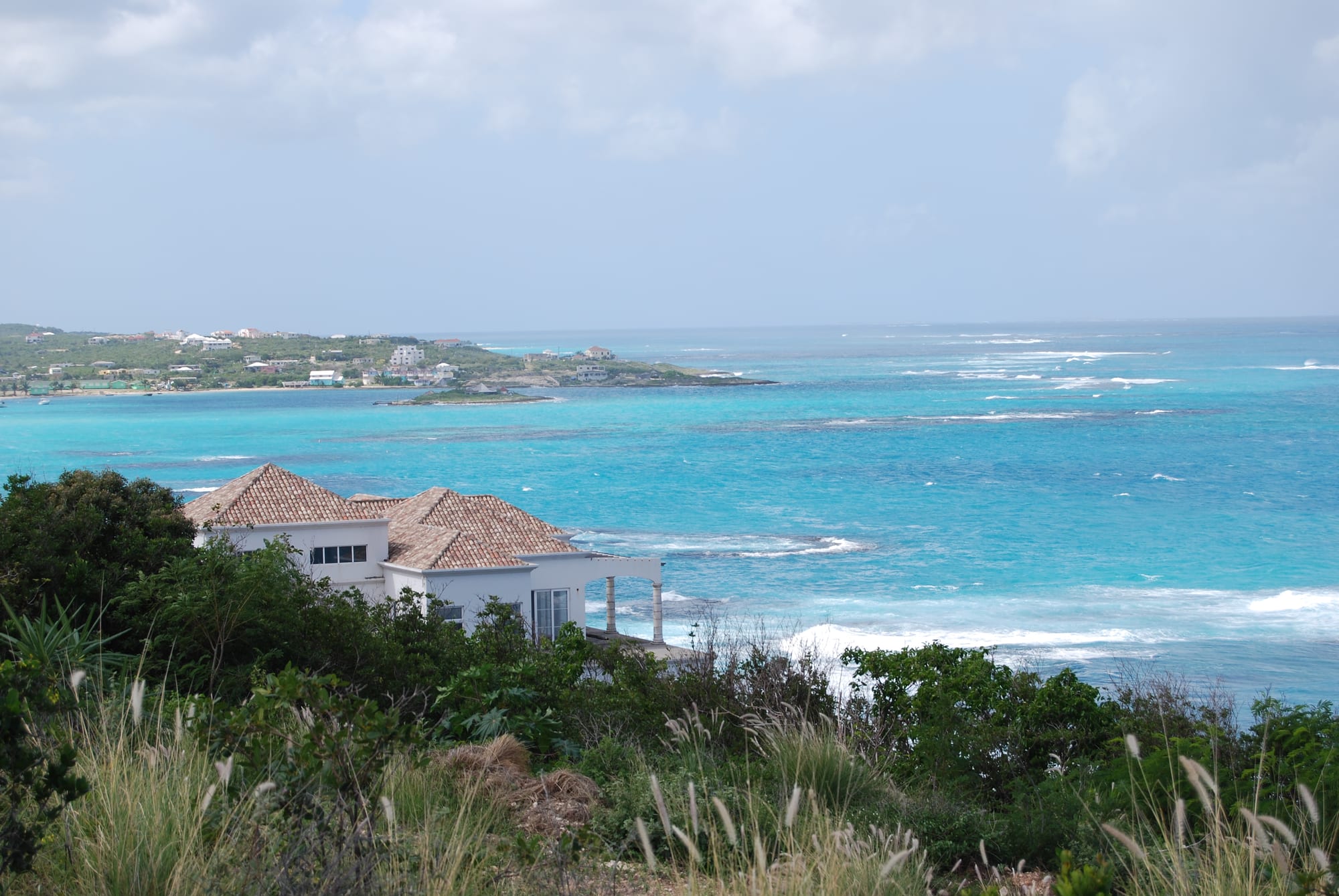
A white villa with a terracotta-tiled roof on a scrubby hillside above a wide bay of vivid turquoise water streaked with white surf, with a tiny islet and a low green headland dotted with houses beyond

Anguilla

Island Harbour and the islet of Scilly Cay, seen from Harbour Ridge Drive on Anguilla. (Roy Googin / Wikimedia Commons · CC BY-SA 3.0)

A long, flat, dry coral island at the northern end of the Leeward Islands, a British Overseas Territory — ringed by white-sand beaches, home to a deliberately low-rise luxury resort scene, and famous for a 1967 "revolution" fought to stay British rather than be ruled from St Kitts.

Explore Anguilla

History

The Arawak, who called the island Malliouhana, left petroglyphs in its caves. English settlers came from St Kitts in 1650, but Anguilla was too dry and flat for a plantation economy: people lived by smallholding, salt-raking, fishing, and boatbuilding, and by seasonal emigration to cut cane in the Dominican Republic, work the oil refineries of Aruba and Curaçao, and later to Britain and the United States.

Governed as part of a three-island colony with St Kitts and Nevis, Anguillians grew resentful of rule from Basseterre. In 1967 they expelled the St Kitts police and declared independence — from the federation, while wanting to remain British. The stand-off ended in 1969 with a near-comic British intervention by paratroopers and London police, and Anguilla was allowed to revert to direct British administration, formally becoming a separate territory in 1980.

Tourism from the 1980s was developed deliberately upmarket and low-key: no cruise ships of size, no casinos, no high-rise or all-inclusive resorts. Hurricane Irma caused severe damage in 2017. More recently the island's ".ai" internet domain, sought after by artificial-intelligence companies, has become a large source of government revenue alongside tourism and offshore finance.

  • Anguilla: The Island That Seceded A poor salt-and-fishing island in the northern Caribbean that fought, in 1967, to stay British rather than be governed from St Kitts

Culture & Customs

Anguillian culture is English-speaking and Christian, descended from enslaved and free Africans and the island's smallholder and seafaring society. Boat racing — not cricket — is the national sport: hand-built wooden sloops with towering sails are raced on public holidays, and crews and home villages are followed with fierce loyalty, the season climaxing at the August festival.

String-band music, "jollification" work-parties, and the goat-stew tradition are part of island life, and Carnival at August Monday marks Emancipation. It is a quiet, conservative, tight-knit community of around 15,000, with a diaspora several times that size and strong ties back and forth.

Daily Life

About 15,000 people live on Anguilla, with the low-key settlement of The Valley as the capital. The economy is tourism — villas and boutique resorts — plus financial services, the domain-name windfall, and remittances; there is no income tax.

Nearly everything is imported, including much of the water, which is desalinated, and electricity is costly. Land is largely in local hands, daily life is car-dependent, and crime is low. The pace is deliberately slow, and much of the visitor economy is built around doing very little in comfortable surroundings.

Food

Anguilla has a reputation as a Caribbean food destination out of proportion to its size. Spiny lobster (called crayfish here), conch — stewed, or in a thick "conch soup" — grilled and stewed fish, pigeon peas and rice, saltfish, johnnycakes, and goat stew are the local base, served both at simple beach shacks and at accomplished restaurants.

The barbecue shacks at Sandy Ground and Island Harbour, and roadside grills across the island, do ribs, chicken, and just-landed fish, often with a band and a rum punch. Local rum and a sunset at a Sandy Ground beach bar are close to a national institution.

  • Anguilla: Food and the National Dish An island too dry for sugar, built instead on salt and fishing, now known across the Caribbean for its crayfish, its grills, and an outsized cluster of fine dining

Attractions & Natural Wonders

The beaches are the point. Shoal Bay East, with its long sweep of powder sand and clear shallows, is the most famous; Rendezvous Bay, Meads Bay, Maundays Bay, and the tiny cliff-backed Little Bay (reached by rope or boat) are others. Offshore, day trips run to Sandy Island, Prickly Pear, and Scilly Cay for snorkelling, grilled lobster, and near-empty sand.

The reefs and a few deliberately sunk wrecks make for easy diving and snorkelling. On land, the Heritage Collection Museum tells the island's story, the Big Spring cave near Island Harbour holds Amerindian petroglyphs, and the salt pond at Sandy Ground recalls the old industry. The Dune Preserve, a driftwood beach bar built by the musician Bankie Banx, hosts the Moonsplash festival, and race day at Sandy Ground or Meads Bay is the best way to see the island at full tilt.

Planning basics

Budget

Anguilla is expensive. Its resorts and villas are luxury-priced and its restaurants are dear. A handful of guesthouses and self-catering apartments, plus supermarket meals and the beach barbecue shacks, are the way to keep spending down.

Daily Budget Midrange
USD 400–1,000+ (boutique hotel or villa, restaurants, a boat trip to the cays, car hire)
Daily Budget Shoestring
USD 150–280 (guesthouse or apartment, self-catering and beach shacks, shared car)

Base in a self-catering unit away from the flagship resorts, eat at the Sandy Ground and Island Harbour shacks, and take the public ferry from Sint Maarten rather than a private boat.

Visa Requirements

Citizens of the UK, EU, US, Canada, and many other countries enter visa-free, commonly for an initial period of up to 90 days, extendable. A passport valid for the stay, an onward or return ticket, and proof of funds and accommodation are expected.

Typical Stay
Up to 90 days visa-free for most Western passports, extendable

Carry proof of onward travel and where you are staying; there is a departure tax, usually included in air and ferry tickets.

Safety

Very safe, with low crime; occasional petty theft from cars and villas is the main issue. Strong currents and surf occur on the Atlantic-facing north and east beaches, hurricanes are a summer-autumn risk, and medical care is limited — serious cases go to Sint Maarten or the US.

Health
Most water is desalinated or cistern-collected; bottled water is common; the sun is very strong

Swim on the calmer south and west beaches when the Atlantic side is rough, secure valuables, and carry insurance with medical evacuation cover.

Climate

Tropical and unusually dry — Anguilla has little fresh water of its own — with temperatures around 27–31°C year-round. The hurricane season runs June to November; Hurricane Irma struck in September 2017. December to April is slightly cooler and breezier.

Dry And Sunny
Most of the year
Hurricane Season
June–November

Transportation

Clayton J. Lloyd International Airport takes regional flights, mostly via San Juan, Antigua, or St Kitts. Many visitors instead fly to Princess Juliana on Sint Maarten and take the 25-minute public ferry from Marigot, or a private boat or charter. On Anguilla, hire a car — a temporary local licence is issued — or use taxis; driving is on the left, and there is no public bus system.

The Sint Maarten ferry is the cheap way in; on the island, hire a car, as taxis are costly and distances add up.

Best Time to Visit

December to April is the dry, calm high season, with the highest prices. May, June, and November are good-value shoulder months. The August Emancipation and boat-racing week is the cultural high point. Avoid the August-to-October hurricane peak.

Events
Anguilla Summer Festival / Carnival around August Monday, built around the sailboat races; Moonsplash music festival at the Dune Preserve (March); the Festival del Mar at Island Harbour (Easter)

Currency

The East Caribbean dollar is the official currency, pegged to the US dollar at 2.70. US dollars are accepted almost everywhere. Cards work at hotels and larger restaurants; carry cash for shacks, taxis, and the ferry.

Symbol
EC$
Currency Code
XCD — East Caribbean dollar (US dollars widely accepted)

Language

English is the official and everyday language, spoken in a local creole-influenced form with its own rhythm.

Official Language
English